

Protecting mature trees should be a priority
Advertisement
Read this article for free:
or
Already have an account? Log in here »
To continue reading, please subscribe:

Digital Subscription
One year of digital access for only $205*
- Enjoy unlimited reading on winnipegfreepress.com
- Read the E-Edition, our digital replica newspaper
- Access News Break, our award-winning app
- Play interactive puzzles
*First annual payment billed as $205.00 + GST for one year. This annual subscription will automatically renew at $233.00 + GST every 52 weeks (10% off the regular annual price of $259.35). Offer available to new and qualified returning subscribers only. Cancel any time.
To continue reading, please subscribe:
Add Free Press access to your Brandon Sun subscription for only an additional
$1 for the first 4 weeks*
- Enjoy unlimited reading on winnipegfreepress.com
- Read the E-Edition, our digital replica newspaper
- Access News Break, our award-winning app
- Play interactive puzzles
*Your next Brandon Sun subscription payment will increase by $1.00 and you will be charged $17.95 plus GST for four weeks. After four weeks, your payment will increase to $24.95 plus GST every four weeks.
Read unlimited articles for free today:
or
Already have an account? Log in here »
Hey there, time traveller!
This article was published 31/03/2026 (185 days ago), so information in it may no longer be current.
I have to tell you — there are days when I am utterly gobsmacked by the stuff people do.
Case in point? Just a few weeks ago, I was walking down a residential street in my neighbourhood, when I turned the corner and came to a dead halt. There, on the edge of a nearby yard were four hacked down trees. I say “hacked” because about four and half feet of their trunks were still visible above the ground. And when I looked a little more closely at the two trees left standing, I could see that most of their canopies had been cut off.
It was the tree equivalent of the Texas chainsaw massacre.
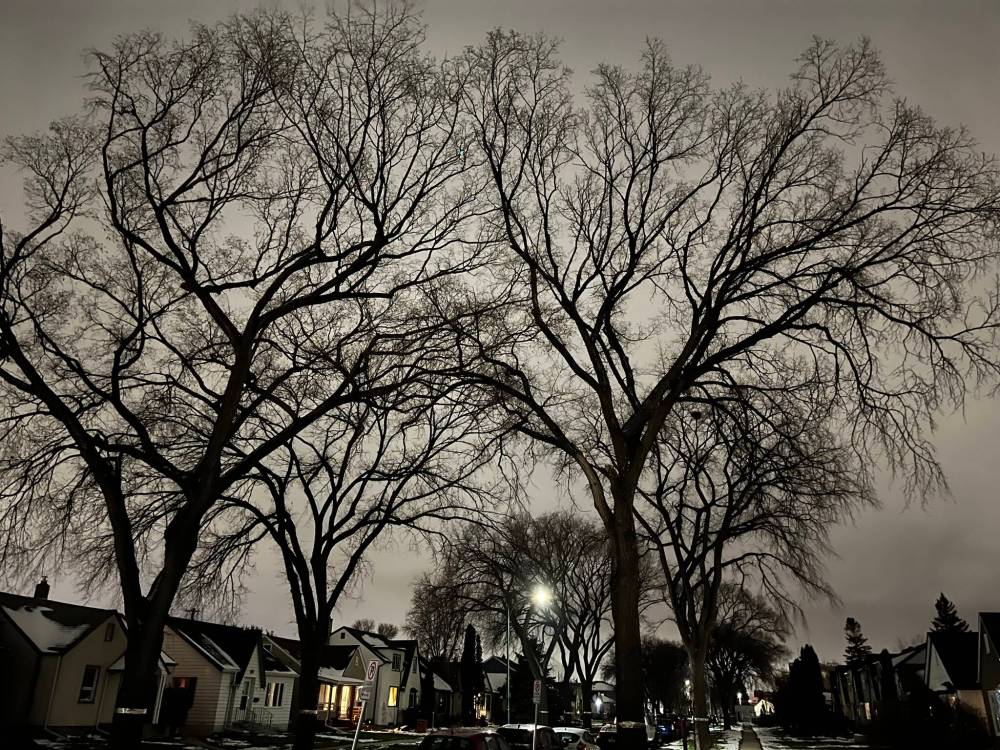
Russell Wangersky / Free Press
Once cut down, Winnipeg’s mature tree canopy isn’t easily or quickly replaced.
And sadly, it’s not the only arboreal crime being committed, despite what we know about the benefits of trees.
In fact, our city, in its infinite wisdom, contributes to the malfeasance by failing to enforce arborists’ reports on land destined for development. They also hand out tree-cutting permits to developers with remarkable alacrity and have thus far done nothing to control or limit tree removal on private land.
As a result, over the past few decades, we’ve lost tens of thousands of trees on private property to construction and development. Worse still, no one at the city is counting those losses, so we don’t even know how many trees we’re losing.
“Big deal,” I hear you say. To which I would respond “Well, yeah, it is a big deal because somewhere between 80 per cent and 90 per cent of our three million trees are situated on private land. In fact our 300,000 publicly owned street and park trees make up only 10 per cent of our total canopy.”
And if you now find yourself saying, “Oh come on. We can just plant new trees and make it all better.” To which I would respond — “Guess again.”
It takes, at minimum, 10 years for a newly planted tree to even come close to delivering the same benefits provided by the thousands of healthy mature trees we blithely cut down.
That’s why 85 scientists wrote an open letter to COP30 urging governments to recognize that “Urban forests are among the most effective, equitable nature-based solutions available” to enhance climate resiliency and protect biodiversity. They also observed that protecting mature trees is even more important than planting new ones, given the benefits they provide.
Benefits that include cooling our bodies, streets and houses, sopping up, cleaning and conserving excess rainwater, reducing air pollution, and capturing carbon.
So why are there no restrictions on tree removals on any Winnipeg properties save those owned by the city? Especially when council ratified the 20-year urban forestry strategy which specifies the need to protect private trees?
Well, according to some civic authorities, council has no power to enact bylaws related to private trees, until the city charter is changed by the province to allow for that. This, when the city charter clearly indicates that council has the power to pass bylaws that ensure the safety, health and well-being of its citizens and is also responsible for ensuring the environmental sustainability of all development projects.
Add to that a clause that gives the city the power to enact bylaws pertaining to trees adjacent to streets, and I’m left somewhat dumbstruck by the lack of action.
Because the reality is that every one of those charter clauses could be used to enact a private tree bylaw.

So, why is the city stalling and what, if anything, are the mayor and councillors afraid of? Well, they may be afraid of a backlash from citizens, insisting that they can do whatever they want on their properties — including cutting down healthy mature trees. When the reality is that our private property rights are already restricted by a host of bylaws pertaining to everything from deck building to lawn mowing. So why not the trees that protect us?
The city might also be afraid of a money-backed, lawyer-loaded development community coming at them with lawsuits or threats to leave the city if the bylaw is enacted.
But here’s the thing, folks. More than nine major Canadian cities already have a “call before you cut” private tree bylaw and, surprise, surprise, no one got sued, no one stomped off to another city, and everyone adjusted.
Bottom line? Trees are a public good no matter where they stand, and we need to protect them. If you agree, tell your councillor. Or better yet come to The All Trees Count Town Hall on April 20 and join other like-minded citizens to ensure that our city council acts now to protect as many mature trees as possible.
Erna Buffie is a writer and environmental advocate. Register for the town hall at http://wfp.to/iaL