

What to do with inconvenient wildlife
Advertisement
Read this article for free:
or
Already have an account? Log in here »
To continue reading, please subscribe:

Digital Subscription
One year of digital access for only $205*
- Enjoy unlimited reading on winnipegfreepress.com
- Read the E-Edition, our digital replica newspaper
- Access News Break, our award-winning app
- Play interactive puzzles
*First annual payment billed as $205.00 + GST for one year. This annual subscription will automatically renew at $233.00 + GST every 52 weeks (10% off the regular annual price of $259.35). Offer available to new and qualified returning subscribers only. Cancel any time.
To continue reading, please subscribe:
Add Free Press access to your Brandon Sun subscription for only an additional
$1 for the first 4 weeks*
- Enjoy unlimited reading on winnipegfreepress.com
- Read the E-Edition, our digital replica newspaper
- Access News Break, our award-winning app
- Play interactive puzzles
*Your next Brandon Sun subscription payment will increase by $1.00 and you will be charged $17.95 plus GST for four weeks. After four weeks, your payment will increase to $24.95 plus GST every four weeks.
Read unlimited articles for free today:
or
Already have an account? Log in here »
Their flocks darkened the skies, over a mile wide and hundreds of miles long. It would take hours or even days for them to pass over a fixed spot. They were a common Manitoba resident, nesting as far north as York Factory. In the 1860s, one hunter trapped 80 dozen in a net near St. Andrews.
Prior to the arrival of Europeans, passenger pigeons were the most abundant bird on the continent, their population estimated between three and five billion. Excepting chickens, they were likely the most abundant bird in the history of the planet. They were slaughtered in untold numbers by hunters and their nesting habitat, the hardwood forests of eastern North America, was cleared to make way for expanding human populations.
And by 1914 they were gone. That was when Martha, the last of her kind, died in the Cincinnati Zoo. Think about that.
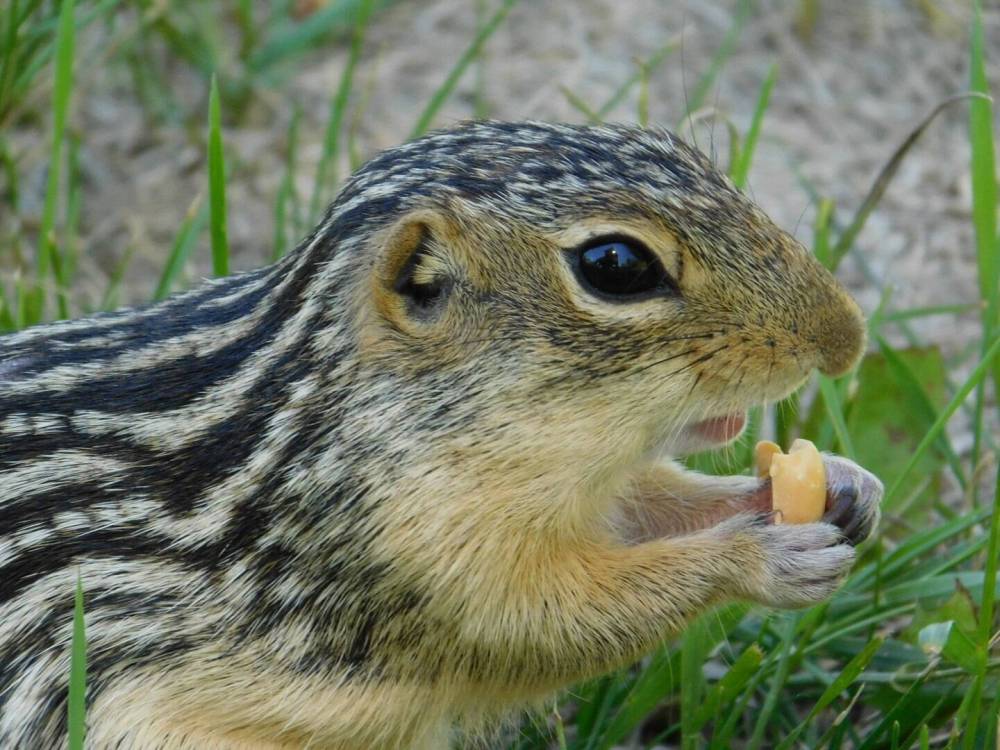
Submitted / Scott Forbes
A 13-lined ground squirrel that shares Scott Forbes’ property.
Humans managed to exterminate the most abundant wild bird in Earth’s history.
At one time, tall-grass prairie extended from southern Manitoba to the Texas Gulf Coast. Today, less than one per cent still stands, the rest lost to urban sprawl and industrial/agricultural development. Many species that called the prairie home — plains bison, burrowing owls, prairie chickens and plains grizzlies — are either gone or barely hanging on.
Some manage to survive in urban habitats. Look at the Cabela’s parking lot. It’s built on top of what were grassy fields. You may have noticed goose nests on the narrow grass strips between the rows of cars and trucks. The geese seem blissfully unaware of the irony.
Today in Winnipeg controversy rages because another Prairie resident burrows into our parks and soccer fields. Our city sits on what was once tall-grass prairie, the natural home of ground squirrels and their predators, such as badgers, foxes, coyotes, weasels, hawks and owls.
The ground squirrels inconveniently dig holes in the fields. Some worry that soccer players and others might twist ankles as a result. The City of Winnipeg’s solution is to break out lethal poisons, hazardous to pets and other wildlife, to eradicate the ground squirrels. These produce a slow, agonizing, inhumane death.
To me, this seems like overkill. Are our emergency rooms overflowing with broken bones and twisted ankles?
For your information my family has shared property for more than a quarter century with colonies of 13-lined and Franklin’s ground squirrels. Small and not-so-small children have run around for years and we have yet to visit an ER for a broken bone or sprained ankle.
In some places the poisoning just won’t work. Pitches sitting across from grass fields will be constantly recolonized by new ground squirrels, what ecologists call source and sink habitats.
But there’s another solution, one slightly less convenient. Place barrels of sand at either end of the field. Before the game, have both teams walk the pitch and fill holes with sand. The ground squirrels will remain underground while soccer players run about. Repeat as necessary. Please don’t say it’s too expensive, as under the current poison plan, city workers will need to visit the fields twice daily to search for dead and dying ground squirrels and other animals.
Ground squirrels are a microcosm of the bigger problem: getting along with inconvenient wildlife.
Why is it important? In 2024, the World Wildlife Fund reported that global wildlife populations had fallen by three-quarters in the last half century. If we want to hang on to the last one-quarter, we need a different approach.
The problem is the prevailing ethos: we just can’t be bothered. That same ethos leads to planetary harm: burning fossil fuels is convenient. Replacing them with cheaper, cleaner alternatives, is not. So we can’t be bothered.
Under our business-as-usual strategy, we face wildfires and choking smoke in spring, summer and fall, rivers that run dry because the glaciers feeding them have melted and oceans becoming inhospitable for marine life.

We need a new ethos, one that starts locally, such as making room for creatures squeezed aside by human sprawl. Then we build out from there.
And maybe it’s not a new ethos, but an old one. The plains bison, passenger pigeons, prairie chickens and the tall-grass prairie did just fine when Indigenous Peoples were stewards of the land. It is the rapacious Western, colonial, growth-at-all-costs instinct that is the problem.
We may look back in 20, 50, 100 years and realize we could have prevented these disasters. We knew it was happening. The science was clear. But we did nothing.
Kurt Vonnegut said it best: “We probably could have saved ourselves, but we were too damned lazy to try very hard … and too damn cheap.”
Scott Forbes is an ecologist at the University of Winnipeg.