

No quick resolution for CUSMA trade deal
Advertisement
Read this article for free:
or
Already have an account? Log in here »
To continue reading, please subscribe:
Digital Subscription
One year of digital access for only $1.44 a week*
- Enjoy unlimited reading on winnipegfreepress.com
- Read the E-Edition, our digital replica newspaper
- Access News Break, our award-winning app
- Play interactive puzzles
*Billed as $5.77 plus GST every four weeks. After 52 weeks, price increases to the regular rate of $19.95 plus GST every four weeks. Offer available to new and qualified returning subscribers only. Cancel any time.
To continue reading, please subscribe:
Add Free Press access to your Brandon Sun subscription for only an additional
$1 for the first 4 weeks*
- Enjoy unlimited reading on winnipegfreepress.com
- Read the E-Edition, our digital replica newspaper
- Access News Break, our award-winning app
- Play interactive puzzles
*Your next Brandon Sun subscription payment will increase by $1.00 and you will be charged $17.95 plus GST for four weeks. After four weeks, your payment will increase to $24.95 plus GST every four weeks.
Read unlimited articles for free today:
or
Already have an account? Log in here »
A few days ago, a reporter asked an adviser to Prime Minister Mark Carney to summarize Canada’s strategy regarding the upcoming Canada-United States-Mexico Agreement (CUSMA) negotiations. He declined, saying it would undermine our interests to reveal our strategy in advance of the talks.
It was the right response, but the strategy is obvious to those who are paying attention.
Contrary to what some politicians and pundits have suggested, the free trade agreement is not due to expire any time soon. Rather, it faces a mandatory review beginning on July 1, nine weeks from today.
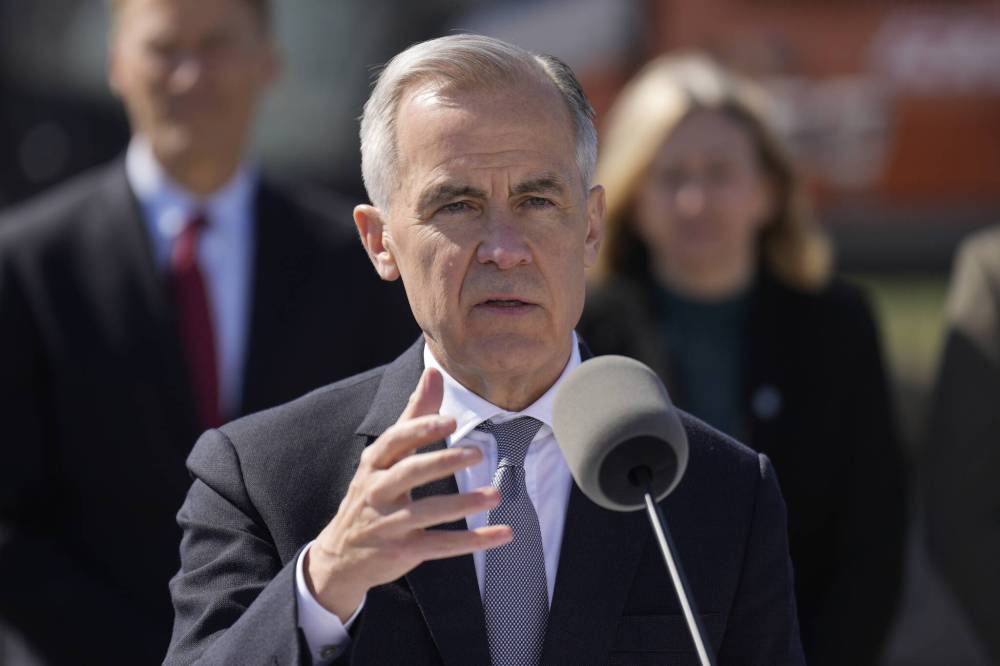
Adrian Wyld / The Canadian Press
Prime Minister Mark Carney responds to a question during an event in Ottawa on April 23.
The agreement is scheduled to expire in 2036, but this year’s review gives the parties the opportunity to renegotiate or potentially end the agreement if a 16-year extension (to 2042) is not agreed to. That said, any party can withdraw from the agreement by giving six months’ notice of its intention to do so.
Given that tenuous reality, Carney is hoping the agreement will be extended in something close to its current form until 2042, but his government is preparing for the possibility the agreement could end by 2036, or even earlier.
That’s why the PM says he wants to double Canada’s trade with nations other than the U.S. over the next 10 years, and why he is criss-crossing the globe to build or improve our trade relationships with other nations.
By doing so, he is attempting to ensure that if or when CUSMA expires, Canada’s economy will be far less dependent on trade with the U.S. and much less vulnerable to the abusive whims of American politicians. That’s called “risk mitigation,” and it’s the logical strategy under the current circumstances.
In order to prevent strategic errors and avoid accusations that Canada’s approach is a one-man vanity exercise, Carney has appointed a tough team of negotiators and has surrounded himself with a talented, experienced and diverse council of advisers. With those groups in place, there are two key objectives Canada hopes to achieve during the upcoming negotiations.
First, they have no desire to renegotiate the current agreement. Rather, Carney has made clear that he prefers to largely restore CUSMA to the state it was in prior to U.S. President Donald Trump’s inauguration as president last year. That means having the tariffs imposed by the Trump administration rescinded and successfully resisting attempts by the U.S. to modify the deal with provisions that further disadvantages Canada.
In order to accomplish those objectives, the prime minister has repeatedly said Canada is prepared to walk away from the negotiations with no deal in order to avoid a deal that is bad for us.
Beyond that, our negotiators can leverage the fact that, contrary to Trump’s claims that Canada has nothing the U.S. needs, there are plenty of Canadian commodities and products the U.S. economy desperately requires and relies upon.
That includes our oil and natural gas, electricity, uranium, aluminum, high-grade nickel, critical minerals, potash and softwood lumber, all of which Americans would be hard-pressed to obtain elsewhere at comparable prices.
There is also the question of whether Canada proceeds with the multi-billion-dollar purchase of F-35 fighters and a range of other military items from U.S. producers, or if it instead buys from other nations. Given the worsening impact of climate change, the U.S. may also become increasingly desperate for access to our water.
Given the dynamics at play, including an increasingly erratic and unpopular Trump, it is extremely unlikely that the CUSMA negotiations will be concluded before July 1, or even shortly thereafter. Rather, discussions between the Canadian and American delegations will likely drag on through the summer, with occasional loud and public disagreements.

The talks will also likely reflect the fact that time is largely on our side. There is zero danger of the Americans terminating the agreement on six months notice — it would capsize the fragile U.S. economy — and the near-certainty of Trump’s Republicans losing control of Congress via the U.S. mid-term elections in November creates the likelihood that a better, more balanced deal can be reached sometime after those elections are held.
All of that means that Canada has cards to play, but Canadians should not expect the current trade uncertainty to be resolved any time soon.
Deveryn Ross is a political commentator living in Brandon.
deverynrossletters@gmail.com
X: @deverynross