

Where are cities in Carney’s nature strategy?
Advertisement
Read this article for free:
or
Already have an account? Log in here »
To continue reading, please subscribe:

Digital Subscription
One year of digital access for only $205*
- Enjoy unlimited reading on winnipegfreepress.com
- Read the E-Edition, our digital replica newspaper
- Access News Break, our award-winning app
- Play interactive puzzles
*First annual payment billed as $205.00 + GST for one year. This annual subscription will automatically renew at $233.00 + GST every 52 weeks (10% off the regular annual price of $259.35). Offer available to new and qualified returning subscribers only. Cancel any time.
To continue reading, please subscribe:
Add Free Press access to your Brandon Sun subscription for only an additional
$1 for the first 4 weeks*
- Enjoy unlimited reading on winnipegfreepress.com
- Read the E-Edition, our digital replica newspaper
- Access News Break, our award-winning app
- Play interactive puzzles
*Your next Brandon Sun subscription payment will increase by $1.00 and you will be charged $17.95 plus GST for four weeks. After four weeks, your payment will increase to $24.95 plus GST every four weeks.
Read unlimited articles for free today:
or
Already have an account? Log in here »
So, the long-awaited federal nature strategy has been released and there’s a lot to praise and a lot that leaves me frustrated and angry.
On the praiseworthy side is support for Indigenous leadership and input, culminating in two projects finally scheduled to move forward — the northern Seal River Watershed, a protected area right here in Manitoba, and Wiinipaawk, another Indigenous-led project on the Quebec side of James Bay.
Add to that plans for other protected areas, including marine conservation zones, and Canada might — and I stress, just might — come close to hitting its target of protecting 30 per cent of our lands and waterways by 2030.
Russell Wangersky / Free Press
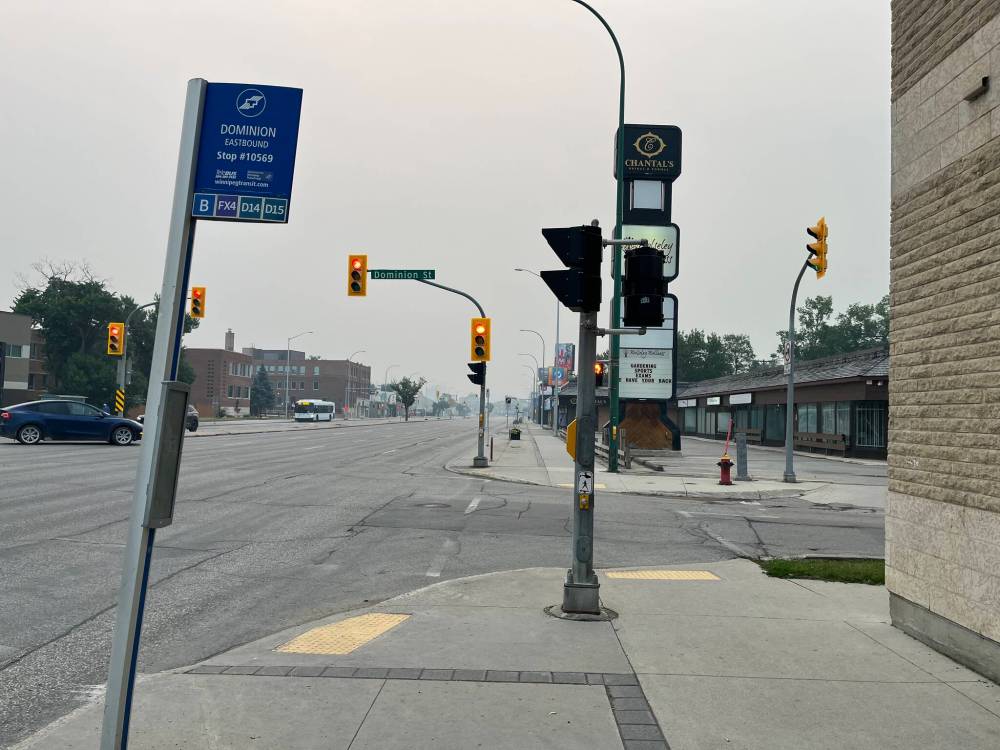
Cities such as Winnipeg need federal nature strategy investment, too, because many people can’t escape the concrete.
Hard as it may be to believe, we currently protect only 14 per cent of this country’s vast land mass and coastlines.
So what, you may ask, am I frustrated about? Well, given that more than 70 per cent of us live in cities, I am utterly stunned that there’s little in the way of funding for urban conservation and nature-smart city planning.
And before you get your knickers in a twist, yes, there is funding for 15 national urban parks. High profile, big money, voter-pleasing projects that could see 15 urban areas, such as the proposed Little Forks riverside park in Winnipeg, become a reality. And yes there is also some reference to making infrastructure projects more “nature smart.”
But while big projects such as Little Forks are great — assuming it also means the feds cough up the money needed to modernize a sewage system that dumps billions of litres of raw sewage into Winnipeg rivers every year — there doesn’t appear to be any money to address the smaller, and to my mind, more significant conservation efforts that will help to climate proof our cities. Money that could be spent to speed up the expansion and protection of our urban canopies. Funds that could be used to buy up and conserve our few remaining natural forests and wetlands, or dig up and remediate a couple of downtown parking lots to plant mini-forests.
All of which would go a long way to making our lives more livable and our cities more climate resilient.
So why is that? Why aren’t the feds investing in nature in the city?
Why, instead, has Carney cancelled the Two Billion Trees program which funded significant tree planting efforts in numerous cities? And why does the future of the Nature Smart Solutions Fund, which helped communities buy or rewild natural green spaces, remain uncertain?
Well, I think it has a lot to do with the misguided belief that nature doesn’t really belong in cities. Nature, for many of us, only exists somewhere “out there,” hundreds of miles away, in the wilds. It’s a place you have to drive hours to get to, assuming you’re lucky enough to have a car, not to mention the cottage or family-sized tent to go with it.
I happen to be one those lucky people — I do have a car and a shack on a boreal lake — but there are thousands of urban dwellers, especially children, who don’t. And many of them live in low-income neighbourhoods that have faced huge tree losses or had little in the way of trees, parks and natural green spaces to begin with.
And just to make matters a worse, the few natural forests and big city parks available in places like Winnipeg generally aren’t anywhere near those neighbourhoods.
So, unless families want to undertake an hourlong bus ride, in the middle of a heatwave, with a picnic basket, a couple of rambunctious kids, plus the equipment required to entertain them, those parks are pretty much inaccessible.
And that needs to change.
Which is why our federal government needs to be working with municipalities to protect biodiversity and conserve and expand nature in the city to facilitate that change.

Because here’s the thing: without urban trees and forests, without healthy green and blue spaces, our cities — draped as they are in heat-absorbing, water-repellant concrete and asphalt — will become increasingly unlivable.
More people will die in heat waves; more properties will be destroyed by flood; and some of us will be rationing water to deal with drought.
That’s a very real future for city dwellers everywhere in this country, and we need to tell Prime Minister Mark Carney to start planning for that future now.
Because welcoming nature into our cities is one of the smartest, most effective and equitable ways to ensure that we’re all less vulnerable, because our cities will be more resilient and better able to cope with a changing climate.
Erna Buffie’s new book, Out on a Limb, about greening our cities and protecting the urban canopy, is now available online and in local bookstores.
Related Articles
Coming up roses: City gardeners put ‘petal’ to the metal every spring to help Winnipeg blossom

Advertisement Advertise With Us
Advertisement Advertise With Us