

Trump’s DOJ targets Comey again
Advertisement
Read this article for free:
or
Already have an account? Log in here »
To continue reading, please subscribe:
Digital Subscription
One year of digital access for only $1.44 a week*
- Enjoy unlimited reading on winnipegfreepress.com
- Read the E-Edition, our digital replica newspaper
- Access News Break, our award-winning app
- Play interactive puzzles
*Billed as $5.77 plus GST every four weeks. After 52 weeks, price increases to the regular rate of $19.95 plus GST every four weeks. Offer available to new and qualified returning subscribers only. Cancel any time.
To continue reading, please subscribe:
Add Free Press access to your Brandon Sun subscription for only an additional
$1 for the first 4 weeks*
- Enjoy unlimited reading on winnipegfreepress.com
- Read the E-Edition, our digital replica newspaper
- Access News Break, our award-winning app
- Play interactive puzzles
*Your next Brandon Sun subscription payment will increase by $1.00 and you will be charged $17.95 plus GST for four weeks. After four weeks, your payment will increase to $24.95 plus GST every four weeks.
Read unlimited articles for free today:
or
Already have an account? Log in here »
When I first read about the U.S. Department of Justice (DOJ) prosecuting James Comey, the former director of the FBI, for allegedly threating U.S. President Donald Trump in a May 2025 Instagram post in which Comey, while walking on a beach, came across seashells arranged to spell out “86 47,” I thought it was a joke.
But no. In Trump World, the ridiculous turns out to be all too true.
According to the DOJ, the implied meaning of “86” is “to eliminate” or “get rid of” and “47” refers to Trump as the 47th president. Trump went further, claiming that “‘86’ is a mob term for ‘kill him.’”
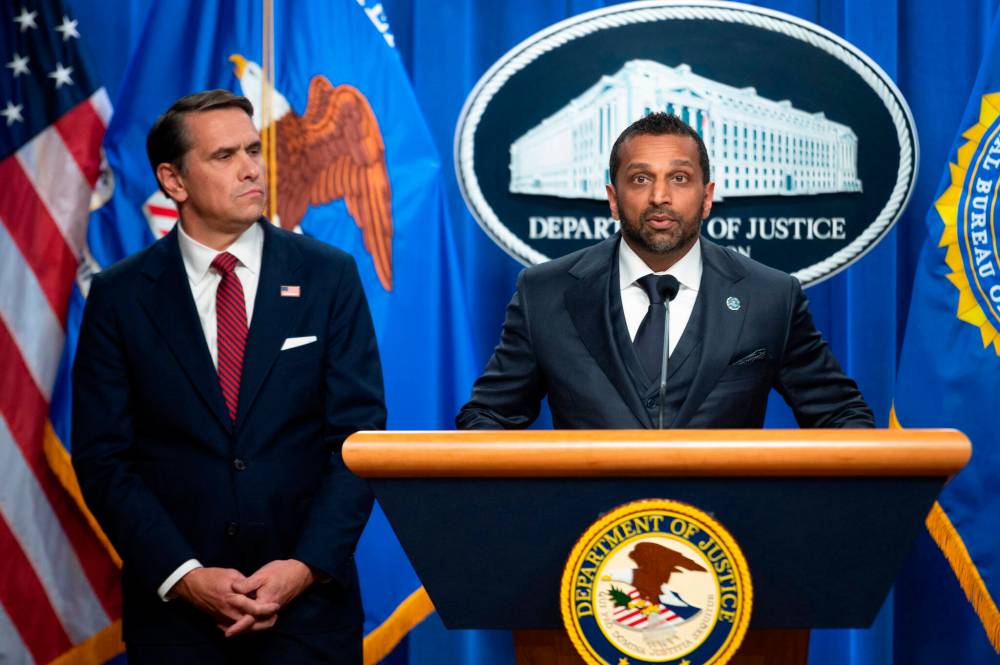
Cliff Owen / The Associated Press files
Acting U.S. Attorney General Todd Blanche (left) watches as FBI director Kash Patel speaks about former FBI director James Comey’s indictment, at the Justice Department in Washington on April 28.
In fact, the Merriam-Webster Dictionary defines “86,” a slang reference that originated in the 1930s, as “to throw out” or “to refuse services.”
When the Secret Service first asked Comey about the Instagram post and told of him of its possible violent meaning, Comey said he believed it was intended as a political statement. He assured the agents that he did not want to harm the president and immediately deleted the post.
That should have been the end of it. Moreover, the phrase adorns hats and t-shirts easily acquired online without legal repercussions.
Nonetheless, a few weeks ago, DOJ lawyers convinced a grand jury in North Carolina that Comey was seriously advocating that Trump be assassinated.
Comey ranks high on Trump’s enemy list for initiating an investigation in 2017 into links between Trump and Russia during the 2016 presidential campaign and for his perceived disloyalty. When Trump realized that Comey would not do his bidding, he fired Comey as FBI director in early May 2017 and has been after him ever since.
Thus, having failed to get anywhere with its first attempt to indict Comey in September 2025 on charges of lying to Congress and obstruction of justice, the DOJ concocted this second case — in keeping with its all too blatant mandate to seek retribution for Trump against all those who have purportedly wronged him.
None of this should be all that surprising. During his first term as president, Trump declared in an interview with the New York Times at the end of December 2017 that, “I have absolute right to do what I want to do with the Justice Department.”
Trump’s use of the DOJ as an arm of the White House in which its lawyers and officials do his bidding, however, goes against long-standing conventions and norms that have been in place since the end of the Watergate scandal and Richard Nixon’s resignation as president in August 1974.
The relationship between the president and the DOJ has been a work-in-progress largely influenced by the personalities, political views and moral standards of individual presidents.
The DOJ was founded in 1870 by then-president Ulysses Grant during the Reconstruction era and following the passage of key constitutional amendments to protect the legal and civil rights of formerly enslaved Black people.
Its main function was to co-ordinate the federal government’s legal work and ensure that African-Americans obtained justice in the courtrooms of the South — no easy task at a time when the Ku Klux Klan operated openly and often with support of local law officials.
Grant naturally held the DOJ in high esteem. Yet, in 1875 in order to protect his position, he fired a special DOJ prosecutor investigating a scandal in the whiskey business who had accused Grant of wrongdoing.
A century later, Richard Nixon did the same thing when the stakes were higher.
In a desperate attempt to stop tape recordings of private conversations dealing with the Watergate scandal being turned over to special prosecutor Archibald Cox, Nixon ordered Elliot Richardson, the attorney general, to fire Cox. Richardson refused and this led to the subsequent resignation of the deputy attorney general, Bill Ruckelshaus, who also refused Nixon’s request.
Nixon then asked then-solicitor general Robert Bork to dismiss Cox and he complied. (This is known as the “Saturday Night Massacre.”)
Nixon’s actions did not save his presidency; impeachment proceedings against him began soon after.
In the years after Watergate, legislative controls were instituted which made the DOJ more independent, rather than an institution to be used by a president to seek revenge on his (or her) enemies.

For the most part, this arrangement has been adhered to until recently.
It is highly ironic that Comey, who unwittingly helped Trump win the presidency in 2016 with critical statements about Hillary Clinton’s “infamous” emails in the last week of the election campaign, should now be one of the main targets of the DOJ and of Trump’s ire.
On the other hand, expect this case about the seashell Instagram post to be dismissed in the very near future. Even a staunch conservative commentator like lawyer Andrew McCarthy thinks so.
“There was not a threat of violence against the president, much less an unambiguous call for his assassination. Nor would it be remotely possible, on the known evidence, to prove beyond a reasonable doubt that Comey intended violence,” McCarthy said recently on Fox News. “This farce … is nothing more than a continuation of Trump’s lawfare campaign against a political enemy …”
Now & Then is a column in which historian Allan Levine puts the events of today in a historical context. His most recent book is The Dollar-A-Year Men: How the Best Business Brains in Canada Helped to Win the Second World War.