

The house Speaker, heckling and ‘banned’ words
Advertisement
Read this article for free:
or
Already have an account? Log in here »
To continue reading, please subscribe:

Digital Subscription
One year of digital access for only $205*
- Enjoy unlimited reading on winnipegfreepress.com
- Read the E-Edition, our digital replica newspaper
- Access News Break, our award-winning app
- Play interactive puzzles
*First annual payment billed as $205.00 + GST for one year. This annual subscription will automatically renew at $233.00 + GST every 52 weeks (10% off the regular annual price of $259.35). Offer available to new and qualified returning subscribers only. Cancel any time.
To continue reading, please subscribe:
Add Free Press access to your Brandon Sun subscription for only an additional
$1 for the first 4 weeks*
- Enjoy unlimited reading on winnipegfreepress.com
- Read the E-Edition, our digital replica newspaper
- Access News Break, our award-winning app
- Play interactive puzzles
*Your next Brandon Sun subscription payment will increase by $1.00 and you will be charged $17.95 plus GST for four weeks. After four weeks, your payment will increase to $24.95 plus GST every four weeks.
Read unlimited articles for free today:
or
Already have an account? Log in here »
On May 4, when providing his ruling on one of the many recent disorderly incidents in the legislature, the Speaker, Tom Lindsey (the NDP MLA for Flin Flon) announced that henceforth MLAs who engaged in “excessive” heckling would be called to order. If this happened three times the offending member would not be recognized to speak for the remainder of the day.
Failure to respect the order of the chair could result in expulsion from the chamber for the rest of the sitting.
The Speaker also announced that five words — “bigot,” “racist,” “homophobe,” “transphobe” and “misogynist” — would be added to an existing list of words already considered unparliamentary language.
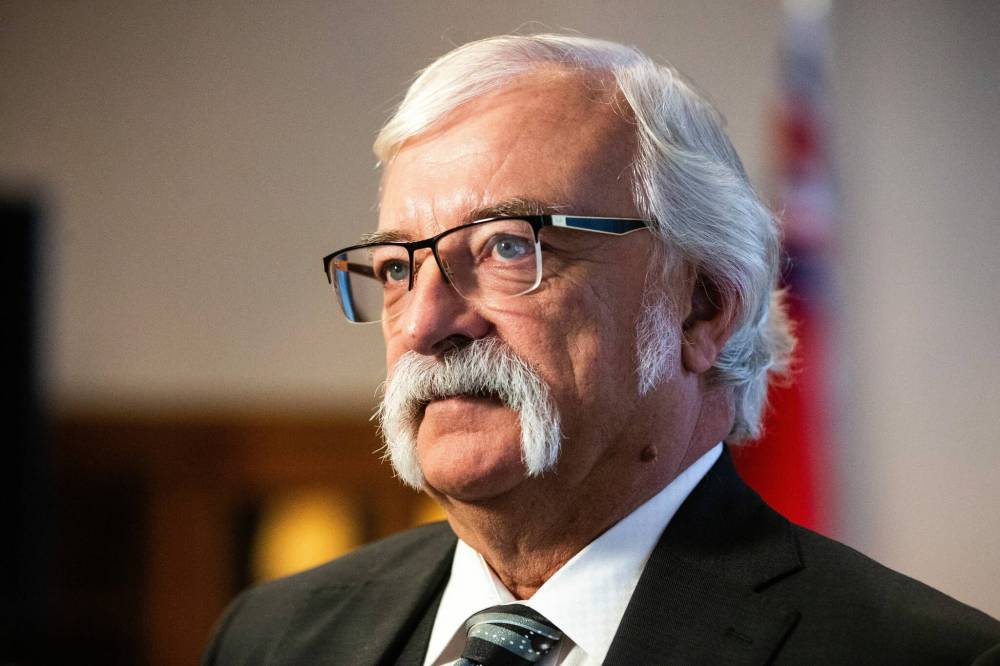
MIKAELA MACKENZIE / WINNIPEG FREE PRESS
House Speaker Tom Lindsey.
Depending on how they are used, the offensive words are deemed to impugn the character of another member. Ordered to withdraw the words, a failure to comply would result in the offender not being recognized to speak until a withdrawal occurred.
There were mixed reactions to the Speaker’s ruling, both inside and outside of the legislature.
The NDP and the PCs seemed to accept the stricter rule on heckling, partly because the Speaker indicated that some amount of heckling would be tolerated as a normal part of partisan competition.
Outside of the legislature many citizens fed up with the negative theatrics of the legislature, especially during question period, probably applauded the Speaker’s clampdown.
The parties disagreed on the proposed “ban” on five new words. PC Leader Obby Khan praised the ruling, claiming his members were unfairly the targets of such inflammatory accusations. In contrast, Premier Wab Kinew argued that the ban was “100 per cent wrong” because it would prevent MLAs targeted by hateful speech from labelling offending members as racist, bigot or one of the other five words. Some outside commentators argued that the ban would curtail free speech and rigorous debate.
The Speaker has an inherently difficult job. His role is to maintain order to enable public business to be conducted, to apply the rules impartially, to protect the rights of individual MLAs, and to promote the dignity and the image of the institution.
He has limited authority to manage the affairs of the legislature. It takes special skills on his part to read the mood of the assembly and to intervene effectively to lower the temperature. An even temperament is helpful to deal with the conflicts that arise regularly.
No Speaker can maintain order and decorum without some level of respect for the office and co-operation from members.
Dealing with misconduct and disorder in the legislature will require changes to both the rules and to the culture of the institution.
The two factors are related, but changing the culture is a much slower, uncertain process and progress made can be quickly lost when there is another uproar in the assembly.
Rule changes have been made in recent decades to reinforce the authority of the Speaker as a neutral referee of partisan fights. In 1999, for the first time, rather than being appointed by the premier, the Speaker was elected by a secret ballot of all MLAs. Lindsey was acclaimed as Speaker in 2023.
Speakers are not required to drop their party membership, but they don’t attend caucus meetings or political events, do not participate in debates, and do not cast votes in the Legislature unless there is a tie.
In 2019, another rule change eliminated appeals of the rulings made by the Speaker.
In criticizing Lindsey’s ruling on “banned” words, Kinew indicated that he would be pressuring the Speaker to reverse his decision. It should be noted that the Speaker cannot be fired or voted out of office. Unless he resigns, Lindsey will serve until dissolution for the scheduled 2027 election.
Interpretation of the rules, including what constitutes unparliamentary language, is generally left to the discretion of the Speaker. Lindsey went to some length to describe the context and range of criteria he would use to apply the new “ban.” Many jurisdictions in Canada and beyond have implemented similar restrictions.
MLAs may have a right to free speech and parliamentary immunity against prosecution for certain statements, but these privileges come with a duty to behave responsibly.

Language or conduct that is out of order can be identified by the Speaker or any MLA. The most common response is for the Speaker to request the offending member to withdraw the remark and to apologize. Failure to comply after multiple requests can cause the Speaker to expel the member for the remainder of the sitting day.
There are limits to the positive impacts of what I would describe as a “naming, blaming and shaming” approach to disciplining MLAs. To reinforce the message that rudeness and aggressive language will not be tolerated, the Speaker might go further by indicating that serial offenders will not be recognized in question period for three days, thus denying them the opportunity to score political points and to generate media content.
Greater decorum and civility will require that party leaders Kinew and Khan drop their personal attacks and constrain their followers. The Speaker might meet with them to discuss how to improve behaviour, but at this juncture, it seems doubtful such a meeting would result in enduring positive change.
No Speaker performs perfectly. Criticism is inevitable. I applaud Lindsey’s efforts to maintain order and to create a respectful culture. There needs to be greater understanding and respect for the crucial role of the Speaker in our parliamentary system.
Paul G. Thomas is professor emeritus of Political Studies at the University of Manitoba.