

The folly of war: the wisdom of peace
Advertisement
Read this article for free:
or
Already have an account? Log in here »
To continue reading, please subscribe:

Digital Subscription
One year of digital access for only $205*
- Enjoy unlimited reading on winnipegfreepress.com
- Read the E-Edition, our digital replica newspaper
- Access News Break, our award-winning app
- Play interactive puzzles
*First annual payment billed as $205.00 + GST for one year. This annual subscription will automatically renew at $233.00 + GST every 52 weeks (10% off the regular annual price of $259.35). Offer available to new and qualified returning subscribers only. Cancel any time.
To continue reading, please subscribe:
Add Free Press access to your Brandon Sun subscription for only an additional
$1 for the first 4 weeks*
- Enjoy unlimited reading on winnipegfreepress.com
- Read the E-Edition, our digital replica newspaper
- Access News Break, our award-winning app
- Play interactive puzzles
*Your next Brandon Sun subscription payment will increase by $1.00 and you will be charged $17.95 plus GST for four weeks. After four weeks, your payment will increase to $24.95 plus GST every four weeks.
Read unlimited articles for free today:
or
Already have an account? Log in here »
Some things never seem to change.
In the 1980s I was a peace advocate —I still am. One of the founders and first president of the Educators for Social Responsibility, I helped organize, promote and speak at peace and anti-nuclear rallies and marches. We developed, collected and distributed peace curricula from across Canada for teaching in Manitoba schools.
We made presentations to government task forces opposing nuclear arms and the military industrial complex. We argued that peace was more than the absence of war. Now, I would be happy with that as a starting point for political and moral thought and action. I trust I am not alone.
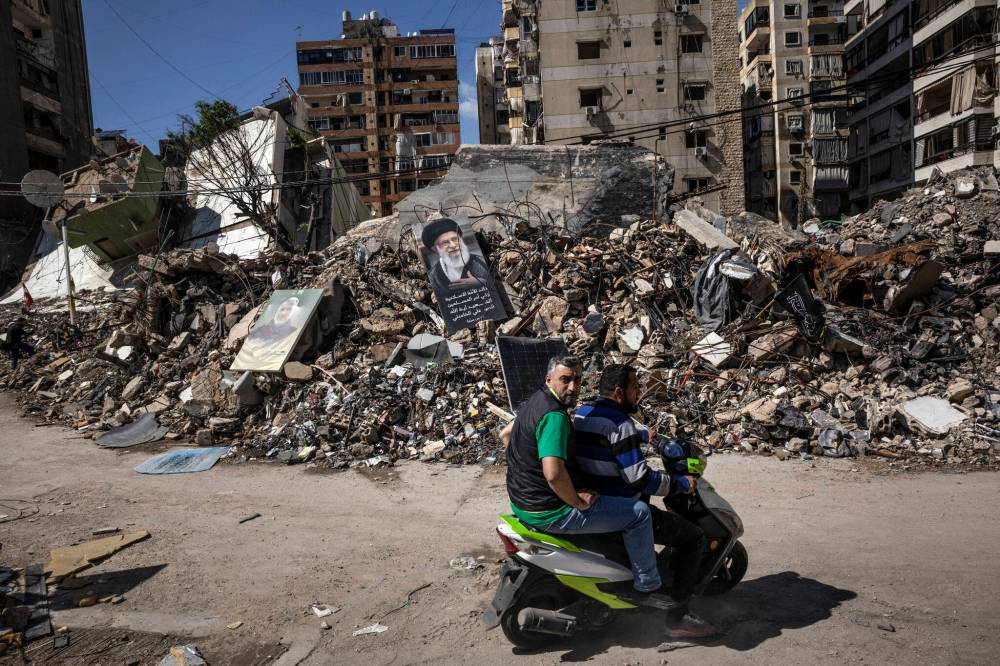
The New York Times / File
Men pass a poster of Ayatollah Ali Khamenei, the late supreme leader of Iran, on a pile of rubble from Israeli airstrikes.
This is not a new struggle. In 1795, Immanuel Kant, a philosopher sometimes mentioned alongside Aristotle and Plato as one of the greatest philosophers in the Western world, wrote Perpetual Peace: A Philosophical Sketch. His ideas are reflected in the 1949 Geneva Conventions; international laws regulating the initiation of armed conflict and conduct during war.
Paramount in his sketch were the protection of innocent people, reduction of potential suffering and prevention of unwarranted destruction. War is still a political aberration and a moral travesty, and a constant presence in our world.
Kant made some appealing suggestions which could just as easily apply to our times: a peaceful moral-political relationship between sovereign states. Politically, no interference in the government and affairs of other states, no deals to have one state take over another, no treaties which allowed for further conflict and the eventual abolishment of all standing armies.
Morally, an attitude of universal hospitality, a nod toward his categorical imperative that our actions should be dictated by an overriding regard for all humanity, including dignity and respect for ourselves.
Interestingly, these ideas form the basis of international law and the United Nations conventions and declarations, most of which all members have signed on to. Included are the sovereign states currently at war —the United States, Russia, Israel, Iran and yes, Ukraine and Lebanon but not the Palestinian Authority (Israeli occupied Gaza and the West Bank) who have Permanent Observer status, allowing them to participate but not vote.
Members signed up to uphold the UN Charter and international law, maintain international peace and promote universal human rights. Starting wars is a direct violation of all those commitments.
War is a folly —fuelled by delusion, deceit and destruction —utter madness! History has shown that wars have no winners unless one considers holding onto one’s statehood subsequently a win. We might be reminded of the outcomes of the wars in Afghanistan, Vietnam and those we call the world wars where, in the aftermath, little changed politically after the loss of tens of thousands of lives.
In Iraq there was regime change, a U.S. brokered new constitution, leading to a brutal inter-sectarian civil war, the rise of ISIS and a shift of power in the region in favour of Iran. It’s hard to believe that victory by any side would reduce resentment and hatred, racial or religious.
The U.S./Israeli-Iran war began, like the Iraq war, under false premises, and was promised to be a “walk in the park” because of America’s overwhelming military advantage, thereby quickly freeing an oppressed people.
The so-called regime leadership purge has resulted in greater repression and internal violence. In all, 256 children were callously killed in their school, and close to 4,000 Iranian civilians and over 5,000 others in the region have been killed.
The cost to date to the United States is US$29 billion — the cost in lives and money probably underestimated. The costs of rebuilding infrastructure are not even part of that total. The Russia-Ukraine conflict and the Israeli-Gaza-Lebanon conflict share similar narratives, justifications nowhere corresponding to the truth and consequences.
Adding insult, the clash in the Strait of Hormuz has not only blocked vital supplies and created shortages worldwide, but like the war it has divided former trusted allies. And there are no beneficial ends in sight —the only real winners seem to be arms producers — an economic windfall based on shoring up human misery, injury and death.
Peace, even as non-war, is wisdom, as in it makes more sense — based on rationality, reasonableness and humanitarianism. Just a few reminders.
The number of people killed in other crimes are miniscule when compared to the loss of lives in wars and, more than often the perpetrators are apprehended and punished, unlike the perpetrators of wars.
In wartime, international aid shifts from long term development goals to emergency humanitarian aid, and even that is greatly reduced. At latest report, the U.S., by far the largest foreign aid donor in the world, is considering a 70 per cent cut to aid while debating a US$1.5-trillion increase in military spending. Last year, this meant over 80 million people in places like Gaza, South Sudan, Sudan and Yemen are left to their own meagre resources, resulting in mass malnutrition and the starvation of thousands of children and their families.
Contrast that with three national programs made possible by not spending money on armaments and war. Canada has recently implemented a National School Food program ($1 billion over five years) — providing 400,000 children with nutritious meals annually —to become permanent after those five years. This program not only reduces hunger but also increases learning and reduces food costs for needy families.
The Canadian government earlier introduced a National Daycare program to support early learning and daycare centres (estimated at $30 billion) by reducing day care costs to $10 a day in conjunction with provincial governments.

Currently under consideration is a National Housing strategy ($415 billion) aimed at providing safe, affordable housing for vulnerable groups and reducing homelessness.
This is in addition to a financially challenged universal health-care system, which now includes a national dental plan ($4.4 billion annually) and pharmaceutical support ($15 million by 2027) for economically vulnerable populations.
Ironically, these costs come under more scrutiny than the $60 billion dollars currently pledged to NATO, including the exorbitant costs of new fighter jets and submarines.
Kant’s 18th-century ideas provide much food for thought, and it’s hard to find a better objective than “perpetual peace” following his prescriptions. And wouldn’t it be wonderful to have our legislatures and parliament discuss what “universal hospitality” might look like both personally and globally. I can dream!
John R. Wiens is dean emeritus at the faculty of education, University of Manitoba.