

Music as therapy — singing through tears

Advertisement
Read this article for free:
or
Already have an account? Log in here »
To continue reading, please subscribe:

Digital Subscription
One year of digital access for only $205*
- Enjoy unlimited reading on winnipegfreepress.com
- Read the E-Edition, our digital replica newspaper
- Access News Break, our award-winning app
- Play interactive puzzles
*First annual payment billed as $205.00 + GST for one year. This annual subscription will automatically renew at $233.00 + GST every 52 weeks (10% off the regular annual price of $259.35). Offer available to new and qualified returning subscribers only. Cancel any time.
To continue reading, please subscribe:
Add Free Press access to your Brandon Sun subscription for only an additional
$1 for the first 4 weeks*
- Enjoy unlimited reading on winnipegfreepress.com
- Read the E-Edition, our digital replica newspaper
- Access News Break, our award-winning app
- Play interactive puzzles
*Your next Brandon Sun subscription payment will increase by $1.00 and you will be charged $17.95 plus GST for four weeks. After four weeks, your payment will increase to $24.95 plus GST every four weeks.
Read unlimited articles for free today:
or
Already have an account? Log in here »
It’s Sunday and I arrive in the middle of hymn sing. Mom and her roommate are dozing on the couch in the lobby as the songs swell around them, the recorded music supplemented by a choir of earnest voices.
The diminutive lady with the horn-rimmed glasses who had vigorously belted out Nancy Sinatra’s These Boots Are Made for Walkin’ at last week’s singalong is more subdued today, her voice soft and plaintive during Why Me Lord?
Indeed, there is an air of sadness to this gathering, the musical selections steeped in nostalgia. It feels more like group therapy than joyful noise.
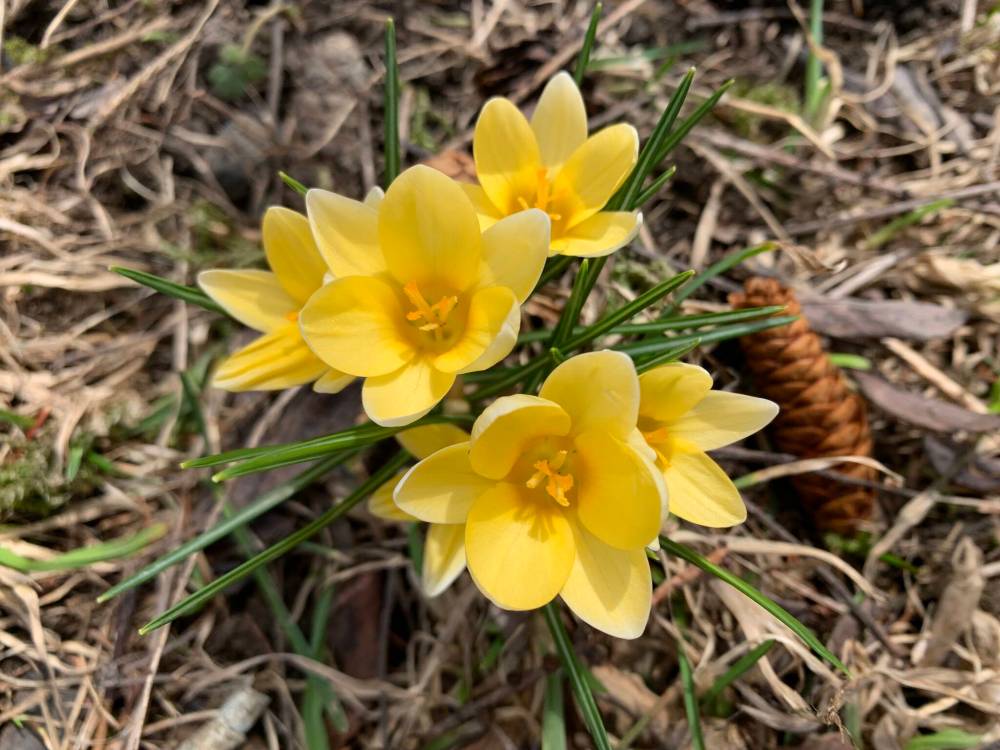
Pam Frampton photo
Spring flowers are a sure sign of brighter days ahead.
But then the residents here are grieving. They have lost two of their number in recent weeks, both wonderful women whose company I enjoyed on many previous visits, and today’s music session has been dedicated to their memories.
I touch Mom’s arm and her eyes flutter awake. Immediately I see that something is off. She does not greet me with her usual radiant smile. Her brown eyes are lifeless, devoid of light; her mouth downturned.
“How are you doing?” I ask.
No answer.
“It takes so long for them to get anything done around here,” she mutters to herself.
Hearing the singing all around her, she starts The Alphabet Song but trails off halfway through, struggling to find the words.
“What’s your name?” she asks, but can’t hear me because of the ambient noise.
I write my name is big letters using the Notes app on my phone and show it to her. She shrugs. “I can’t read that,” she says.
I take her hand and she holds mine for a moment before letting it drop. I try to engage her interest with the stuffed bunny we brought her on Mother’s Day, which is on her lap. We call him Reg the Rabbit after my late dad, whose first name seems lost to her now. She refers to him only as her former teacher, Mr. Frampton. We hope that if we say his name often enough it might act like a key to the locked door of recall.
This new loss is difficult to bear. With dad now hovering only at the periphery of her memory, she — and we — are deprived of her loving recollections of him after their 62-year marriage. It is another painful development along Alzheimer’s cruel path.
In the months immediately following his death she would ask us repeatedly if we had gotten him a headstone, which we had, and we took her to visit his grave. But those memories have disappeared. If she knows he is gone, it doesn’t seem to register. When I showed her a photo of him recently, there was no flicker of recognition.
“I think I only saw him once,” she says.
“What do you remember about him?” I say, anxious for any crumb of acknowledgment of the wonderful life they had together.
“He was a good man,” she says.
The lady in the horn-rimmed glasses gestures to a page in the songbook, snapping me back into the present.
“This is a sad one,” she says.
“Yes,” I say, even though I am unfamiliar with the song.
The room fills with sound as Kitty Wells launches into How Far is Heaven:
How far is Heaven? When can I go?
To see my daddy, he’s there, I know
How far is Heaven? Let’s go tonight
I want my daddy to hold me tight
A couple of the residents are moved to tears; one man is sobbing and wiping his eyes. The music co-ordinator distributes Kleenex. It’s enough to break your heart.
The bespectacled lady next to me is crying and I touch her on the shoulder and ask if she’s all right. She nods yes through her tears.
I look around the room and think about how much loss these people must have already borne — not just the recent passing of their friends, but spouses, siblings, parents, even children. A lifetime of loss must be a heavy load to bear.
I think of my mother and her own father, lost at sea 70 years ago. Like the dad in Kitty Wells’ sad song, “He was called so suddenly and could not say goodbye.”
Mom cried for years after that, but today she seems almost to have been called away herself; unreachable.
The music has changed now, with songbook pages turned to The Stanley Brothers’ Angel Band, a banjo prettily picking out the twangy melody:
My latest sun is sinking fast
My race is nearly run

My strongest trials now are past
My triumph has begun
I hope the singing and the tears are cathartic. I hope that for the residents, coming together to give voice to the hurt and loss eases their burden for a little while.
I hope Mom’s strongest trials are now past, that today is just an anomaly, and that she will be there to greet me when I come again.
Pam Frampton lives in St. John’s.
Pam Frampton is a columnist for the Free Press. She has worked in print media since 1990 and has been offering up her opinions for more than 20 years. Read more about Pam.
Pam’s columns are built on facts, but offer her personal views through arguments and analysis. Every column Pam produces is reviewed by an editing team before it is posted online or published in print — part of the Free Press‘s tradition, since 1872, of producing reliable independent journalism. Read more about Free Press’s history and mandate, and learn how our newsroom operates.
Our newsroom depends on a growing audience of readers to power our journalism. If you are not a paid reader, please consider becoming a subscriber.
Our newsroom depends on its audience of readers to power our journalism. Thank you for your support.
Pam Frampton is a columnist for the Free Press. She has worked in print media since 1990 and has been offering up her opinions for more than 20 years. Read more about Pam.
Pam’s columns are built on facts, but offer her personal views through arguments and analysis. Every column Pam produces is reviewed by an editing team before it is posted online or published in print — part of the Free Press‘s tradition, since 1872, of producing reliable independent journalism. Read more about Free Press’s history and mandate, and learn how our newsroom operates.
Our newsroom depends on a growing audience of readers to power our journalism. If you are not a paid reader, please consider becoming a subscriber.
Our newsroom depends on its audience of readers to power our journalism. Thank you for your support.
Advertisement Advertise With Us
Advertisement Advertise With Us