

American ownership and Canadian sovereignty
Advertisement
Read this article for free:
or
Already have an account? Log in here »
To continue reading, please subscribe:

Digital Subscription
One year of digital access for only $205*
- Enjoy unlimited reading on winnipegfreepress.com
- Read the E-Edition, our digital replica newspaper
- Access News Break, our award-winning app
- Play interactive puzzles
*First annual payment billed as $205.00 + GST for one year. This annual subscription will automatically renew at $233.00 + GST every 52 weeks (10% off the regular annual price of $259.35). Offer available to new and qualified returning subscribers only. Cancel any time.
To continue reading, please subscribe:
Add Free Press access to your Brandon Sun subscription for only an additional
$1 for the first 4 weeks*
- Enjoy unlimited reading on winnipegfreepress.com
- Read the E-Edition, our digital replica newspaper
- Access News Break, our award-winning app
- Play interactive puzzles
*Your next Brandon Sun subscription payment will increase by $1.00 and you will be charged $17.95 plus GST for four weeks. After four weeks, your payment will increase to $24.95 plus GST every four weeks.
Read unlimited articles for free today:
or
Already have an account? Log in here »
As Canada’s federal and provincial governments prepare to invest billions of dollars toward making Canada more economically independent of the U.S., they must do a better job of explaining how that goal can be accomplished despite high levels of American ownership in key sectors of the Canadian economy.
Approximately 75 per cent of Canada’s oil and gas assets are managed by Canadian-headquartered operators, but U.S. investors and equity holders own controlling interests in many of those corporations. Large American energy companies also maintain huge ownership stakes in Canadian production. In particular, U.S. investors own roughly 60 per cent of the four largest oil-sands producers, which collectively account for the vast bulk of Canada’s oil-sands output.
That means that the recently announced oil pipeline to the Pacific coast will (if it proceeds) create jobs during the construction phase, fewer jobs once operating, revenue for B.C. and Indigenous groups, and royalties for Alberta. The largest profits by far, however, will go to the American owners of oil sands companies.
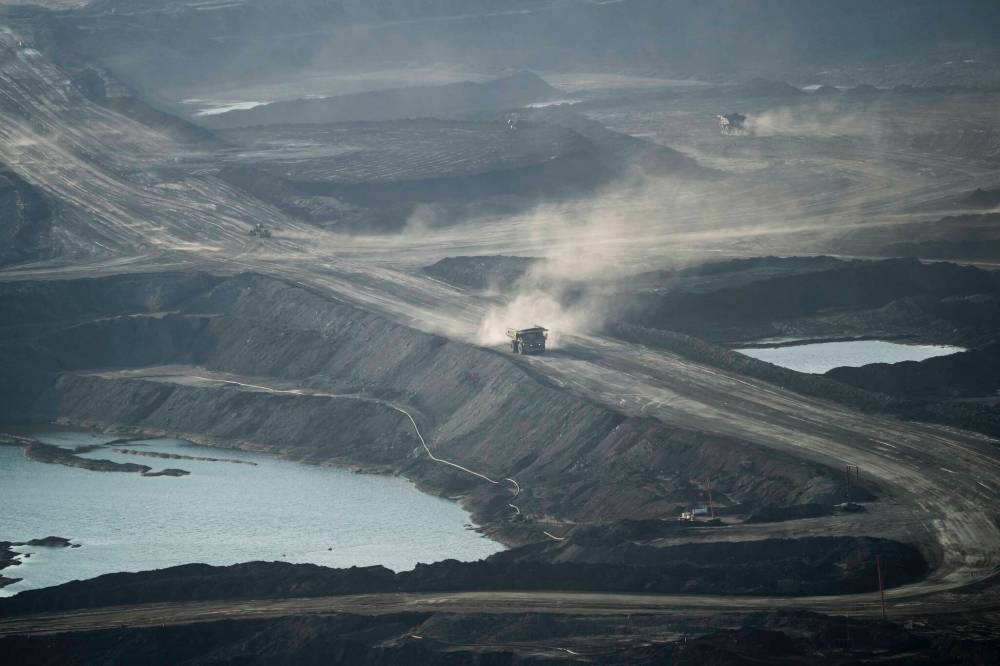
Victor R. Caivano / Associated Press Files
Ownership by American companies — including in the Alberta oil sands — threatens Canadian economic sovereignty.
Given that reality, how does Canada’s national projects strategy lessen American leverage in our energy sector if major U.S. interests own and control much of our oil and gas industry? How could Canada prevent American-controlled companies from shipping their bitumen via tankers to refineries on the U.S. West Coast, especially if doing so is more profitable than transporting the oil to Asian destinations?
Those facts and questions are a problem for Prime Minister Mark Carney’s Liberal government. It’s easy to talk about having our “elbows up” and selling “our” products and commodities to non-U.S. countries as part of a strategy to reduce our economic reliance on the U.S., but the high level of American investment and ownership across a range of Canada’s economic sectors makes the achievement of that goal far more complicated and far less certain.
Many Canadians feel our vast reserves of critical minerals give us an advantage in trade talks with the U.S., but several American mining companies are already working in Canada to secure access to metals and minerals deemed essential for American national defence. U.S. government entities have even taken direct equity stakes in Canadian-based mining companies in order to reduce American reliance on suppliers such as China.
That’s just one of many areas in which U.S. corporations are elbows-deep in our economy. For example, the Canadian aluminum, steel and auto manufacturing industries are all foreign-owned, with American companies having large stakes in each sector. Three of Canada’s four major potash producers are foreign-owned, including Florida-based Mosaic. U.S.-based Cargill and Brazil-based JBS collectively control more than 95 per cent of our beef slaughter capacity.
The government wants to spend a smaller portion of its military procurement dollars in America, but subsidiaries of U.S. giants such as Boeing, Lockheed Martin and General Dynamics are deeply embedded here in Canada. Just last week, Canada agreed to acquire 26 M142 High Mobility Artillery Rocket Systems and related munitions. Those systems are manufactured by Lockheed Martin in Arkansas.
All of that American investment and integration underscores the complexity of the challenge facing Carney and his government. He knows the Americans have far too much control over several sectors of Canada’s economy — and that U.S. President Donald Trump’s administration is willing to abuse that power — but he can’t take decisive steps to counteract that threat without putting millions of Canadian jobs at risk.

He is also keenly aware that Canada’s privileged access to the U.S. market via the Canada-United States-Mexico Agreement and other trade agreements is an advantage, but that losing some or all of that access would also jeopardize jobs and harm the national economy.
Finally, he realizes there isn’t sufficient investment capital available in Canada to pay for the proposed national projects, let alone our other large infrastructure projects. That explains why he is attempting to attract investment from other jurisdictions, but those efforts could result in large U.S. companies controlling an even greater portion of our economy, giving the Trump administration even greater leverage over us.
That’s not the outcome we want from the huge investments our governments plan to make across the country. It underscores the need to exercise diligence in ensuring that those projects create long-term benefits for Canadians, and don’t worsen the current situation.
Deveryn Ross is a political commentator living in Brandon.
deverynrossletters@gmail.com | X: @deverynross