

Road work gains cause business pain
Advertisement
Read this article for free:
or
Already have an account? Log in here »
To continue reading, please subscribe:
Digital Subscription
One year of digital access for only $1.44 a week*
- Enjoy unlimited reading on winnipegfreepress.com
- Read the E-Edition, our digital replica newspaper
- Access News Break, our award-winning app
- Play interactive puzzles
*Billed as $5.77 plus GST every four weeks. After 52 weeks, price increases to the regular rate of $19.95 plus GST every four weeks. Offer available to new and qualified returning subscribers only. Cancel any time.
To continue reading, please subscribe:
Add Free Press access to your Brandon Sun subscription for only an additional
$1 for the first 4 weeks*
- Enjoy unlimited reading on winnipegfreepress.com
- Read the E-Edition, our digital replica newspaper
- Access News Break, our award-winning app
- Play interactive puzzles
*Your next Brandon Sun subscription payment will increase by $1.00 and you will be charged $17.95 plus GST for four weeks. After four weeks, your payment will increase to $24.95 plus GST every four weeks.
Read unlimited articles for free today:
or
Already have an account? Log in here »
In Winnipeg, construction season can feel more like “survival season” for local small businesses affected by roadwork.
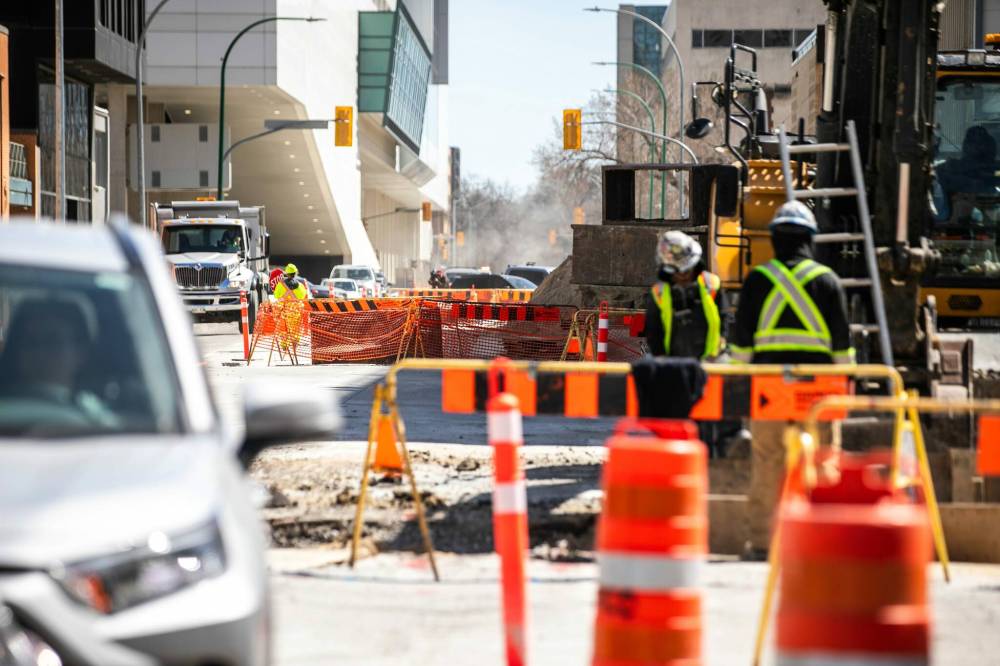
Each spring, small businesses brace for impact as pylons go up, lanes narrow, parking disappears and streets are torn up.
One local business owner, at Beaucage Lawn & Garden Centre, recently described how the operation is about to be impacted during the most critical weeks of the year.
MIKAELA MACKENZIE / FREE PRESS FILES
Each spring, small businesses brace for impact as pylons go up, lanes narrow, parking disappears and streets are torn up.
While access to the business will technically remain open during the project, road closure signs erected by the city are creating confusion and could potentially deter customers.
As a result, the business took it upon itself to create and post its own access map online. Planting season, Beaucage noted, lasts only a few weeks and represents the bulk of annual sales. If access becomes more difficult and sales decline during this narrow window, those losses cannot simply be recovered later.
Unfortunately, this sort of disruption is not uncommon. Across Winnipeg, business owners describe the same pattern repeating year after year — “new” projects layered on top of old ones, streets reopened only to be dug up again and long stretches of reduced access which directly affect sales and cash flow.
As one retailer on South Osborne near Jubilee Avenue put it: “They just finished redoing the whole road here, it was under construction for many years, and then they had the bridge that was under construction for basically another two years. So, it will affect parking quite a bit, and that’s precious to us as store owners.”
The frustration is understandable. It is not just the inconvenience of a single project, it is the cumulative weight of years of disruption in the same corridors, affecting the same businesses, with little relief in between.
This is happening at a time when small businesses are already under severe strain. Canada is facing an entrepreneurial drought, with more businesses closing than opening. Inflation, labour shortages and supply chain pressures have already worn down razor-thin margins. Construction disruption is an added pressure many simply cannot absorb.
Recent data from the Canadian Federation of Independent Business (CFIB) shows 66 per cent of Manitoba small businesses have been impacted by construction in the past five years, and nearly half say they received little or no notice before work began.
Businesses understand the need for roadwork. No one questions the need to fix roads, water lines and aging infrastructure. But year after year, small businesses feel they are the last to know and first to pay the price — and the costs are significant.
In fact, Canadian businesses affected by public construction report an estimated average revenue loss of 22 per cent over the last five years, or nearly $53,000 per business.
This is why CFIB has consistently called for compensation when public projects significantly disrupt business operations. In a June 2024 open letter to the City of Winnipeg, CFIB urged consideration of direct compensation through grants or temporary tax relief, including property tax holidays for affected businesses.
Some municipalities are already taking a more practical approach. In Montreal, businesses impacted by major construction can access compensation of up to $40,000. In Calgary, pilot programs provide direct financial support and assign liaison officers to help businesses manage disruptions in real time.
During major work on St. Anne’s Road between Fermor Avenue and St. Mary’s Road last summer, one business owner described how the project was causing serious challenges for small local firms. Parking became difficult as side streets were blocked, walk-up traffic disappeared and even planned outdoor events had to be cancelled.
“A lot of small businesses were a month or two away from disaster,” she said, echoing CFIB’s call for temporary tax relief or compensation during major disruptions.
We appreciate that Winnipeg has taken some steps in the right direction by improving co-ordination, communication efforts and staging projects to reduce timelines and complete work more quickly.

CFIB was also encouraged to see that in December 2025, its recommendation that the city explore compensation for businesses affected by construction was brought forward at city hall by councillors Sherri Rollins and Brian Mayes. Their motion called for a study into a financial assistance program for affected businesses and referred to Montréal’s program, which has “proven effective in mitigating the negative economic impacts of prolonged infrastructure works.”
Unfortunately, despite these encouraging steps, there have been no meaningful, practical changes. We are still missing a formal construction mitigation framework that treats small business impacts as part of planning from the start rather than an afterthought once damage is already done.
If a small business loses its busiest season, it does not simply “catch up.” That revenue is gone. Staff hours are lost. Confidence erodes. And in many cases, the business does not recover.
Businesses are not asking for perfection. They are asking for stability and predictability. That means turning acknowledgment into action by putting a formal construction mitigation framework in place with clear communication standards, enforceable timelines and meaningful cost relief when disruptions become unavoidable.
Brianna Solberg is CFIB’s director of legislative affairs for the Prairies and northern Canada.