

Seize control of drug supply, rather than seizing drugs
Advertisement
Read this article for free:
or
Already have an account? Log in here »
To continue reading, please subscribe:

Digital Subscription
One year of digital access for only $205*
- Enjoy unlimited reading on winnipegfreepress.com
- Read the E-Edition, our digital replica newspaper
- Access News Break, our award-winning app
- Play interactive puzzles
*First annual payment billed as $205.00 + GST for one year. This annual subscription will automatically renew at $233.00 + GST every 52 weeks (10% off the regular annual price of $259.35). Offer available to new and qualified returning subscribers only. Cancel any time.
To continue reading, please subscribe:
Add Free Press access to your Brandon Sun subscription for only an additional
$1 for the first 4 weeks*
- Enjoy unlimited reading on winnipegfreepress.com
- Read the E-Edition, our digital replica newspaper
- Access News Break, our award-winning app
- Play interactive puzzles
*Your next Brandon Sun subscription payment will increase by $1.00 and you will be charged $17.95 plus GST for four weeks. After four weeks, your payment will increase to $24.95 plus GST every four weeks.
Read unlimited articles for free today:
or
Already have an account? Log in here »
Displaying millions of dollars’ worth of drugs and weapons confiscated while enforcing the current approach to drug use and abuse is only a symbolic victory.
This event, which was possible as a result of untold hours of diligent police work, has been repeated thousands of times at similar displays across North America for the past half century.
Drug busts are recognition that police officers everywhere are doing their job, despite often dangerous circumstances. Drug busts take time, money and courage.
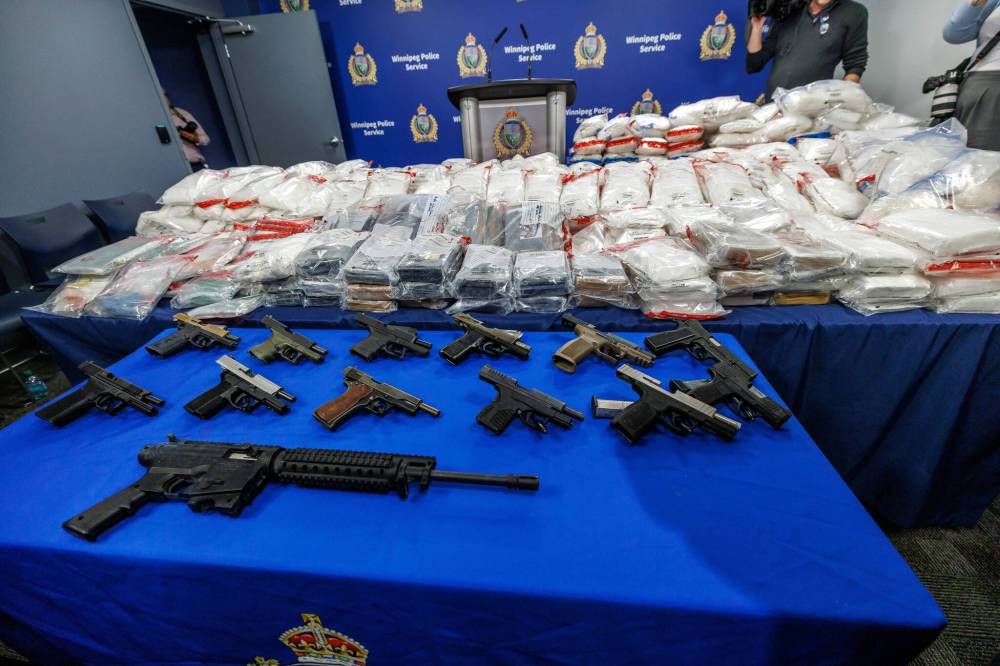
MIKE DEAL / FREE PRESS
A display of the seizure of over $37.2 million worth of drugs, 14 firearms, approximately $825,000 in currency and 1.35 million illegal cigarettes on May 20.
Sadly, drug busts are not a real solution. They are a symptom. And we can predict with some certainty that more drug busts will be necessary in the future. Not because of any failure on the part of police officers, but because our governments seem unwilling to abandon a strategy that has not worked in a century and is unlikely to work any time soon.
Drug busts cannot solve the problem. We insist on asking police to enforce a law which actually creates both criminals and, paradoxically, their support networks — gangs and drug lords.
Addressing drug use and abuse as a health matter has never really been tried. Recent efforts to decriminalize simple possession still leaves addicts at the mercy of illicit drug suppliers and gangs — drug dealers who use addicts to steal and create chaos in the community.
The current approach to controlling drug use, drug overdoses or deaths from tainted drugs is a fool’s errand. The approach has failed, and the drug wars of the last 50 years have costs us billions of dollars and thousands of lives.
If we want to make the public display of drug seizures a thing of the past, we need a new approach.
When someone goes to hospital or to the doctor to deal with the repercussions of the personal abuse of alcohol, tobacco or prescription medicines, we treat them as humans with a health problem, not as criminals. This is both a logical and a wise choice, because attempting to control the behaviour of individuals with addictions using the law and the legal system has never proven effective.
No jurisdiction in Canada has successfully dealt with the cost — to either taxpayers or addicts and their families — of drug abuse. That is because, while we talk about drug addiction and treatment as a health issue, we don’t actually walk the walk.
In Canada, simple possession of some drugs remains illegal. Those using illicit drugs are criminals.
Perhaps one of the biggest ironies in this debate is the fact that the government treats some addictions differently. If you are a heroin addict, your doctor can legally prescribe methadone, a heroin substitute, as treatment. A month’s supply of methadone costs half what it costs to jail someone for a day.
Clearly, the actual cost of providing these drugs directly to addicted patients makes sense, both in terms of health and the social and financial costs of our current approach. If methadone treatment for heroin addiction can be done on the public dime, why can that not be applied to other drugs?
Providing real health care, rather than pursuing the never-ending war on drugs, would be better for addicts. It would also cost the public a small fraction of the cost of relentless and pointless policing, convicting and incarcerating people who need help.
The federal government spends approximately $16 billion a year enforcing the Controlled Drugs and Substances Act (CDS Act). Statistics Canada says the federal government spends roughly 40 per cent of the law enforcement budget following CDS Act provisions.
Provincial and municipal governments spend hundreds of millions more on the fallout from drug-related crimes and addiction. Those budgets cover related costs such as public intoxication, property crimes, violence and vandalism, and domestic disturbances.
None of this accounts for the cost of having an addicted person in our community or our lives. None of this spending seems to have had the desired effect of reducing drug use or abuse. Neither has it reduced the thousands of drug-user deaths resulting from the ingestion of tainted drugs or overdoses each year.
Allowing addicts to manage their addictions in a safe environment — with safe drugs and where help is available — should be our priority. Allowing health practitioners to treat and counsel addicts is simply better medicine than the status quo.
Addicts not compromised by fear of prosecution, or the very real fear of vengeance from their illicit drug suppliers, are much more likely to recover from addiction.
We need to think of drug addiction as an illness, and to define the medication addicts need as legal and prescribable.
Of course, no province will be able to act alone. The federal government is responsible for the CDS Act. Changing it will require significant amendments to make a new approach possible. The federal government and the CDS Act often work to stymie provincial efforts to treat drug addiction and its ramifications in new ways.
Unfortunately, the lack of federal support for a safe injection site in Winnipeg may explain, in part, why such efforts have failed so far.

The provinces and the federal government need to work together to establish a new framework for dealing with illicit drugs and drug enforcement. One that actually deals with drug supply, not just the consequences of drug use. One that allows health-care providers to offer the drugs, or their equivalent, to addicts who need them at this point in their lives.
History can teach us something. No one would argue that getting bootleggers out of the alcohol business was a bad idea. It worked on many levels. It worked because governments simply took over supplying the product — alcohol. We can control the supply of drugs in the same way we have with alcohol, to the advantage of addicts and taxpayers.
Like the bootleggers of the prohibition era, gangs and drug dealers need to be left unemployed with no market for their often-tainted drugs.
Addicts need the help we can give them now.
Jerry Storie is a former politician and educator who writes from Winnipeg.