

Deciphering Raúl Castro’s U.S. federal indictment
Advertisement
Read this article for free:
or
Already have an account? Log in here »
To continue reading, please subscribe:

Digital Subscription
One year of digital access for only $205*
- Enjoy unlimited reading on winnipegfreepress.com
- Read the E-Edition, our digital replica newspaper
- Access News Break, our award-winning app
- Play interactive puzzles
*First annual payment billed as $205.00 + GST for one year. This annual subscription will automatically renew at $233.00 + GST every 52 weeks (10% off the regular annual price of $259.35). Offer available to new and qualified returning subscribers only. Cancel any time.
To continue reading, please subscribe:
Add Free Press access to your Brandon Sun subscription for only an additional
$1 for the first 4 weeks*
- Enjoy unlimited reading on winnipegfreepress.com
- Read the E-Edition, our digital replica newspaper
- Access News Break, our award-winning app
- Play interactive puzzles
*Your next Brandon Sun subscription payment will increase by $1.00 and you will be charged $17.95 plus GST for four weeks. After four weeks, your payment will increase to $24.95 plus GST every four weeks.
Read unlimited articles for free today:
or
Already have an account? Log in here »
Given its targeted audience, I wasn’t surprised at all by how gleeful the Miami Herald’s editorial was about the issuing of a multi-count murder indictment of 95-year-old former Cuban president Raúl Castro.
“This is a huge moment for Miami, 30 years in the making. That’s how long this community has waited — and waited — for justice in the Brothers to the Rescue attack,” the op-ed piece intoned. For good measure, it added the following: “The Raúl Castro indictment alone won’t accomplish true justice for the Cuban people. For that to happen, there must be serious steps that include a release of all political prisoners and a change in the country’s leadership to allow real democratic reforms.”
If that wasn’t enough, elements of the rabid anti-Castro Cuban-American community in Miami’s Little Havana could barely contain themselves.
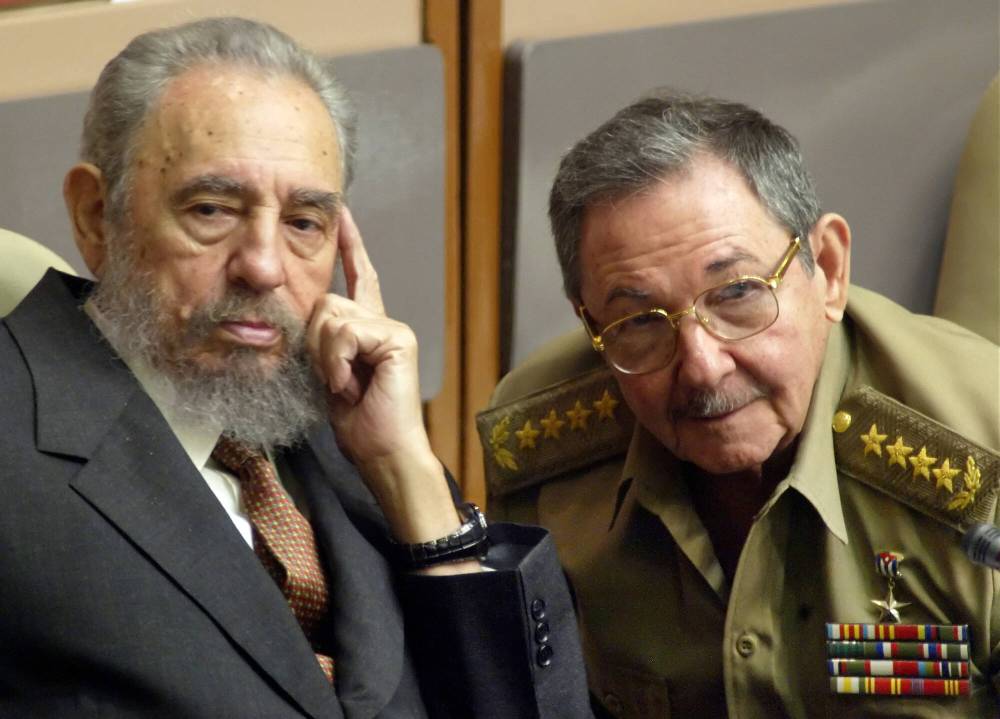
AP/FILE
Former Cuban president Fidel Castro, left, and Defence Minister Raúl Castro are pictured in the Cuban parliament in this 2004 file photo. Raúl Castro turned 95 on June 3, 2026.
“I’m glad there’s a reason to finally execute him because he executed many people,” said one Cuban immigrant. Another man, who left central Cuba in the 1990s, put it this way: “We have been waiting for our government to seek justice — even if it’s late, sooner or later justice will be served. We are really happy that he was indicted.”
Not surprisingly, the Cuban government response to the indictment was one of anger, anxiety and accusations. Cuban President Miguel Díaz-Canel was particularly blunt: “This is a political action, with no legal basis, that only seeks to beef up the case they’re manufacturing to justify the folly of a military aggression against Cuba.”
The Cuban embassy in Washington, of course, did not want to be left out of the combative diplomatic fray.
“The accusation against General Raúl Castro only reveals the arrogance and frustration of the representatives of the empire toward the Cuban revolution,” it posted on X.
It’s pretty obvious that the federal indictment of Castro is just another piece of Marco Rubio’s grand scheme to remove the current Cuban government. And he won’t stop as long as he is a central player in the Trump Administration.
It is instructive to remember that Rubio also has his sights squarely set on running for U.S. president in 2028.
That means the backing of the Cuban-American community in Florida is integral to his winning a critically important battleground state with 30 electoral college votes.
There is no disputing the fact Rubio, a former Florida senator, wanted to arrange something newsworthy to mark the 30th anniversary of the shooting down of two civilian Cessna aircraft by Cuban fighter pilots in February 1996. (It bears remembering that the anti-Castro, Brothers to the Rescue aircraft had repeatedly violated Cuban airspace, had been flying over Havana and dropping leaflets calling for Cubans to rebel, and that the group had been previously warned by the U.S. Federal Aviation Administration to cease and desist.)
Nothing riles up the Cuban-American base in Florida more than an announcement with great fanfare in Miami to indict Raúl Castro — the brother of arch-enemy Fidel Castro.
Please forgive me, having just returned from a couple of weeks in humid Panama, for thinking about the possible linkages between the Castro indictment and the late 1980s U.S. indictment of Panamanian strongman Manuel Noriega.
The federal indictment of Noriega had little to do with criminal matters and everything to do with U.S. domestic politics and presidential image-building (i.e., shedding then-U.S. president George H. W. Bush’s “wimp factor”).
Similarly, U.S. President Donald Trump wants to use the Castro indictment to change the channel on the Iran war fiasco, rising gas and food prices and growing inflation pressures. And don’t forget about the Epstein files still lurking, the off-putting White House ballroom expenditures, the legal compensation payments to “J6ers,” and his presidential self-dealing.
Like the Noriega example and the resultant Operation Just Cause of December 1989, it could be that the U.S. is angling to build a case for why military intervention in Cuba is justified. Or, perhaps the indictment of Castro is intended to force Havana to reconsider its options and to comply with every single one of Trump’s demands (not likely in my view).

It is most assuredly designed to ratchet up the pressure and to rattle the nerves of the Cuban leadership.
This performative indictment has nothing to do with justice, holding dictatorial leaders to account or fostering greater liberal democratization and marketization in Cuba. It certainly has even less to do with a decimated Cuba posing a national security threat to the U.S. nor with any Russian and Chinese military engagement with the island.
What is really going on here has everything to do with creating a pretext for the U.S. to once again gain control and dominance over a long-lost “colony” just 90 miles away. Indeed, this is about an America that has a long memory, a never-ending grudge and an unfulfilled goal to extract revenge against a country that has openly defied it since 1959.
It may very well be 2026, but the core message to others remains the same: don’t ever mess with us or American economic interests.
Peter McKenna is professor of political science at the University of Prince Edward Island in Charlottetown.