

Preserving experience by sharing it

Advertisement
Read this article for free:
or
Already have an account? Log in here »
To continue reading, please subscribe:

Digital Subscription
One year of digital access for only $205*
- Enjoy unlimited reading on winnipegfreepress.com
- Read the E-Edition, our digital replica newspaper
- Access News Break, our award-winning app
- Play interactive puzzles
*First annual payment billed as $205.00 + GST for one year. This annual subscription will automatically renew at $233.00 + GST every 52 weeks (10% off the regular annual price of $259.35). Offer available to new and qualified returning subscribers only. Cancel any time.
To continue reading, please subscribe:
Add Free Press access to your Brandon Sun subscription for only an additional
$1 for the first 4 weeks*
- Enjoy unlimited reading on winnipegfreepress.com
- Read the E-Edition, our digital replica newspaper
- Access News Break, our award-winning app
- Play interactive puzzles
*Your next Brandon Sun subscription payment will increase by $1.00 and you will be charged $17.95 plus GST for four weeks. After four weeks, your payment will increase to $24.95 plus GST every four weeks.
Read unlimited articles for free today:
or
Already have an account? Log in here »
Last fall, while walking through downtown Los Angeles, I found myself standing beneath Alexander Calder’s Four Arches, the monumental red steel sculpture that rises dramatically among the city’s office towers.
Like many of Calder’s large-scale stabiles, it’s not simply an object to be viewed. It is a structure people move around and through. It shapes space, influences movement, and creates relationships between people, architecture, and the public realm.
The sculpture itself is important, but so too is everything it makes possible.
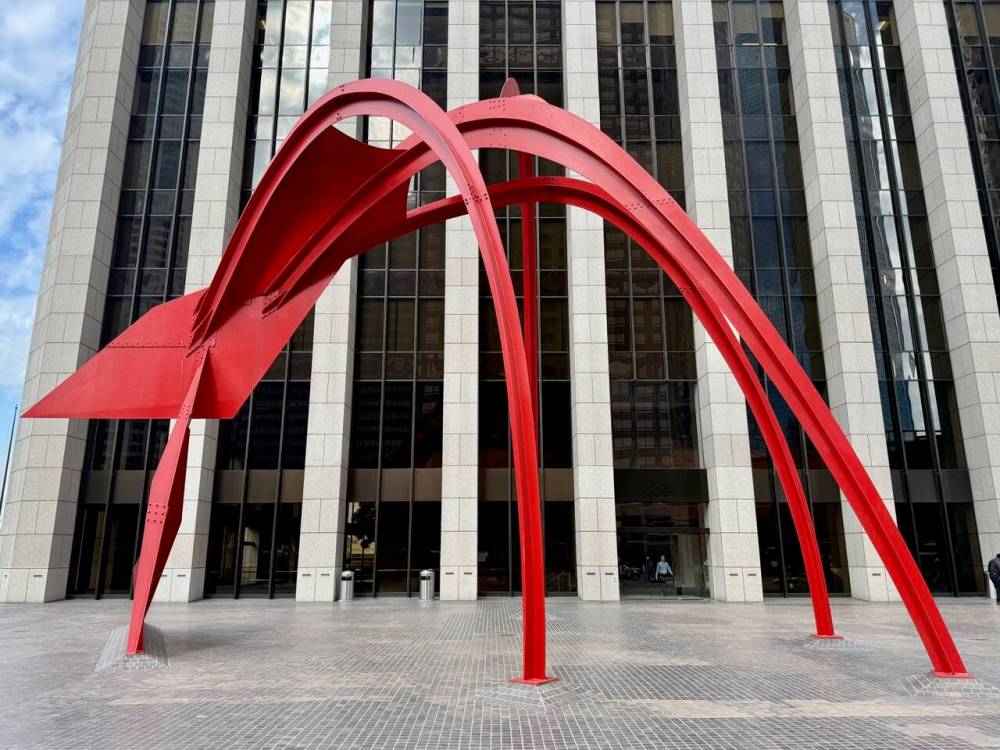
STEPHEN BORYS PHOTO
Alexander Calder’s Four Arches (1973), at Bank of America Plaza in Los Angeles.
Standing there on the plaza, I was reminded of a question that has become increasingly important to me over the years — and one that clients and colleagues often raise in our discussions.
How do we preserve and convey institutional knowledge? Cultural organizations devote enormous effort to preserving collections, archives, programs, and buildings. Yet they often struggle to retain and transfer experience. What happens to the lessons learned through years of leadership, change, and growth?
The importance of safeguarding physical assets for future generations is widely understood. Yet much of what truly matters in organizational life resides in judgment, relationships, and experience.
These qualities are difficult to catalogue, impossible to store on a shelf, and often undervalued until they are gone.
This challenge extends across sectors. Cultural organizations, universities, non-profits, and community organizations all grapple with leadership transitions and organizational change.
The question is not whether institutions will face change, but how effectively they will navigate it. Increasingly, I believe one of the most important responsibilities of experienced leaders is to ensure that knowledge continues to circulate rather than disappear.
Over the past year, my work has taken me into a remarkable range of settings.
One day I may be involved in discussions about the future of a historic heritage site and its role in a changing downtown. Another day involves strategic planning with a cultural institution, governance conversations with a non-profit board, advising on a new museum initiative, teaching students preparing to enter the arts and cultural sector, or participating in discussions about Canada’s movable cultural property.
Yet the conversations are often remarkably similar: relevance, trust, leadership succession, financial sustainability, and long-term impact.
Organizations are trying to balance ambition with reality, honour history while embracing change, and remain relevant in an increasingly complex world.
I have come to better understand why so many experienced cultural leaders gravitate toward consulting, teaching, and writing. They are not recreating former roles; they are finding new ways to contribute.
Leadership does not end when someone leaves an executive position. More often, it changes form.
One of the unexpected benefits of working across multiple organizations is the ability to recognize patterns.
Challenges that appear unique are often widely shared, and solutions frequently transfer from one setting to another. A lesson learned during a major capital project may prove useful to a community organization. An approach to stakeholder engagement developed in one context may help unlock progress elsewhere.
Experience becomes less about expertise in a particular subject and more about perspective — the ability to connect ideas, identify opportunities, and help others navigate change.
One lesson has surfaced repeatedly throughout my career.
Institutions are not ultimately defined by their physical assets or organizational charts. Important as they are, they are not what sustains an organization over time. Organizations endure because of relationships — between staff and volunteers, boards and communities, donors and institutions, elders and youth.
Those relationships create the trust, shared purpose, and sense of belonging upon which successful institutions are built.
The strongest organizations understand that relevance is not something they declare; it is something they earn.
They listen carefully, engage diverse voices, invite participation, and remain open to new ideas while staying grounded in their core values. Whether the conversation centres on governance, heritage preservation, fundraising, or engagement, the most meaningful work rarely involves producing a report or completing a project plan. More often, it involves helping people have better conversations about identity, stewardship, and what comes next.
Despite the challenges facing the sector, I remain optimistic.
Everywhere I look, I encounter people who care deeply about their institutions. I see volunteers contributing countless hours, donors investing in causes they believe in, board members accepting difficult responsibilities, and staff demonstrating remarkable resilience and creativity. I see organizations willing to ask difficult questions rather than avoid them, and communities committed to ensuring that the institutions they value continue to thrive.
Perhaps that is why so many former leaders remain engaged in the sector in new ways. Not because they are unable to let go of the past, but because they recognize that accumulated knowledge has value only when it is shared.

The cultural sector possesses an extraordinary reservoir of knowledge, creativity, and leadership. The challenge is ensuring that wisdom continues to circulate — not only within institutions, but between them.
If museums exist to preserve and share knowledge across generations, perhaps those of us who have spent our careers within cultural institutions have a similar responsibility. Infrastructure, collections, and capital projects all matter. So do the lessons they generate.
Standing beneath Calder’s Four Arches, I was reminded that the most enduring artworks do more than occupy space. They shape movement, create connections, and make new possibilities visible. Experience works much the same way. Its value lies not in what it represents, but in what it enables.
In a period of rapid change, one of the greatest risks facing our institutions may not be a lack of resources or ideas. It may be our willingness to let hard-earned knowledge disappear just when it is needed most.
Stephen Borys is president and CEO of Civic Muse, an arts and cultural consulting practice based in Winnipeg.
Our newsroom depends on a growing audience of readers to power our journalism. If you are not a paid reader, please consider becoming a subscriber.
Our newsroom depends on its audience of readers to power our journalism. Thank you for your support.
Our newsroom depends on a growing audience of readers to power our journalism. If you are not a paid reader, please consider becoming a subscriber.
Our newsroom depends on its audience of readers to power our journalism. Thank you for your support.
Advertisement Advertise With Us
Advertisement Advertise With Us
History
Updated on Thursday, June 11, 2026 7:51 AM CDT: Updates bio