

Ebola stretches weakened global aid system
Advertisement
Read this article for free:
or
Already have an account? Log in here »
To continue reading, please subscribe:

Digital Subscription
One year of digital access for only $205*
- Enjoy unlimited reading on winnipegfreepress.com
- Read the E-Edition, our digital replica newspaper
- Access News Break, our award-winning app
- Play interactive puzzles
*First annual payment billed as $205.00 + GST for one year. This annual subscription will automatically renew at $233.00 + GST every 52 weeks (10% off the regular annual price of $259.35). Offer available to new and qualified returning subscribers only. Cancel any time.
To continue reading, please subscribe:
Add Free Press access to your Brandon Sun subscription for only an additional
$1 for the first 4 weeks*
- Enjoy unlimited reading on winnipegfreepress.com
- Read the E-Edition, our digital replica newspaper
- Access News Break, our award-winning app
- Play interactive puzzles
*Your next Brandon Sun subscription payment will increase by $1.00 and you will be charged $17.95 plus GST for four weeks. After four weeks, your payment will increase to $24.95 plus GST every four weeks.
Read unlimited articles for free today:
or
Already have an account? Log in here »
After Ebola started spreading in West Africa in early 2014, a major international response took shape. The effort, anchored by America, lasted almost two years. Still, some 28,000 people were infected and over 11,300 people officially died. Both figures are almost certainly a huge undercount.
A similar crisis may now be unfolding in central Africa. Yet the political circumstances are drastically different.
Authorities in the Democratic Republic of Congo (DRC) and Uganda last month reported fresh Ebola cases caused by the rare Bundibugyo strain, for which there are no vaccines. The World Health Organization (WHO) says it was likely circulating in the region for two months before being detected.
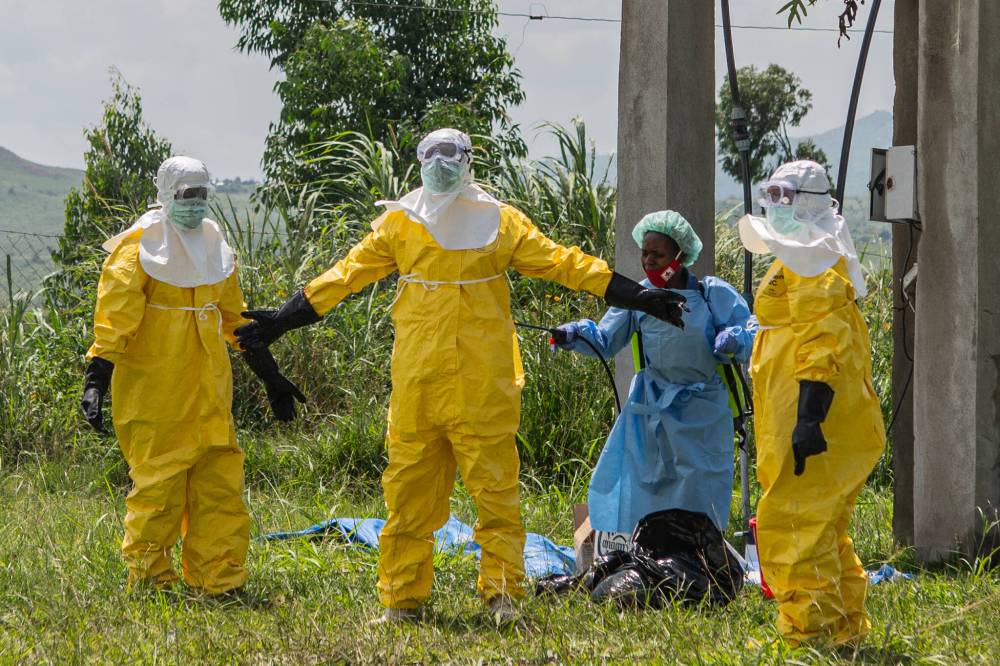
Moses Sawasawa / The Associated Press
Red Cross workers disinfect themselves after transporting the bodies of people who died of Ebola from a health centre in Rwampara, Congo, May 20.
Confirmed cases now eclipse 600 — the overwhelming majority in the DRC. The mortality rate is roughly one-in-five.
Humans typically first contract Ebola through consuming bushmeat or handling infected wildlife such as fruit bats in remote communities. Human-to-human transmission then occurs via contact with contaminated blood or other bodily fluids. Symptoms mimic the flu or malaria and can lead to severe bleeding and lethal organ failure.
The WHO has declared the current outbreak an international public health emergency. But there’s a problem. The world seems even less prepared now than it was in 2020 to deal with a contagious pathogen.
The Global Preparedness Monitoring Board — a watchdog group established following the 2014 Ebola outbreak — warned in a report last month that, faced with another pandemic, the world would find itself “more divided, more indebted and less able to protect its people than it was a decade ago, exposing all countries to potentially greater health, social and economic impacts.”
The politicization of government’s pandemic-era responses is one factor. Populist attacks on institutions and scientific expertise are, too. But perhaps the fastest growing threat is deep cuts to foreign aid.
The Trump administration’s exit from the WHO and gutting of the U.S. Agency for International Development last year erased critical support for numerous global disease surveillance programs. But Washington is not alone.
A recent study by the OECD found total foreign aid worldwide dropped by a whopping 23 per cent between 2024 and 2025. This includes a retreat in funding from major donor countries such as Germany, France, Japan and the U.K.
“It is the largest annual contraction on record and a second consecutive year of decline,” the OECD said.
The Carney government has followed suit. Its budget last November committed to shrinking Canada’s foreign aid contributions by $2.7 billion over the next four years. Explicitly targeted are reductions in development funding for global health programming.
The current crisis is also rendered more complex by where it’s taking place. More than 100 different armed groups reside in the vast, semi-lawless eastern provinces of the DRC. All of them are vying for a greater share of the region’s vast mineral wealth. They frequently clash with the national military, peacekeepers and each other.
Backed by thousands of troops, money and weapons from neighbouring Rwanda, the M23 insurgent outfit alone occupies an area the size of Greece. Its shadow government in the hub city of Goma profits from the looting and export of minerals into global supply chains. M23 fighters also dictate travel and charge tolls within territory under their control.
“Years of insecurity had already made it difficult for health workers to reach communities, transport samples, track disease outbreaks and maintain basic medical services,” Bloomberg reports. Meanwhile, local distrust of authorities also looms large.

In the 20th century, brutal colonial rule by Belgium gave way to military dictatorship under Mobuto Sese Seko. The three decades after Mobuto was ousted in 1997 have since been marked by mismanagement and neglect by corrupt political elites thousands of kilometres away in the capital, Kinshasa. Expensive and high-profile UN peacekeeping missions have chronically failed to protect communities as well.
All of this combines to create a situation where residents say they feel unsafe to report symptoms and assist health workers with contact tracing, accept isolation and alter traditional burial practices. The latter can involve multiple people washing the body of the deceased over several days. Misinformation is rife.
But there are reasons to be optimistic. The WHO has devised a six-month, US$518-million joint emergency response plan with the African Center for Disease Control. And African experts’ deep knowledge, experience and previous successes dealing with Ebola should not be discounted. The current outbreak is not destined to become an international catastrophe.
However, achieving that will require wealthy donor nations to volunteer greater money and resources — just as most of them are pulling away.
Kyle Volpi Hiebert is a Montreal-based political risk analyst focused on globalization, conflict and emerging technologies.