

210 years of resistance: the Métis at Seven Oaks
Advertisement
Read this article for free:
or
Already have an account? Log in here »
To continue reading, please subscribe:
Digital Subscription
One year of digital access for only $1.44 a week*
- Enjoy unlimited reading on winnipegfreepress.com
- Read the E-Edition, our digital replica newspaper
- Access News Break, our award-winning app
- Play interactive puzzles
*Billed as $5.77 plus GST every four weeks. After 52 weeks, price increases to the regular rate of $19.95 plus GST every four weeks. Offer available to new and qualified returning subscribers only. Cancel any time.
To continue reading, please subscribe:
Add Free Press access to your Brandon Sun subscription for only an additional
$1 for the first 4 weeks*
- Enjoy unlimited reading on winnipegfreepress.com
- Read the E-Edition, our digital replica newspaper
- Access News Break, our award-winning app
- Play interactive puzzles
*Your next Brandon Sun subscription payment will increase by $1.00 and you will be charged $17.95 plus GST for four weeks. After four weeks, your payment will increase to $24.95 plus GST every four weeks.
Read unlimited articles for free today:
or
Already have an account? Log in here »
Friday, June 19, marks 210 years since the historic Battle of Seven Oaks. This battle, which took place in present-day Winnipeg, was part of the Pemmican War, which saw several altercations between the Hudson’s Bay and North West companies as they fought for domination of the fur trade between 1812 and 1821.
A principal figure of the Battle of Seven Oaks was Cuthbert Grant Jr., the first leader of the Métis, who was born in 1793 at the North West Company’s Fort de la Rivière Tremblante, near my hometown of present-day Kamsack, Sask. He is also my ancestor, through my maternal family.
Grant, like his father before him, was a member of the North West Company. He was of mixed heritage, Scottish and Indigenous, and spent his childhood living at various NWC posts along the Assiniboine River and being educated in Montreal and Scotland. He was a born leader, with the qualities and experience that would serve him as he became a leader of the emerging Métis Nation.
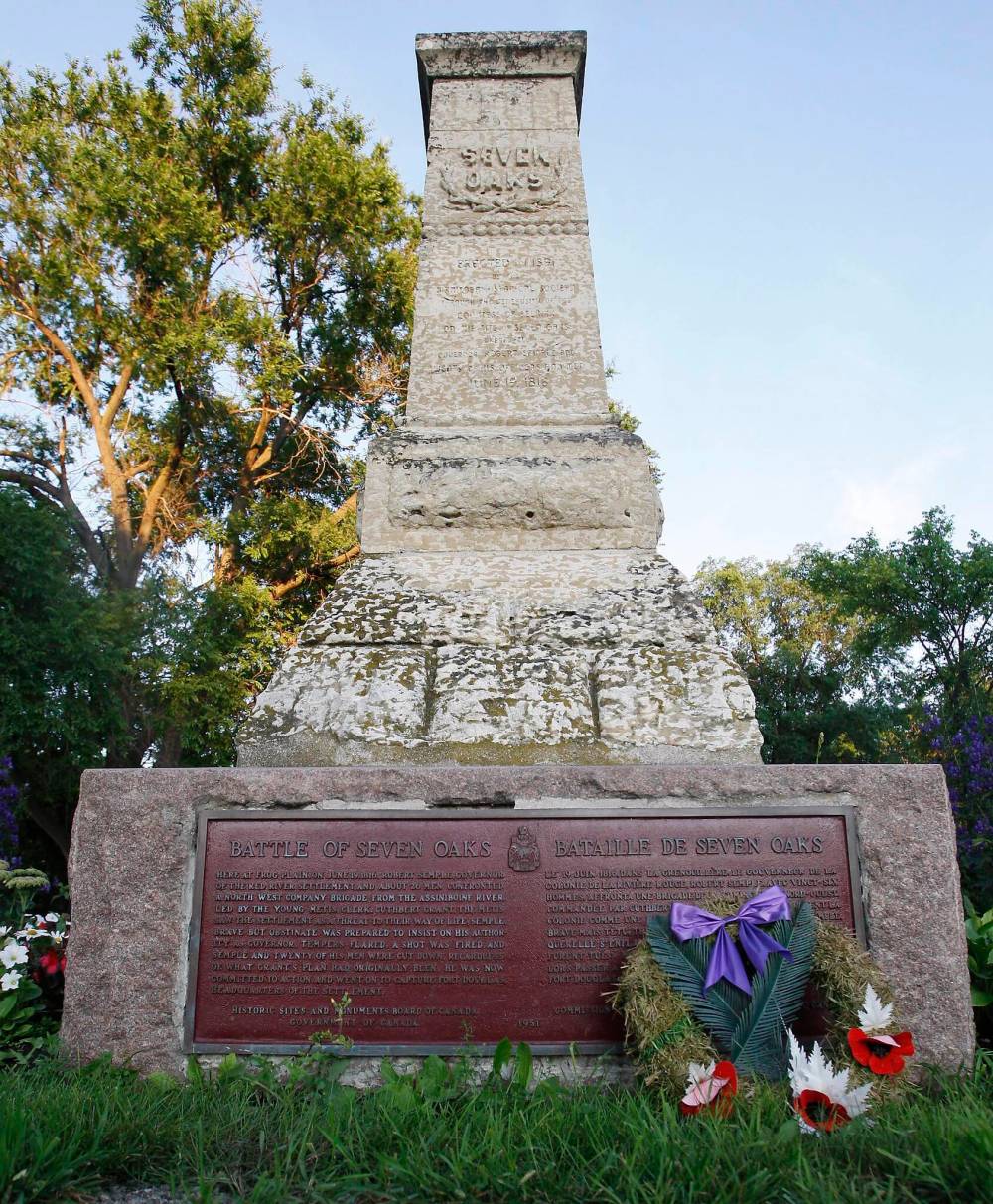
Free Press Files
The Seven Oaks monument, erected by the Manitoba Historical Society in 1891, is the oldest historic marker in Western Canada. It sits at the northeast corner of Main Street and Rupertsland Avenue.
The arrival of the Selkirk settlers in the Red River Valley (present-day Winnipeg) in 1812, as part of a 300,000 sq. km. land grant to Thomas Douglas, the fifth Earl of Selkirk, from the Hudson’s Bay Company, would mean the complete transformation of both the region and the way of life of both the First Nations and the Métis.
Land along the Red River was cleared for agriculture, there were scant resources and the Pemmican Proclamation of 1814, issued by Miles Macdonell, governor of the Red River colony, prohibited the export of pemmican from the colony for the next year. Both the Métis and the North West Company saw this as the Hudson’s Bay Company and the Selkirk settlers monopolizing the region’s primary resource, thus affecting the livelihoods and way of life of both groups. The Pemmican War had begun.
Farms, and forts were ransacked and settlers were harassed. On June 19, 1816, Grant and a combined party of Métis and First Nations freighters transporting pemmican to their NWC partners, were intercepted at Seven Oaks (on present-day Main Street in Winnipeg) by HBC governor Robert Semple (Macdonell’s successor) and 28 HBC employees. There was a verbal altercation between the two parties and one of Semple’s men fired the first shot.
The Métis and First Nations fighters came away victorious. Semple and 20 of his men were killed. This battle was coined a “massacre” and figures such as Grant would be charged for their participation, although a Royal Commission ultimately exonerated the Grant party. The Pemmican War ended in 1821, when the North West Company merged with the Hudson’s Bay Company.

The Battle of Seven Oaks is often seen as the first act of resistance of the Métis Nation. Grant as a historical figure exemplifies the complexity of the conflicts of the time, as he had to navigate both his leadership of the Métis and his loyalty to the North West Company. He deserves to be in the same discussion as Louis Riel and Gabriel Dumont.
In 1891, a cenotaph was erected by the Manitoba Historical Society near the site of the battle — at the corner of Main Street and Rupertsland Avenue — and it became a national historic site in 1920.
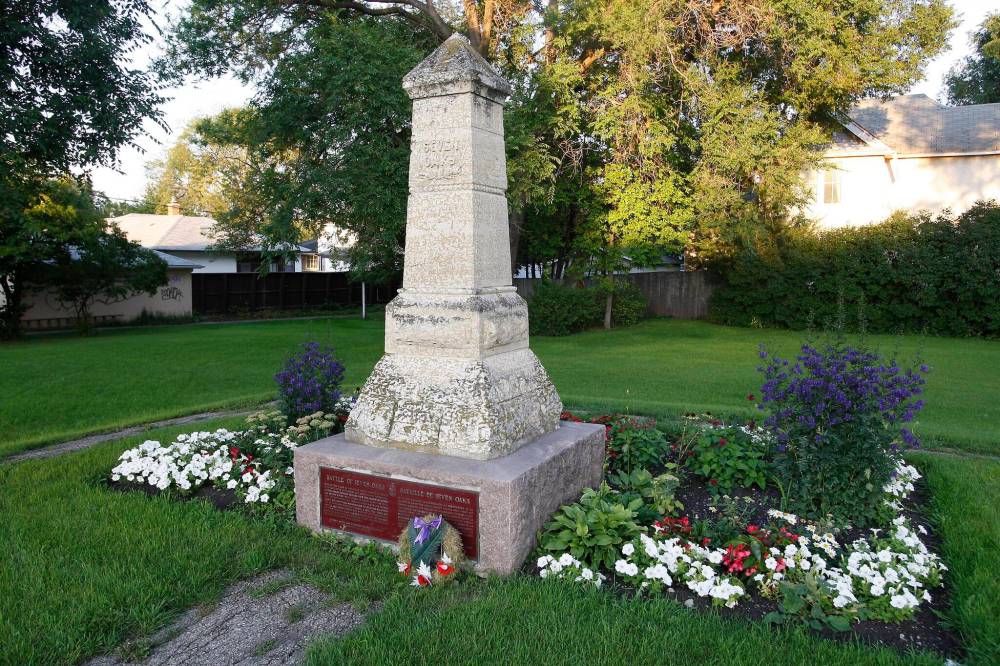
Free Press Files
The Seven Oaks monument, erected by the Manitoba Historical Society in 1891, is the oldest historic marker in Western Canada. It sits at the northeast corner of Main Street and Rupertsland Avenue.
Free Press Files
The Seven Oaks monument, erected by the Manitoba Historical Society in 1891, is the oldest historic marker in Western Canada. It sits at the northeast corner of Main Street and Rupertsland Avenue.
In 2025, I was able to take a research trip to the site and, as both a historian and member of the Métis Nation, it was fascinating.
Now, 210 years later, the Battle of Seven Oaks illustrates the richness of prairie history. Grant was born in a fort that rests in a farmer’s field near my hometown, almost unknown. The site of the battle which led to the merger of the NWC and HBC lies now at the intersection of a Winnipeg thoroughfare and a quiet residential street.
Mason Hausermann is a Regina-based historian, researcher and educator with a focus on the political and military history of Canada and Turtle Island, spanning from the mid-Victorian era to the early 20th century.