

‘Chequebook federalism’ is no solution

Advertisement
Read this article for free:
or
Already have an account? Log in here »
To continue reading, please subscribe:
Digital Subscription
One year of digital access for only $1.44 a week*
- Enjoy unlimited reading on winnipegfreepress.com
- Read the E-Edition, our digital replica newspaper
- Access News Break, our award-winning app
- Play interactive puzzles
*Billed as $5.77 plus GST every four weeks. After 52 weeks, price increases to the regular rate of $19.95 plus GST every four weeks. Offer available to new and qualified returning subscribers only. Cancel any time.
To continue reading, please subscribe:
Add Free Press access to your Brandon Sun subscription for only an additional
$1 for the first 4 weeks*
- Enjoy unlimited reading on winnipegfreepress.com
- Read the E-Edition, our digital replica newspaper
- Access News Break, our award-winning app
- Play interactive puzzles
*Your next Brandon Sun subscription payment will increase by $1.00 and you will be charged $17.95 plus GST for four weeks. After four weeks, your payment will increase to $24.95 plus GST every four weeks.
Read unlimited articles for free today:
or
Already have an account? Log in here »
It’s pretty rich that the richest province in Canada wants out. Or is it?
In politics, like life, emotion often trumps fact. It fuels grievance. It creates myths that morph into “common knowledge.” Once embedded, it is strikingly difficult to change.
This is where we have arrived with Alberta’s separation movement and the October referendum on whether to “remain in Canada” or “commence the legal process … to hold a binding provincial referendum on whether or not Alberta should separate from Canada.”
The Canadian Press files
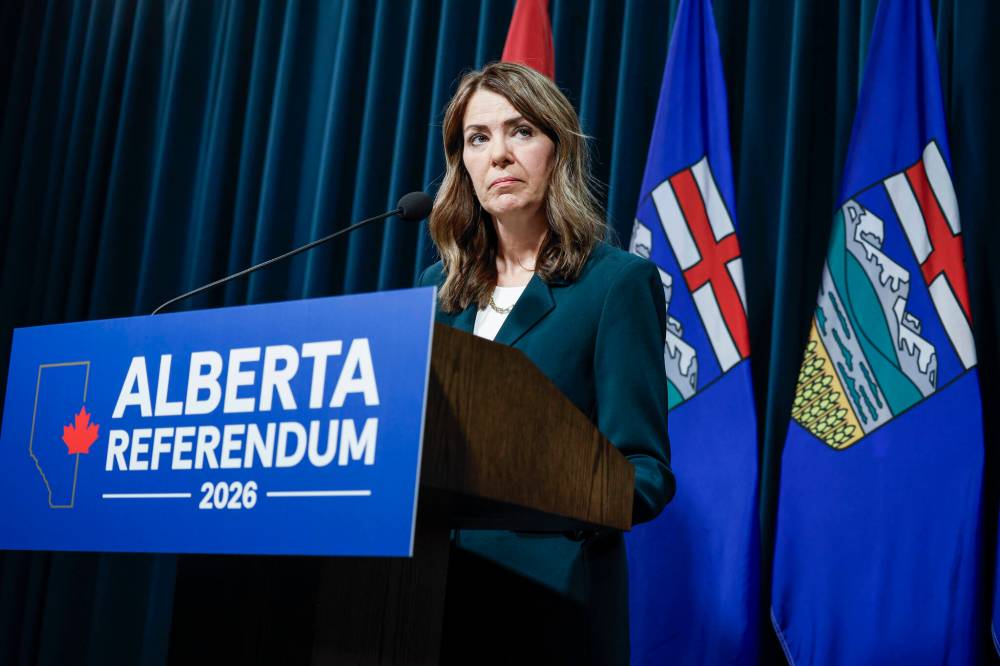
Alberta Premier Danielle Smith speaks last month at a press conference on the province’s October referendum.
By every financial metric, Albertans are the most well-off Canadians. So much so that for years the province marketed the “Alberta Advantage.” That is the factual argument. However, the separatist movement believes the province would have been even better off, but Canada wouldn’t let them. Alberta must therefore separate. That is the emotional argument.
Separating the two (pun intended) is not obvious because there is truth to both arguments. Let’s begin with the factual part: Being in Canada has enabled Alberta to prosper.
The before-tax average annual salary in Alberta was almost $136,000 in 2023, compared to a national average of about $110,000 — a difference of more than $25,000 per year. In 2024, the last full year of the Trudeau Liberal government, the after-tax, take-home pay of a typical Albertan household was $85,300, nearly $10,000 more than the national average. Fact.
More “one per centres” — the top income earners — live in Alberta than anywhere else; the province contains more than 15 per cent of Canada’s total “one per cent” population. Fact.
It’s not just the uber-rich who reside in Alberta. Household incomes overall are higher and more concentrated in Alberta than the rest of Canada. Nineteen per cent of all Alberta households have after-tax incomes ranging from $125,000 to $200,000 compared to 15 per cent in the rest of the country. Fact.
This is first and foremost due to the lowest set of tax rates across Canada. Famously, of course, Alberta has no sales tax. But its personal income taxes are the lowest, too. You can earn up to $61,000 before paying any provincial tax, a higher level than anywhere else in the country — about $8,000 more than in Ontario, $10,000 more than in B.C., and $13,000 more than in Manitoba. Fact.
Looking at it another way, if Albertans paid the equivalent of all of Manitoba taxes and rates, they would pay almost $29 billion more each year in provincial taxes, $31 billion more at Quebec levels, and $17 billion more at next-door British Columbia’s levels. Fact.
Alberta made these tax choices based on its current constitutional and fiscal status as a province within Canada. Right now, that same status enables Albertans to enjoy lower taxes and higher incomes compared to Canadians living in other provinces. Fact.
Far from holding Alberta back financially, its long-term financial situation is better than any other province. Its net-debt-to-GDP ratio is the lowest in the country at just 12.9 per cent. By contrast, Manitoba’s exceeds 38 per cent. Fact.
Alberta separatists complain that they disproportionately subsidize equalization payments to other provinces. Higher incomes and the best fiscal capacity in the country will do that. But federal transfers to Alberta are also quite high. This fiscal year, it will receive $9.2 billion in support from Ottawa, a 56 per cent increase in 10 years. That compares to a 34 per cent increase in transfers to Quebec. Alberta’s population has been growing, and it is receiving more federal dollars to compensate. Fact.
While Alberta does not qualify for equalization payments because of its above-average fiscal capacity, it has received a mirror-opposite sort of payment called a fiscal stabilization payment. This one-off federal program provides assistance to provinces facing “significant year-over-year declines in their revenues resulting from extraordinary economic downturns.” Alberta received two such payments in the past 10 years, amounting to over $800 million, owing to precipitous oil price declines. Fact.
In the end, where does “chequebook federalism” take us? Not very far. A country is far more than a balance sheet. But Alberta separatists have made this their star argument.
Declaring Canada “unfair” in its treatment, never acknowledging that the same unfairness is allowing Alberta to prosper more than any other province. The question never answered is: “If Canada is so bad, why is Alberta doing so well?”
Exceeding the national average in prosperity shows Canada is working for Alberta. But the emotional argument separatists then make is that it would be even more prosperous, except Canada has held it back. Empirically, there is truth to this that Ottawa must acknowledge.

Federal policy choices over the past 10 years did hinder energy development in the province. Equalization payments are the result of a unilateral federal formula. Adjustments to both situations would benefit Alberta; factually, in the first instance, emotionally in the second.
Ultimately, the real solution for Alberta is not independence through unilateralism but prosperity through federalism. The Canada/Alberta memorandum of understanding on energy is a prime example of the latter at work.
More hard work along those lines is the best solution for Alberta succeeding even more in the federation.
Separation? That’s just cheap chequebook talk, which comes with a very rich price.
David McLaughlin is a former clerk of the executive council and cabinet secretary in the Manitoba government.
Our newsroom depends on a growing audience of readers to power our journalism. If you are not a paid reader, please consider becoming a subscriber.
Our newsroom depends on its audience of readers to power our journalism. Thank you for your support.
Our newsroom depends on a growing audience of readers to power our journalism. If you are not a paid reader, please consider becoming a subscriber.
Our newsroom depends on its audience of readers to power our journalism. Thank you for your support.
Advertisement Advertise With Us
Advertisement Advertise With Us