

250 years ago: Thomas Jefferson and the American Declaration of Independence
Advertisement
Read this article for free:
or
Already have an account? Log in here »
To continue reading, please subscribe:

Digital Subscription
One year of digital access for only $205*
- Enjoy unlimited reading on winnipegfreepress.com
- Read the E-Edition, our digital replica newspaper
- Access News Break, our award-winning app
- Play interactive puzzles
*First annual payment billed as $205.00 + GST for one year. This annual subscription will automatically renew at $233.00 + GST every 52 weeks (10% off the regular annual price of $259.35). Offer available to new and qualified returning subscribers only. Cancel any time.
To continue reading, please subscribe:
Add Free Press access to your Brandon Sun subscription for only an additional
$1 for the first 4 weeks*
- Enjoy unlimited reading on winnipegfreepress.com
- Read the E-Edition, our digital replica newspaper
- Access News Break, our award-winning app
- Play interactive puzzles
*Your next Brandon Sun subscription payment will increase by $1.00 and you will be charged $17.95 plus GST for four weeks. After four weeks, your payment will increase to $24.95 plus GST every four weeks.
Read unlimited articles for free today:
or
Already have an account? Log in here »
In the 16th and 17th centuries, countries and territories such as the Netherlands and Portugal boldly declared their independence from Spain. But 250 years ago, on July 4, 1776, the American Declaration of Independence — marked in the U.S. by the semiquincentennial celebrations — was the first time an overseas colony (the 13 colonies, in this case) had set out in an official document its reasons for breaking away from its mother country.
Because the Declaration ultimately gave birth to the United States, it is considered one of the greatest of historical treatises. Thomas Jefferson, its primary author, later explained that his main aim was “not to find out new principles, or new arguments, never before thought of … but to place before mankind the common sense of the subject; in terms so plain and firm as to command their assent.”
He did so brilliantly, creating, in theory at least, an enlightened argument for American independence based on the political, economic, social and philosophical thinking of the era.
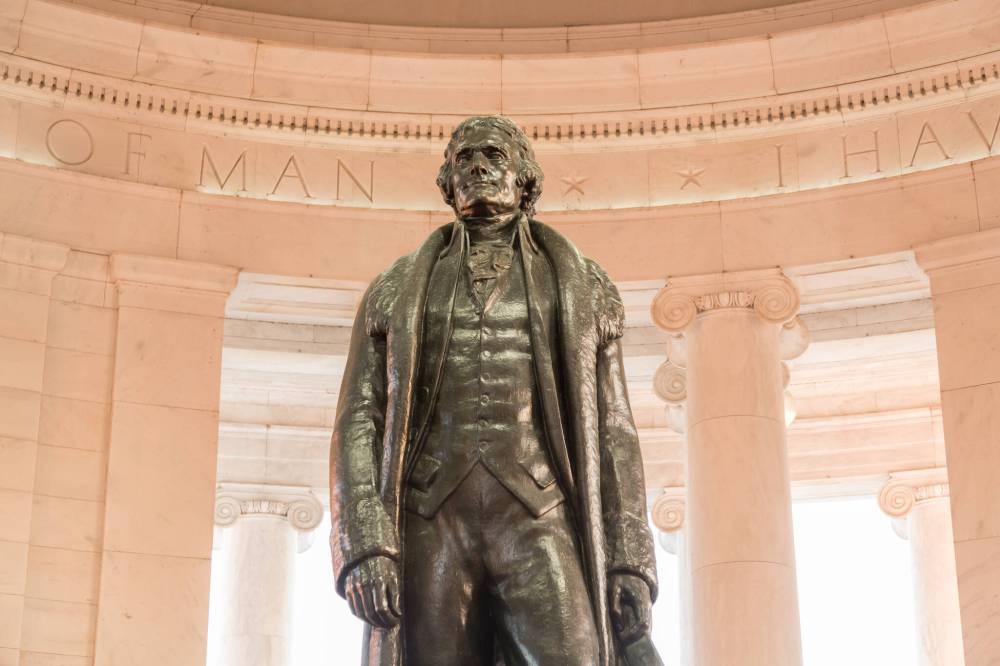
AdobeStock
A bronze statue of Thomas Jefferson stands inside the Jefferson Memorial in Washington, D.C.
Influenced by such philosophers as John Locke and Montesquieu, Jefferson, then 33 years old, a lawyer, landowner, Virginia politician and a delegate to the Second Continental Congress which met in Philadelphia, passionately believed in natural law — that all human beings were born free and equal and that no king or ruler could abolish these rights. It was a key point he made in the Declaration’s well-known preamble.
“We hold these truths to be self-evident, that all men are created equal, that they are endowed by their Creator with certain unalienable Rights, that among these are Life, Liberty and the pursuit of Happiness.”
The great contradiction (and hypocrisy), of course, was that in 1776, slavery of Black Africans was institutionalized in the economic life of the 13 colonies. Indeed, Jefferson, who was elected the country’s third president, serving from 1801 to 1809, was a slave owner.
Jefferson owned more than 600 slaves, about 200 at a time between 1774 and his death in 1826. (In a twist of history, Jefferson and his slightly older rival, John Adams, the second U.S. president, both died on July 4, 1826, the 50th anniversary of the Declaration of Independence.)
Moreover, in the years after his wife, Martha, died at the age of 34, Jefferson had several children with an enslaved Black woman, Sally Hemings, who was 30 years younger than him. He had “inherited” her from his father-in-law, John Wayles, who was Sally’s biological father, and hence his wife’s half-sister.
Deep in his soul, Jefferson understood that slavery was an abomination, referring to it as a “moral depravity” and a “hideous blot.” He included in his first draft of the Declaration a long paragraph denouncing King George III for allowing it by waging “cruel war against human nature itself” and “violating its most sacred rights of life and liberty.” However, delegates from the southern colonies refused to accept any mention of slavery and the clause was deleted from the Declaration’s final version.
Still, Jefferson, a product of his time, allowed self-interest (for much of his adult life, he was land-rich and cash poor), political complexities and his need for support from wealthy slaveowners to cloud his judgment.
“He knew slavery was a moral wrong and believed it would be ultimately abolished,” writes his biographer Jon Meacham. “He could not, however, bring himself to work for emancipation. As a politician he understood that sectional tensions represented the great threat to the union.”
That assessment proved true. Slavery did tear the union apart in the Civil War, 84 years after the Declaration of Independence was formally adopted. For decades, free Blacks in the North refused to celebrate July 4, a day Frederick Douglass, a former slave and abolitionist, said reminded them of the “gross injustice and cruelty” they were subjected to.
Black Americans, especially in the South, continued to be victimized long after the Civil War ended in 1865, with Jim Crow laws and lynchings. Slavery may have been abolished, but true equality and justice eluded them for more than a century.
The Voting Rights Act of 1965, which effectively prohibited discriminatory voting practices in the southern states, was a progressive step forward into making Jefferson’s “all men are created equal” a reality — almost.
In truth, Jefferson’s elegant phrases remain hollow. Despite Black advancement in nearly every aspect of U.S. society, issues of race and racism continue to be a harsh fact of American life.

In a recent U.S. Supreme Court ruling that gutted the Voting Rights Act, conservative Justice Samuel Alito Jr., writing for the majority opinion, argued the contrary. He insisted that “vast social change has occurred throughout the country and particularly in the South.”
From his perspective, Black Americans no longer need any special considerations in voting protections because the issues involved are supposedly about partisanship, not race. His argument was an example of judicial wilful blindness.
The predictable outcome: several southern states controlled by Republicans have redrawn their voting districts in a way that will negatively impact Black voters, most of whom are Democratic Party supporters.
It is a lousy way to mark the Declaration of Independence’s 250th anniversary.
Now & Then is a column in which historian Allan Levine puts the events of today in a historical context. His most recent book is The Dollar-A-Year Men: How the Best Business Brains in Canada Helped to Win the Second World War.
Related Articles
Trump mixes patriotism with partisanship as he celebrates America's 'joyous' 250th anniversary
Advertisement Advertise With Us
Advertisement Advertise With Us