

Manitoba Tories can learn from Poilievre’s mistake
Advertisement
Read this article for free:
or
Already have an account? Log in here »
To continue reading, please subscribe:
Digital Subscription
One year of digital access for only $1.44 a week*
- Enjoy unlimited reading on winnipegfreepress.com
- Read the E-Edition, our digital replica newspaper
- Access News Break, our award-winning app
- Play interactive puzzles
*Billed as $5.77 plus GST every four weeks. After 52 weeks, price increases to the regular rate of $19.95 plus GST every four weeks. Offer available to new and qualified returning subscribers only. Cancel any time.
To continue reading, please subscribe:
Add Free Press access to your Brandon Sun subscription for only an additional
$1 for the first 4 weeks*
- Enjoy unlimited reading on winnipegfreepress.com
- Read the E-Edition, our digital replica newspaper
- Access News Break, our award-winning app
- Play interactive puzzles
*Your next Brandon Sun subscription payment will increase by $1.00 and you will be charged $17.95 plus GST for four weeks. After four weeks, your payment will increase to $24.95 plus GST every four weeks.
Read unlimited articles for free today:
or
Already have an account? Log in here »
Among the many errors made by Pierre Poilievre since becoming leader of the Conservative Party of Canada, his decision to attempt to persuade supporters of Max Bernier’s People’s Party and other right-wing groups to return to the Tory party — as opposed to adopting policies that would make the CPC more attractive to moderate Canadians — may be his greatest mistake.
By pandering to that small group of voters, Poilievre alienated a much larger group of centrist voters who would have otherwise considered voting for Conservative Party candidates in the 2025 federal election. Instead, those voters found the pro-Canadian, fiscally and socially moderate platform offered by Mark Carney’s Liberals to be more attractive, resulting in the humiliating defeat of the Conservatives.
The situation for the federal Tories has worsened since then, with the Liberals continuing to hold a large lead in public opinion polls and Carney leading Poilievre by almost 30 points on the “preferred prime minister” question. Those same polls also reveal that many Conservative voters approve of the Liberal government’s performance and prefer Carney over Poilievre as PM.
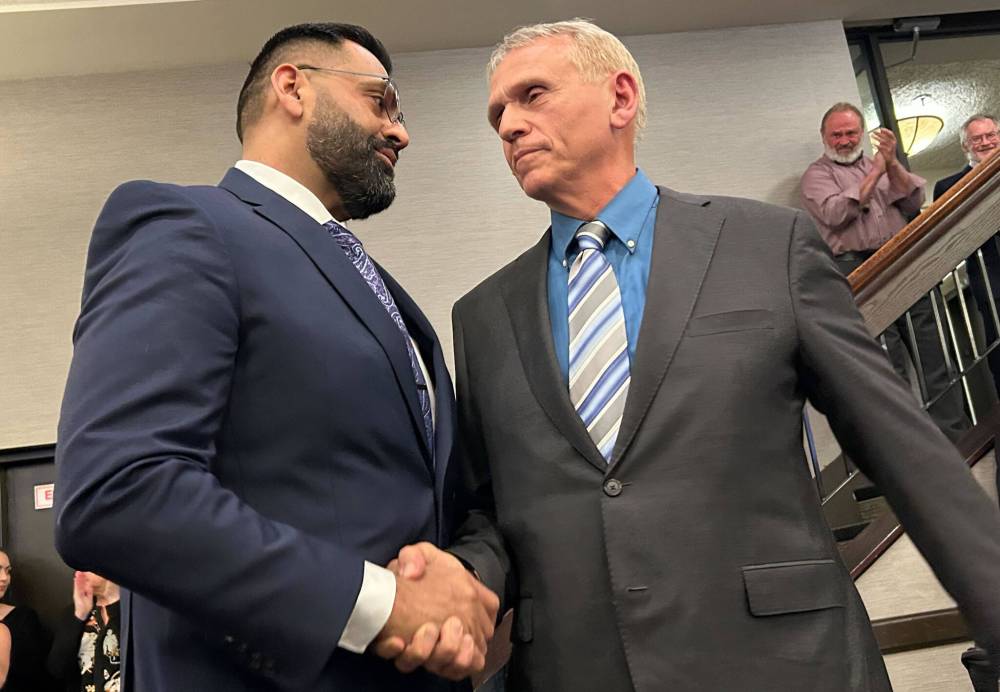
Free Press files
Wally Daudrich (right) shakes hands with Obby Khan after losing the leadership of the Progressive Conservative Party of Manitoba in April 2025. Daudrich will run for the Keystone Party in the July 21 byelection in The Pas-Kameesak.
Despite all of those numbers — and all the evidence that pushing policies designed to attract the right-wing fringe of the political spectrum is making it all but impossible for the CPC to have any realistic hope of winning the next election — Poilievre continues to rely on the same caustic rhetoric that cost his party the 2025 election. If anything, he has turned up the volume lately, with his efforts increasingly resembling a political suicide mission.
Manitoba’s Progressive Conservatives can learn from those mistakes. Their party is almost equally divided between socially-moderate members who mostly reside in urban areas and socially-conservative members who live primarily in rural southern Manitoba. Social conservative Wally Daudrich received the majority of votes in the party’s leadership contest last year, but the more moderate Obby Khan won the party’s leadership under a formula that weighted votes by constituency.
Months after that defeat, Daudrich announced he would seek the PC Party’s nomination for the next election in the Turtle Mountain riding, long considered one of the safest Tory-held seats in the province. He was disqualified from that contest by the party, however, allegedly due to statements he had previously made. In response, he has left the party and is now running as the Keystone Party’s candidate in The Pas-Kameesak byelection, which is set for July 21.
Daudrich complains that “the PC party has completely abandoned me and all conservatives like me.” He says that Khan’s team has “created a new liberal party and I guess I am now politically homeless.” He argues that Manitoba needs “a new conservative movement because the PC party has abrogated that responsibility.”
His sizable support among PC Party members, combined with his comments regarding the ideological direction of the party, could be viewed as a crisis that could split the non-NDP vote in ridings across the province, which would virtually guarantee a huge defeat for the Tories in next year’s provincial election.

Alternately, Manitoba Tories can regard Daudrich’s comments as an echo of Bernier’s complaints when the latter launched the People’s Party and an opportunity to avoid the mistakes Poilievre has made. They could view the current situation as a chance to shed the angry extremists in their party, whose intolerant ideas cost them the 2023 election, and re-emerge as a more moderate party with policies that appeal to a larger cross-section of Manitobans.
They can follow the narrow ideological path favoured by Daudrich, which will lead to many more years of NDP government or they can adopt an approach that results in a party — a movement — all Manitobans would feel comfortable being part of. Such a policy shift, if executed properly, could give the Tories a far better chance of winning future elections.
If you want to be successful in politics, you must offer policies that appeal to a large enough group of voters to give you a realistic chance of winning elections. Manitoba’s Tories broke that rule in the 2023 election and are paying the price on the opposition benches. If they have learned anything from that experience, and Poilievre’s loss last year, they won’t repeat that mistake in next year’s election.
Deveryn Ross is a political commentator living in Brandon.
Email: deverynrossletters@gmail.com | X: @deverynross
Related Articles
Khan cites infighting, quits as Tory leader

Advertisement Advertise With Us
Advertisement Advertise With Us