

Looking with Ted Barker

Advertisement
Read this article for free:
or
Already have an account? Log in here »
To continue reading, please subscribe:

Digital Subscription
One year of digital access for only $205*
- Enjoy unlimited reading on winnipegfreepress.com
- Read the E-Edition, our digital replica newspaper
- Access News Break, our award-winning app
- Play interactive puzzles
*First annual payment billed as $205.00 + GST for one year. This annual subscription will automatically renew at $233.00 + GST every 52 weeks (10% off the regular annual price of $259.35). Offer available to new and qualified returning subscribers only. Cancel any time.
To continue reading, please subscribe:
Add Free Press access to your Brandon Sun subscription for only an additional
$1 for the first 4 weeks*
- Enjoy unlimited reading on winnipegfreepress.com
- Read the E-Edition, our digital replica newspaper
- Access News Break, our award-winning app
- Play interactive puzzles
*Your next Brandon Sun subscription payment will increase by $1.00 and you will be charged $17.95 plus GST for four weeks. After four weeks, your payment will increase to $24.95 plus GST every four weeks.
Read unlimited articles for free today:
or
Already have an account? Log in here »
I had planned to attend the opening of Ted Barker’s exhibition at 226 Gallery last Friday evening, but another commitment intervened. By the time I arrived the following afternoon, three of the works I most wanted to see had already sold. Disappointing for me, encouraging for the exhibition.
As it turned out, missing the opening may have been the better outcome.
With the Friday evening crowds gone, Barker was sitting near the entrance. He offered to walk through the exhibition with me, and we moved slowly from one work to the next, talking about images, drawing, memory, and the many decisions that shape a finished work. It was an unexpected privilege. We often encounter paintings long after the artist has left the room. This time, the conversation became part of the experience.
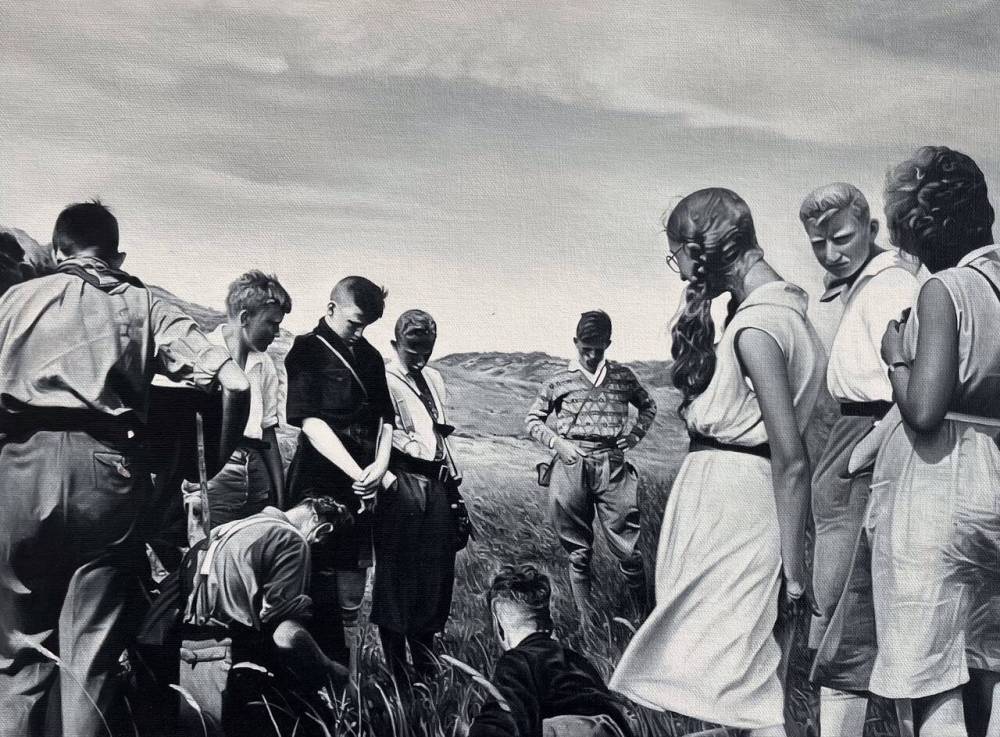
Ted Barker photo
Ted Barker’s Kinderen (2023), oil on canvas.
It reminded me of one of Winnipeg’s understated cultural strengths. Here, the distance between artist and audience can be remarkably short. You can spend an afternoon in a commercial gallery discussing paintings with the person who created them. Encounters like this are rarely orchestrated. They simply happen, and they are part of what makes the city’s arts community distinctive. Galleries such as 226 Gallery are helping reduce the long queue of artists who deserve solo exhibitions — and doing so in a smart and elegant way.
A graduate of the University of Manitoba School of Art, Barker has exhibited across Canada and internationally. Working primarily in oil, graphite, and conté crayon, he often begins with photographs — family albums, anonymous snapshots, images discovered online or found among discarded vintage prints — but the photograph is never the destination. It is simply where the work begins.
One idea surfaced repeatedly during our conversation: editing.
Barker spoke less about technique than about choices. Every painting evolves through decisions about what to retain, what to remove, how tightly to crop an image, how light alters the emotional register of a scene, and how drawing itself becomes a way of understanding a composition before paint is ever applied. I was struck by how rarely he talked about virtuosity. Instead, he described painting as a gradual process of discovering what really matters within an image.
That distinction explains why Barker’s work occupies more interesting territory than conventional photorealism. Technical precision is immediately apparent, but precision is not really the point. The camera records appearances in an instant. Barker spends days or weeks reconsidering them. The photograph functions less as something to reproduce than something to question. Through careful editing and sustained observation, familiar images become something more reflective. As Barker himself puts it, photorealism is an act of respect as well as interpretation.
One work in particular, Kinderen (2023), stayed with me long after I left the gallery. Based on a family photograph from the Netherlands dating back to the 1930s, the modestly scaled painting depicts a group of youth gathered around something just beyond the edge of the composition. We never discover what has captured their attention.
Barker leaves the question unanswered. It is a remarkably confident decision.
Many painters would have resolved the mystery or offered more clues. Barker does neither. Instead, the painting directs our attention to the people themselves — the subtle shifts in posture, the relationships between the figures, and the quiet intensity of their shared concentration. Before long, we realize that we have begun looking at them as carefully as they are looking at whatever lies beyond the frame.
What impressed me was Barker’s willingness to leave ambiguity intact. Contemporary visual culture has become remarkably impatient. Images arrive already explained, captioned, categorized, and quickly replaced by the next. Kinderen asks for something different. It doesn’t announce its meaning or reward a quick glance. Like much of Barker’s work, it unfolds gradually, expecting only that we spend a little time with it.
Looking across the exhibition, I found myself thinking first of Tim Gardner and then of Karel Funk, two artists whose work I have studied in preparation for solo exhibitions and publications. The comparison is neither stylistic nor intended to suggest a direct influence. Their paintings occupy different territory.
But what they share is an understanding that realism is never simply about description. Gardner begins with photographs drawn from his own life. Barker often works from family albums or random images whose original stories have largely disappeared. Funk pares away almost everything except the human figure or form. Distinct approaches, but all three understand that painting begins where photography leaves off. Observation becomes interpretation rather than replication.

Barker’s exhibition also prompted me to think about the enduring influence of the University of Manitoba School of Art. In fact, all three artists studied at the school, which for generations has produced artists who have shaped Canadian painting while continuing to build careers in Winnipeg. That legacy rarely announces itself. Instead, it has developed through decades of disciplined studio practice, thoughtful teaching, and artists committed to making ambitious work while maintaining strong ties to the city. Barker fits comfortably within that tradition while continuing to refine a voice that is unmistakably his own.
By the time our conversation ended, I had spent nearly an hour in the gallery. I looked carefully at the three paintings I had originally come to see, now sold. Oddly enough, I stopped regretting that fairly quickly.
The unexpected reward of the afternoon turned out not to be a particular work but the chance to spend time with the artist behind them. Paintings often arrive in galleries as finished objects, detached from the months of decisions, revisions, and second thoughts that brought them into being. Walking through the space with Barker quietly restored that missing dimension. He acknowledged that exhibitions offer artists something they rarely experience in the studio: the opportunity to see months — or years — of work assembled in one place. It reinforced something I have long appreciated about Winnipeg’s arts community. Artists, galleries, and audiences continue to occupy many of the same spaces. The conversation is rarely far from the work.
I left 226 Gallery thinking less about the individual works than about how they came to be, as Barker had revealed that afternoon. By the time I got home, I wanted to write something — not a review of the show (I’ll leave that to someone else) but a record of the encounter. Barker later sent me images of several of the works we had discussed. Looking at them again, they brought that afternoon back to mind. The exhibition is called small work. The ideas it set in motion felt considerably larger.
Stephen Borys is president and CEO of Civic Muse, an arts and cultural consulting practice based in Winnipeg.
Our newsroom depends on a growing audience of readers to power our journalism. If you are not a paid reader, please consider becoming a subscriber.
Our newsroom depends on its audience of readers to power our journalism. Thank you for your support.
Our newsroom depends on a growing audience of readers to power our journalism. If you are not a paid reader, please consider becoming a subscriber.
Our newsroom depends on its audience of readers to power our journalism. Thank you for your support.
Advertisement Advertise With Us
Advertisement Advertise With Us