

Making deals with ‘the Donald’

Advertisement
Read this article for free:
or
Already have an account? Log in here »
To continue reading, please subscribe:

Digital Subscription
One year of digital access for only $205*
- Enjoy unlimited reading on winnipegfreepress.com
- Read the E-Edition, our digital replica newspaper
- Access News Break, our award-winning app
- Play interactive puzzles
*First annual payment billed as $205.00 + GST for one year. This annual subscription will automatically renew at $233.00 + GST every 52 weeks (10% off the regular annual price of $259.35). Offer available to new and qualified returning subscribers only. Cancel any time.
To continue reading, please subscribe:
Add Free Press access to your Brandon Sun subscription for only an additional
$1 for the first 4 weeks*
- Enjoy unlimited reading on winnipegfreepress.com
- Read the E-Edition, our digital replica newspaper
- Access News Break, our award-winning app
- Play interactive puzzles
*Your next Brandon Sun subscription payment will increase by $1.00 and you will be charged $17.95 plus GST for four weeks. After four weeks, your payment will increase to $24.95 plus GST every four weeks.
Read unlimited articles for free today:
or
Already have an account? Log in here »
The old Canada-United States relationship has entered its terminal lucidity phase. That sudden burst of cognitive clarity accompanying the Gordie Howe International Bridge shakedown reveals once and for all that there is no going back to what was before.
Canadians critical of the prime minister doing any form of “Donald Deal” will think this is a bridge too far. But the “dying of the light” illuminates a harder question: what choice did Carney have?
It stings now but it won’t hurt for long. Digging in our performative heels in protest would have amounted to a diplomatic blockade of trade by Canada. Matching Mafiosi tactics with the U.S. would have just kept the bridge closed longer when its economic benefits are needed and obvious. We built it for a reason, after all.
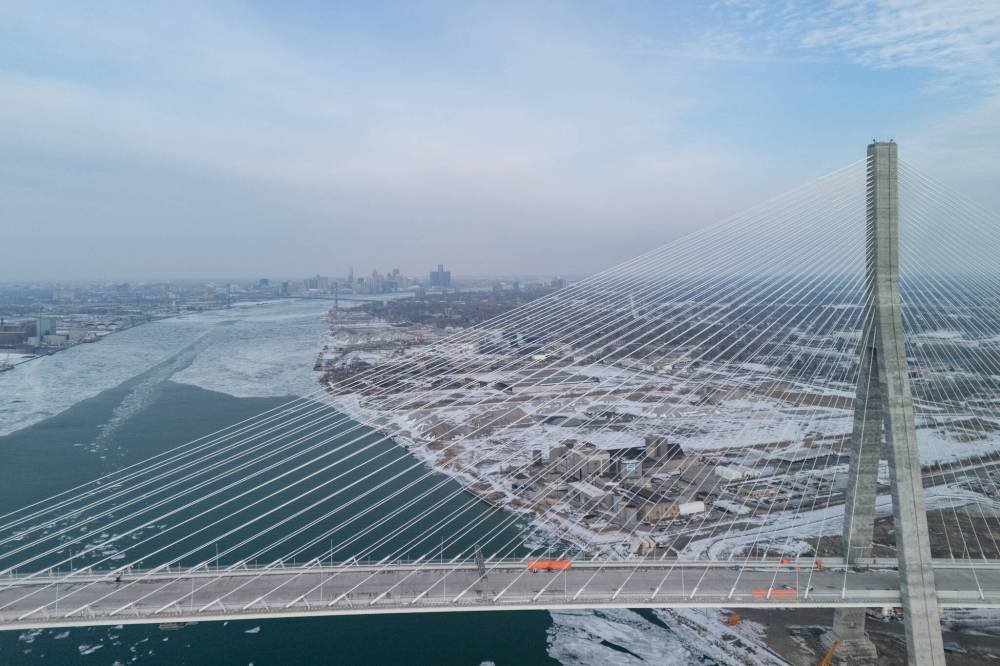
The Canadian Press files
Construction of the Gordie Howe International Bridge is shown in Windsor, Ont. in February.
Does that mean any sort of deal was acceptable? No. Is this one? Yes, but.
“But” because we don’t really know what Canada gave up to keep what we already paid $6.4 billion to get. Details are scarcer than a list of truths ever told by Donald Trump. Neither side has given the full story on the new bridge deal, perhaps because it isn’t fully settled. Or perhaps because, as in any negotiation, both gave up something to get something, and neither wants to spell that out.
On the public record is this: in exchange for allowing the bridge to open on July 27, the U.S. will now receive 50 per cent of the net toll revenue for a period of 15 years, placed into an economic development fund controlled and spent by Americans. Where Canada would have received 100 per cent of that revenue under the original deal, it now has to share some of it for some time.
There’s also this interesting wrinkle: toll rate changes that affect future revenue for Canada will now have to be worked out with the U.S. first, not decided by the Windsor-Detroit Bridge Authority, the Crown corporation that manages the international crossing. This is all because of local Michigan politics and the influence of two “Ambassador Bridges.”
The current, competing Ambassador Bridge crossing is owned and operated by a rich, well-connected, donating Republican family by the name of Maroun. Then there’s America’s ambassador to Canada, former leader of the Michigan Republican Party Pete Hoekstra, who ran interference for Republican and U.S. interests in Michigan to get this new bridge deal. Regulating future toll rates on the Gordie Howe Bridge will help mitigate any future revenue declines on the Maroun-owned Ambassador Bridge. And maybe help Republican fortunes in the important swing state of Michigan in November’s mid-term elections.
If these provisions had been part of the original Canada-Michigan bridge deal in 2012, few, if any Canadians would have batted an eye. Now, it sticks in Canada’s craw. It shouldn’t. Swallow hard and let the medicine digest. It is the transactional way of dealing with the Donald.
In doing so, it reveals patterns in both Canada and America’s negotiating patterns. Prime Minister Carney can and will do deals with Trump’s White House. What he won’t do is proactively tell Canadians much about the how and what of those deals. How they’re being done and what’s in them. Trump’s mercurial, capricious behaviour may be a reason for doing so. Carney doesn’t want to unduly risk another blowout from the blowhard.
Canadians get that. What they don’t get is being asked to stay in the dark on the most important political and economic relationship we have. By overcompensating on risk with Trump, Carney is undercompensating risk with Canadian voters. Without details, without explaining the trade-offs, voters will fill in the blanks themselves.
Negotiating in secret is one thing; keeping deals secret is quite another.

It is why the PM had to perform some fast cleanup on his own deal when Trump announced it first. Carney hastened to explain that bridge toll revenue sharing would be much smaller than you thought, as it would only cover net profits. That is, money left over after Canada receives payments on other costs it already incurred.
“We are sharing after Canada is paid back,” the PM said. “So, we get the revenues, then the servicing of the cost of the bridge and paying the debt of the bridge.”
That’s surely a better arrangement than first reported. Trouble is, the cleanup isn’t yet done. Details on the deal are as murky as Trump’s algae-infected reflecting pool. The sooner and clearer the PM makes those details public as part of the deal’s written text, the better. For us and for him. He needs to consider this first actual negotiated settlement with the U.S. since he became prime minister as a template for how he levels with Canadians to keep their support for the longer haul ahead.
Long-haul truckers crossing the new bridge in droves will be a welcome balm to our ongoing trading relationship with America. But for any Canadian who thinks the old Canada-U.S. relationship is coming back — have I got a bridge to sell to you.
David McLaughlin is a former clerk of the executive council and cabinet secretary in the Manitoba government.
Our newsroom depends on a growing audience of readers to power our journalism. If you are not a paid reader, please consider becoming a subscriber.
Our newsroom depends on its audience of readers to power our journalism. Thank you for your support.
Our newsroom depends on a growing audience of readers to power our journalism. If you are not a paid reader, please consider becoming a subscriber.
Our newsroom depends on its audience of readers to power our journalism. Thank you for your support.
Related Articles
Trump imposes 50% tariffs on Canadian goods, citing disputes over autos, alcohol and cheese
Advertisement Advertise With Us
Advertisement Advertise With Us