

Why is Cuba embracing freer markets?
Advertisement
Read this article for free:
or
Already have an account? Log in here »
To continue reading, please subscribe:

Digital Subscription
One year of digital access for only $205*
- Enjoy unlimited reading on winnipegfreepress.com
- Read the E-Edition, our digital replica newspaper
- Access News Break, our award-winning app
- Play interactive puzzles
*First annual payment billed as $205.00 + GST for one year. This annual subscription will automatically renew at $233.00 + GST every 52 weeks (10% off the regular annual price of $259.35). Offer available to new and qualified returning subscribers only. Cancel any time.
To continue reading, please subscribe:
Add Free Press access to your Brandon Sun subscription for only an additional
$1 for the first 4 weeks*
- Enjoy unlimited reading on winnipegfreepress.com
- Read the E-Edition, our digital replica newspaper
- Access News Break, our award-winning app
- Play interactive puzzles
*Your next Brandon Sun subscription payment will increase by $1.00 and you will be charged $17.95 plus GST for four weeks. After four weeks, your payment will increase to $24.95 plus GST every four weeks.
Read unlimited articles for free today:
or
Already have an account? Log in here »
As long as Donald Trump is entangled in a war with Iran, Cuba is probably safe from being next on his hit list.
But if the mercurial U.S. president can somehow extricate himself from the Persian Gulf trap, then all bets are off. One thing is certain: Trump is not going to give up the idea of getting his greedy hands on the Caribbean island.
In response to Trump’s threats of military invasion, the beleaguered Cuban government is understandably in full panic mode. Right now, it is just trying desperately to keep its head above water as the situation on the ground in Cuba deteriorates further with each passing day.
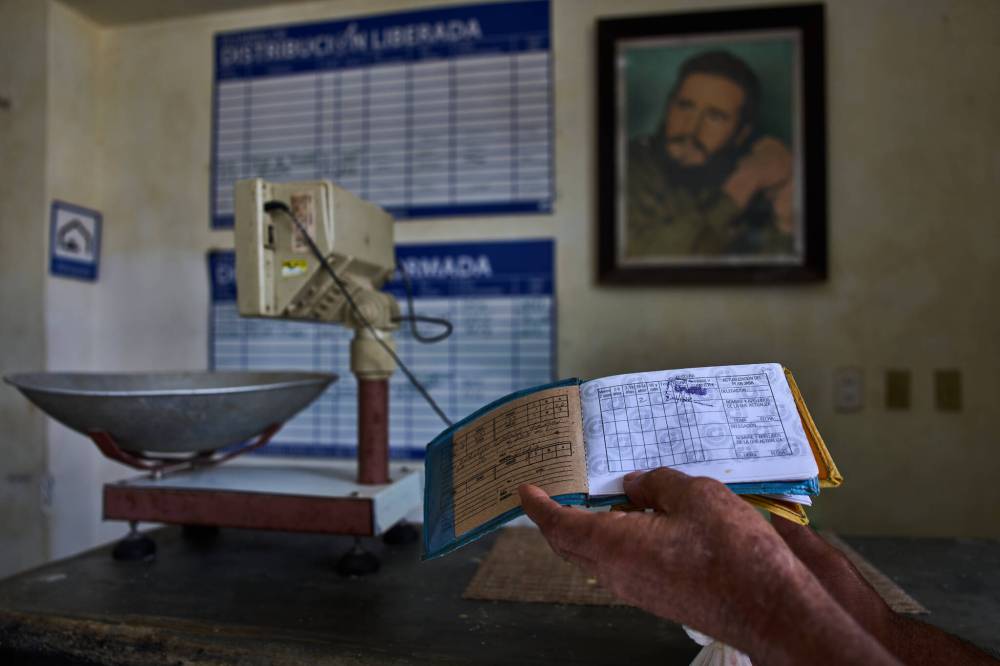
The Associated Press
A man shows his ration book, known as a ‘libreta,’ backdropped by a framed image of Fidel Castro, at a state-run bodega in Havana, Cuba.
Not all of the blame for the country’s current humanitarian crisis can be laid at the feet of the Trump White House. The Cuban political leadership deserves its fair share of blame for poor economic and financial management, for too much emphasis on expanding the tourism market, and for not enough attention on modernizing the electrical grid and attracting much-needed foreign investment.
But Washington’s full-court press — largely orchestrated by U.S. Secretary of State Marco Rubio — is unprecedented in the annals of U.S.-Cuba relations.
Accordingly, the socio-economic impact on the island has been devastating. There are shortages of just about everything, and the situation has been exacerbated by the U.S.-imposed oil blockade, the tightening of the American economic embargo and the desertion of previous allies in Mexico City, Caracas, Beijing and Moscow.
Needless to say, Havana does not have a whole lot of options at its disposal. With its back to the wall, the Cuban government has approved a series of emergency economic measures. All of them are intended to deal with the current crisis and to inject some life back into a moribund Cuban economy.
Using China and Vietnam as guideposts, the government is hoping to implement more free enterprise reforms to replace almost 70 years of a centrally planned economy. Some 175 proposed changes, if implemented, will significantly transform Cuba’s socialist model — while leaving its one-party dictatorship in place — into something more along the lines of regulated market capitalism.
Cuban Prime Minister Manuel Marrero Cruz told the National Assembly last month that the role of the private sector will be expanded into areas such as tourism, corporate banking, retail trade and agriculture. Foreign investment will be permitted to enter Cuba’s burgeoning private sector, state-owned enterprises will be given greater autonomy (and opened up to private investors), and the overall role of the government will be scaled back.
In addition, the leasing of farmland (still owned by the state) will be expanded, real estate development in the tourism sector will be given the green light and the country’s telecom/digital networks will be opened to foreign investors. The government will also liberalize various import and export activities so as to incentivize small and medium-sized businesses to bypass state-operated enterprises altogether.
There are a number of offensive and defensive reasons for why the Cuban government has chosen to radically change course. First and foremost, it begins with the horrendous humanitarian situation on the ground in Cuba.
As a recent report by the UN High Commissioner for Human Rights makes clear: “The fuel restrictions imposed since early 2026 and recent tightening of extraterritorial sanctions, taken together, are directly harming Cubans, especially the most vulnerable.” It goes on to explain, “Children are dying because doctors lack access to essential medical supplies and medicines.”

The raw numbers are simply jaw-dropping. Available medical services for maternal health, oncology and dialysis are under tremendous strain. Cuba’s infant mortality rate has doubled to 9.9 per 1,000 live births and childhood cancer survival rates have dropped precipitously from 85 per cent to 65 per cent. Supplies of essential medicines have been reduced to about 30 per cent of previous levels and even food production (in light of the fuel embargo) has decreased by some 60 per cent.
To be sure, the Cuban leadership is making these ground-breaking changes in an effort to stabilize its rule, to survive politically and to perpetuate its grip on power. These reforms are also intended to neutralize domestic pressures and to be seen as responding to growing discontent and public demonstrations. Part of it, no doubt, is to deflect attention away from the daily grind, the awful socio-economic conditions, and to give Cubans some hope.
Furthermore, there is an obvious need to alter Cuba’s current trajectory and its economic and financial ecosystem. It has little choice right now but to make fundamental structural reforms in order to revitalize an economy teetering on collapse. Finally, there is an element of trying to do something, anything, to stave off a possible U.S. military invasion.
Only time will tell, of course, whether these proposed changes will actually see the light of day. One can also be concerned about the impact that these reforms could have on deep Cuban values and collective or community-based thinking. Either way, Cuba is headed for an extraordinary set of challenges and difficulties in the next few years.
Peter McKenna is professor of political science at the University of Prince Edward Island in Charlottetown.
Related Articles
As blackouts stretch for days, life in Cuba revolves around small bursts of electricity
Advertisement Advertise With Us
Advertisement Advertise With Us