

Protests spur Ukraine military reshuffle
Advertisement
Read this article for free:
or
Already have an account? Log in here »
To continue reading, please subscribe:

Digital Subscription
One year of digital access for only $205*
- Enjoy unlimited reading on winnipegfreepress.com
- Read the E-Edition, our digital replica newspaper
- Access News Break, our award-winning app
- Play interactive puzzles
*First annual payment billed as $205.00 + GST for one year. This annual subscription will automatically renew at $233.00 + GST every 52 weeks (10% off the regular annual price of $259.35). Offer available to new and qualified returning subscribers only. Cancel any time.
To continue reading, please subscribe:
Add Free Press access to your Brandon Sun subscription for only an additional
$1 for the first 4 weeks*
- Enjoy unlimited reading on winnipegfreepress.com
- Read the E-Edition, our digital replica newspaper
- Access News Break, our award-winning app
- Play interactive puzzles
*Your next Brandon Sun subscription payment will increase by $1.00 and you will be charged $17.95 plus GST for four weeks. After four weeks, your payment will increase to $24.95 plus GST every four weeks.
Read unlimited articles for free today:
or
Already have an account? Log in here »
Even nations fighting for their survival can’t escape politics.
“The president should not choose sides during a war,” Ukrainian President Volodymyr Zelenskyy told reporters earlier this month after sacking his defence minister to quell a growing rift between him and the country’s military chief. “But if the parties cannot solve the issue, then I have to solve it.”
Many Ukrainians felt their leader picked the wrong side.
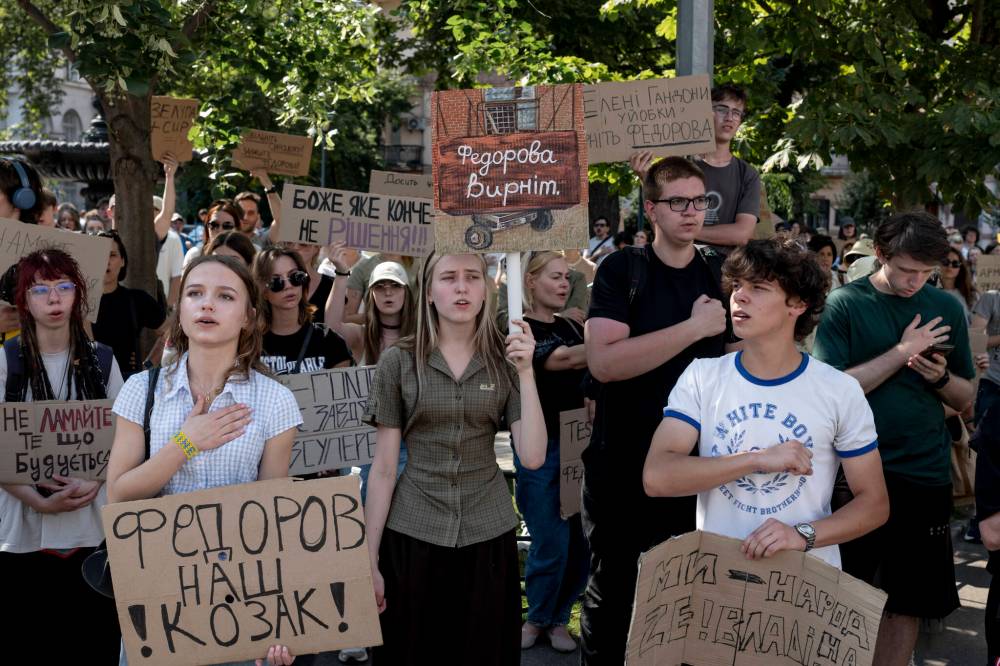
Jedrzej Nowicki / The New York Times
Demonstrators gather to protest the dismissal of the country’s defence minister, Mykhailo Fedorov, outside the Ivan Franko Theater in Kyiv, Ukraine, on July 16.
Protesters poured into Ukraine’s streets for days beginning July 16 to condemn the dismissal of 35-year-old Mykhailo Fedorov. The tech savvy iconoclast is fiercely popular. He’s also considered the architect of Kyiv’s robot-first military strategy that has tilted the war in Ukraine’s favour.
Soon after being handed the defence portfolio in January, Fedorov — previously minister of digital transformation — began clashing with Ukraine’s top general, Oleksandr Syrskyi. It was a classic case of an upstart modernizer colliding with a stalwart of the old guard.
According to the Financial Times, contributing to their falling out was backlash from defence industry elites who felt Fedorov wasn’t keen on striking lucrative deals with their preferred companies.
“We encountered a situation in which all the initiatives we proposed began to be blocked,” Fedorov said after his firing, while admitting he did push to get Syrskyi replaced. The general was widely celebrated for organizing Kyiv’s stunning defence in the war’s opening days. Yet four years on, he’d developed a reputation for inflexibility.
Mounting reports indicated the Russian-born Syrskyi — trained in Moscow during the Soviet era — clung too strongly to a hierarchical, centralized command style. Many inside and outside the country thus felt he was hindering the battlefield experimentation that has propelled Ukraine’s asymmetric war effort.
The general had also become known as “the Butcher” among his rank-and-file troops. The dubious nickname reflected his habit of ordering Ukrainian infantry units to fight to the death over strategically unimportant towns and villages simply to deny Russia meaningless victories it could spin as propaganda.
For much of Ukraine, Syrskyi “had come to represent the darkest, most punishing realities of a war fought through sheer attrition,” wrote the New York Times.
This contrasted with Fedorov’s ascent.
“It is becoming increasingly clear that removing Fedorov — a figure widely regarded as a symbol of success and, in many ways, a role model for younger Ukrainians — will not be politically easy,” the Kyiv Post warned when the defence minister was removed from his position.
Less than a week later, Syrskyi found himself on the way out, as well. In a July 21 social media post, Zelenskyy said he was installing a 45-year-old ally of Fedorov’s as Ukraine’s new military commander.
Still, it’s clear damage has been done. And not everyone is happy with Zelenskyy’s U-turn.
Fedorov has so far spurned his president’s offer to return to government in a fresh capacity. Plus, the episode has revealed political fault lines within the country’s military. For example, the Wall Street Journal reported Syrskyi was staunchly supported by the leaders of Ukraine’s navy, elite air assault forces and military reserves.
“We’ll soon reach a point — as a nation — where every position like that of commander in chief, or, for example, any other high-level government post, will be decided by a rally with placards,” a member of Ukraine’s parliamentary national security committee lamented in comments to the paper. “That’s a road to nowhere.”
This isn’t the first time public pressure has caused Zelenskyy to shake up his government. The president’s longtime influential chief of staff was forced to resign last November amid a corruption investigation linked to the country’s energy sector.
That scandal also claimed Zelenskyy’s justice and energy ministers.
The president — whose term officially ended in May 2024 but who remains in office because Ukraine’s constitution prohibits wartime elections — is also simultaneously trying to overhaul his foreign policy strategy. The changes pushed out the country’s prime minister, a vocal ally of his who had served less than a year in the role.

Her successor is the former CEO of Ukraine’s state-run natural gas company. Analysts view it as a sign Kyiv is seeking new ways to steel the country for another winter of relentless strikes on Ukraine’s power plants and electrical grid.
Indeed, the Kremlin hasn’t wavered in its maximalist war aims.
This despite Russia — an energy export superpower — being reduced to importing fuel from India this month thanks to Ukrainian long-range drone strikes taking some 40 per cent of its oil refining capacity offline. Russian state coffers are rapidly dwindling as well.
However, if Zelenskyy’s moves don’t show dividends, expect protesters back out in the streets soon.
Kyle Volpi Hiebert is a Montreal-based political risk analyst focused on globalization, conflict and emerging technologies.
Related Articles
Ukraine — does it need an election now?
Advertisement Advertise With Us
Advertisement Advertise With Us