

Gearing up for trade war, at speed

Advertisement
Read this article for free:
or
Already have an account? Log in here »
To continue reading, please subscribe:

Digital Subscription
One year of digital access for only $205*
- Enjoy unlimited reading on winnipegfreepress.com
- Read the E-Edition, our digital replica newspaper
- Access News Break, our award-winning app
- Play interactive puzzles
*First annual payment billed as $205.00 + GST for one year. This annual subscription will automatically renew at $233.00 + GST every 52 weeks (10% off the regular annual price of $259.35). Offer available to new and qualified returning subscribers only. Cancel any time.
To continue reading, please subscribe:
Add Free Press access to your Brandon Sun subscription for only an additional
$1 for the first 4 weeks*
- Enjoy unlimited reading on winnipegfreepress.com
- Read the E-Edition, our digital replica newspaper
- Access News Break, our award-winning app
- Play interactive puzzles
*Your next Brandon Sun subscription payment will increase by $1.00 and you will be charged $17.95 plus GST for four weeks. After four weeks, your payment will increase to $24.95 plus GST every four weeks.
Read unlimited articles for free today:
or
Already have an account? Log in here »
It’s a hell of a way to go to war.
“You’re at war when you get attacked,” Prime Minister Mark Carney matter-of-factly stated in response to the very last question of his Saturday news conference after trade talks with the United States collapsed. Not a formal declaration of war, more a circumstantial statement of reality.
Still, many other elements of two warring nations are present. Midnight negotiations disintegrating. Withdrawal of negotiating teams. Blaming the other side. Refusing to re-engage. Retaliatory strikes readied. And that’s just Canada.
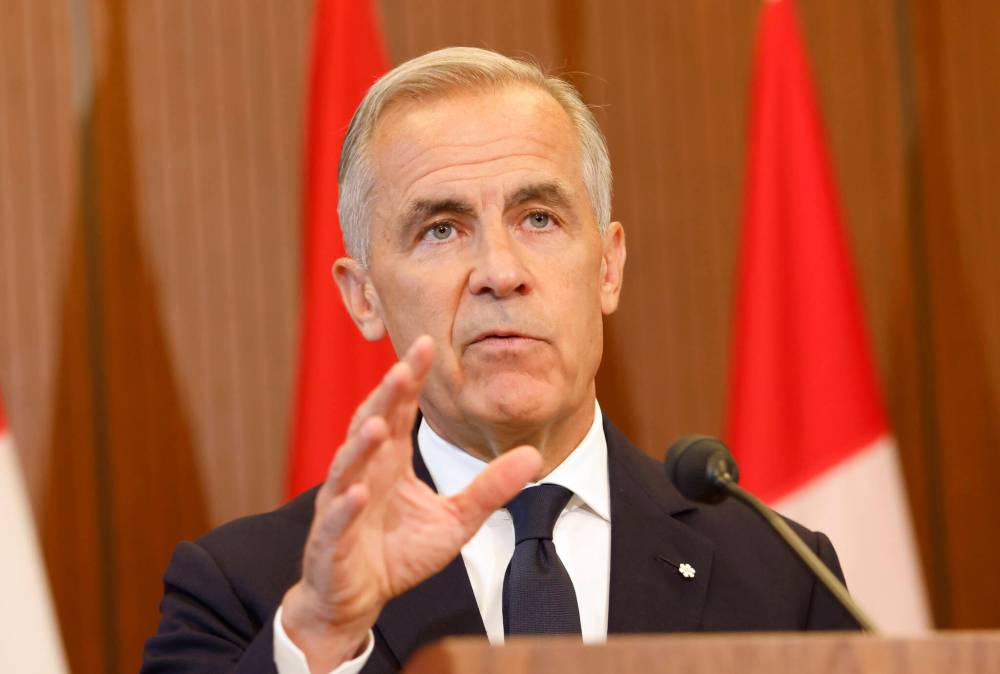
Patrick Doyle / THE CANADIAN PRESs fileS
Prime Minister Mark Carney speaks Aug. 22 on Parliament Hill on Canada’s response to new U.S. tariffs.
For America, retaliatory strikes are already landing. New ones threatened. Territory is being renamed. As for blame, it’s all ours not theirs.
At least ambassadors haven’t been recalled. Not yet anyway, although more than 225,000 Canadians have signed a petition calling for the government to declare U.S. Ambassador Pete Hoekstra “persona non grata and request his removal.”
When it comes to names and memes, it certainly sounds like war. Chest-thumping insults are flying fast and furious. On both sides of the border. But you don’t win a war with words unless you’re in a war of words. Mark Carney says it’s more than that and Donald Trump’s escalating tariffs are proof of that.
If so, where’s the mobilization for war? Canadians are ready. Nationalistic pride is at its highest in years. If there was ever a moment when Canadians could be called upon to do their patriotic economic duty, now is it. What we need is our governments — all our governments — plus business and labour to find common cause for the struggle ahead.
That’s not happening. For three reasons.
First is the federal government’s use of retaliatory tariffs. It’s a strategy of “wield and shield.” Wield them against American businesses and workers; shield Canadian business and workers from the effects. They are designed to get attention in Washington to get to a deal. You don’t go to a DEFCON 1 war condition with all the attendant changes to your industries and economy if it’s a just a negotiating tactic.
Second, most provincial governments don’t want an economic war with the United States. They are reluctant warriors, at best — “Kiss my ass, Donald Trump” notwithstanding. That’s because our country’s diversified economy at the national level is much more concentrated at the provincial, regional and local levels. Think autos in Ontario, aluminum in Quebec, lumber in B.C., fish and seafood in Atlantic Canada and oil and gas in Alberta. There’s a reason Premier Danielle Smith in Alberta has kept American liquor on the shelves and inveighs strongly against an export tax on energy going south.
Third, business naturally wants to keep the American markets it already has rather than expend time, effort and money to secure new ones. It’s cheaper, easier and more profitable than retooling, rebranding and rebuilding abroad.
But if we truly are in an economic war with the United States, if we’ve come to a rupture in the relationship or a hinge moment in our history (as Mr. Carney has said), all those things must change. Canada’s mobilization machine needs to gear up, now.
We need to move at unprecedented rates if there is truly no going back to our previous economic relationship with the U.S. And Canada needs to move at unprecedented levels of collaboration across the full spectrum of the public and private sectors to make this work. In short, we need to deliver at speed and implement at velocity.
Governments showed a capacity to do this during the pandemic. Decision times were shortened. Risk aversion was jettisoned. Policy design and operational needs were considered jointly by public servants and politicians at the front end to make sure things happened not just more quickly, but more effectively so they worked better. And business, labour and civil society were brought together around many of the same tables to build consensus and give practical advice on what needed to be done. Do all this again.
A fast-burning public health emergency is not the same as a slow-burning economic war. But the implications are just as dire in the long run. We need to recognize as much and act accordingly. With much more determination and dispatch than we’ve exhibited to date.
“War. What is it good for?” was a 1969 anti-Vietnam War anthem. “Absolutely nothing” was the lyrical answer to the knee-deep in the big muddy morass it became.

But mobilization for war is different. Focusing public and private investment on new growth in strategic priorities, building resilience to American market pressures through diversification, and improving business competitiveness and productivity through tax reform and innovation will put us in a much stronger position to wage an economic war now and later.
Most of all, mobilization across government to focus on improving its ability to implement all this — and more — to deliver faster and more effectively for Canadians must be job No. 1 for the Carney government.
When it comes to war, Winston Churchill quotes are the best. “Jaw-jaw is better than war-war” is one the negotiators like. But in a fighting speech to our own House of Commons in the Second World War, Churchill quoted defeatist generals saying, after France fell to the Germans, that in three weeks England will have her neck wrung like a chicken.
His answer one year on, with Britain unconquered: “Some chicken; some neck.”
David McLaughlin is a former clerk of the executive council and cabinet secretary in the Manitoba government.
Our newsroom depends on a growing audience of readers to power our journalism. If you are not a paid reader, please consider becoming a subscriber.
Our newsroom depends on its audience of readers to power our journalism. Thank you for your support.
Our newsroom depends on a growing audience of readers to power our journalism. If you are not a paid reader, please consider becoming a subscriber.
Our newsroom depends on its audience of readers to power our journalism. Thank you for your support.
Advertisement Advertise With Us
Advertisement Advertise With Us