

Recognizing the value of phys-ed for kids
Advertisement
Read this article for free:
or
Already have an account? Log in here »
To continue reading, please subscribe:

Digital Subscription
One year of digital access for only $205*
- Enjoy unlimited reading on winnipegfreepress.com
- Read the E-Edition, our digital replica newspaper
- Access News Break, our award-winning app
- Play interactive puzzles
*First annual payment billed as $205.00 + GST for one year. This annual subscription will automatically renew at $233.00 + GST every 52 weeks (10% off the regular annual price of $259.35). Offer available to new and qualified returning subscribers only. Cancel any time.
To continue reading, please subscribe:
Add Free Press access to your Brandon Sun subscription for only an additional
$1 for the first 4 weeks*
- Enjoy unlimited reading on winnipegfreepress.com
- Read the E-Edition, our digital replica newspaper
- Access News Break, our award-winning app
- Play interactive puzzles
*Your next Brandon Sun subscription payment will increase by $1.00 and you will be charged $17.95 plus GST for four weeks. After four weeks, your payment will increase to $24.95 plus GST every four weeks.
Read unlimited articles for free today:
or
Already have an account? Log in here »
The message from Premier Wab Kinew and Education Minister Tracy Schmidt last week about the importance of exercise for young people was timely and important — but it is not new.
Some 2,000 thousand years ago, Plato reportedly said, “In order to succeed in life, a person has two means: education and physical activity. Not separately, one for the soul and the other for the body, but for the two together.”
That was the message being reinforced last week by our provincial leaders.
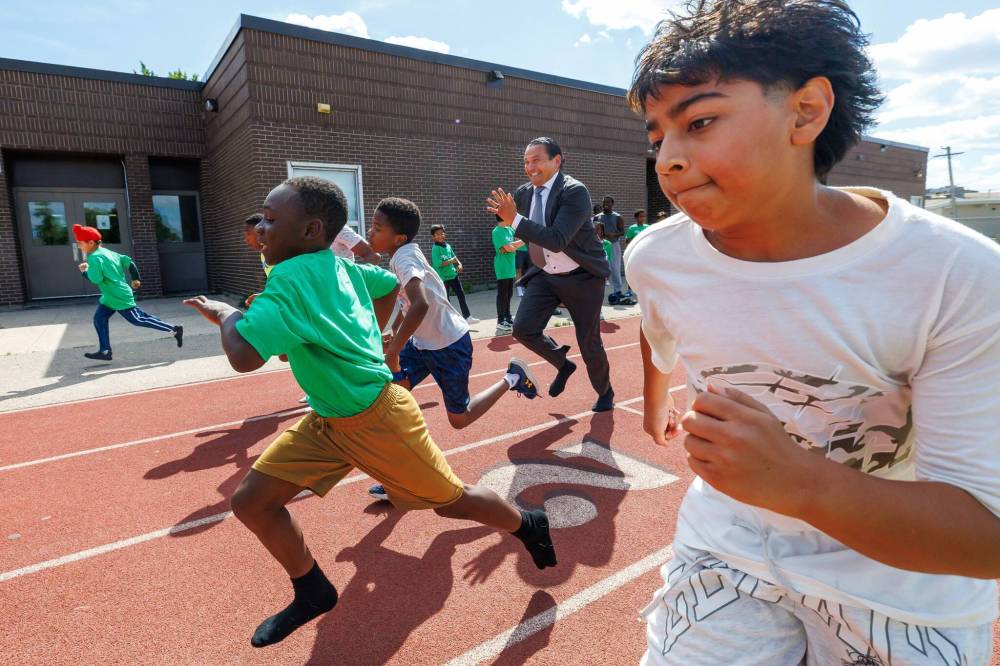
MIKE DEAL / FREE PRESS
Premier Wab Kinew runs a race with kids from BGC Winnipeg after the Aug. 27 announcement of a new health and physical education curriculum
The decision to focus on looking after our bodies as part of a healthy lifestyle, has seldom been consistently followed in education or in our daily lives. The reintroduction of daily physical education into our schools will only be meaningful if everyone, including our children, their families and schools and health-care professionals take up the challenge of making physical health a priority.
It should be a priority because our physical health is connected to everything else, including our sense of self, and ultimately to our overall well-being.
So, why haven’t we been able to deliver on that promise for our children?
Often the kind of physical activity promoted at school focuses on sports rather than more basic elements of physiological health, such as heart and lung health. Physical activity at school seldom focuses on or promotes sustained, strenuous aerobic activity.
Beginning in the late 1970s, research started to confirm that the real benefit of a good workout, which got the heart rate and breathing rate up substantially, was based on aerobic exercise.
In his book, Spark: The Revolutionary New Science of Exercise and the Brain, John Ratey, a Harvard neuroscientist, looked at how exercise can enhance learning and health.
The real-life test of Ratey’s proposition, and its implications for education, was started by a teacher in a Naperville, Ill., school in 1990. It began as an exercise program, featuring aerobic exercise, starting in the fifth grade, and allowed students to track their own fitness.
The result of that experiment were so convincing that, in 1999, the Naperville school district decided to have all of its students participate in the highly regarded Trends in International Mathematics and Science Study to test its students against international standards. Although U.S. student have never fared well in international math and science testing programs, Naperville district Grade 8 students scored No. 1 in the world in science and No. 6 in the world in math, an unheard-of accomplishment for an American public school.
The Naperville study showed that physical activity helps kids concentrate in class.
Among its other benefits, it has been found that aerobic exercise can help create new brain cells, something that, until recently, we had been told couldn’t happen. Exercise that gets your heart rate up and provides a cardio workout for 20 minutes is magic.
In Canada, Saskatoon’s City Park Collegiate was the first Canadian school to try to demonstrate the benefits of using aerobic exercise as a springboard to learning. The results, according to Allison Cameron, the Grade 8 teacher who began the program, were miraculous.
Cameron had her students spend 20 minutes on a treadmill getting their heart rates up while watching a documentary or reading. Then her students did mental math while in the weight room. Academically, the program was a remarkable success. But there were other benefits.
Cameron, like others who have tried to combine exercise with education, found that student behaviour also improved. Exercise before starting a new task helps to focus attention and makes leaning more likely.
The students at Park City Collegiate confirmed that suggestion, and the approach offers a viable solution to the modern problem of too much screen time and a sedentary lifestyle.
Because aerobic exercise has also been shown to increase several hormones essential to mental health, such as serotonin, exercise helps students deal with the stress of learning and growing.
The benefits of aerobic exercise may also help us tackle increasing obesity levels and growing levels of depression and anxiety among young people.
Regrettably, it doesn’t seem to matter how much information we get, how relevant or sensible the advice, human beings are slow to change their behaviour.
The recent ParticipAction Report Card on Physical Activity for Children and Youth (2026) is just the latest plea to get kids active.
The report notes that. “Canada’s youth are also now the most inactive age group in the country. While physical activity levels among children have remained relatively stable over time, youth physical activity levels, particularly among girls, have steeply declined… Just 33 per cent of boys and eight per cent of girls ages 12 to 17 years meet the national physical activity recommendation.”

Health Canada suggests that 30 per cent of young people between five and 17 are overweight and the repercussions may impact their mental health and wellness as much as their physical health. That means the latest announcement by the provincial government, and its active support of daily physical activity, is profoundly important.
Too little research has been done at Canadian universities, particularly in faculties of education, on the link between strenuous physical exercise and its affect on learning and mental health. If something as simple as exercise can make a big difference in the lives of our children, it is time all of the partners in the education process took it seriously.
Education Minister Schmidt has identified an important component of making our children stronger, mentally and physically. Clearly, engaging our children in activities that will make them more capable and resilient will require the support of the province, school boards, parents and teachers, including our physical education teachers.
If we really want to help our kids be their best, we now know at least one path ahead that can make a difference.
Jerry Storie, a former teacher and dean of education at Brandon University, writes from Winnipeg.