

Can Brazil’s Lula best Bolsonaro’s backers?
Advertisement
Read this article for free:
or
Already have an account? Log in here »
To continue reading, please subscribe:

Digital Subscription
One year of digital access for only $205*
- Enjoy unlimited reading on winnipegfreepress.com
- Read the E-Edition, our digital replica newspaper
- Access News Break, our award-winning app
- Play interactive puzzles
*First annual payment billed as $205.00 + GST for one year. This annual subscription will automatically renew at $233.00 + GST every 52 weeks (10% off the regular annual price of $259.35). Offer available to new and qualified returning subscribers only. Cancel any time.
To continue reading, please subscribe:
Add Free Press access to your Brandon Sun subscription for only an additional
$1 for the first 4 weeks*
- Enjoy unlimited reading on winnipegfreepress.com
- Read the E-Edition, our digital replica newspaper
- Access News Break, our award-winning app
- Play interactive puzzles
*Your next Brandon Sun subscription payment will increase by $1.00 and you will be charged $17.95 plus GST for four weeks. After four weeks, your payment will increase to $24.95 plus GST every four weeks.
Read unlimited articles for free today:
or
Already have an account? Log in here »
Brazilian President Luiz Inácio Lula da Silva, who is in search of his fourth non-consecutive presidential term since 2002 (and after a stint in prison for corruption) as the Workers’ Party spear-carrier, had once pledged that he would not seek a second term this time around.
But time in office and a fondness for political power have a way of changing minds.
Many prognosticators had predicted that Lula would win easily in any head-on contest with hard right Brazilian Senator Flávio Bolsonaro — the eldest son of former disgraced president Jair Bolsonaro, who was given a 27-year sentence of house arrest for plotting a failed coup attempt in 2023.
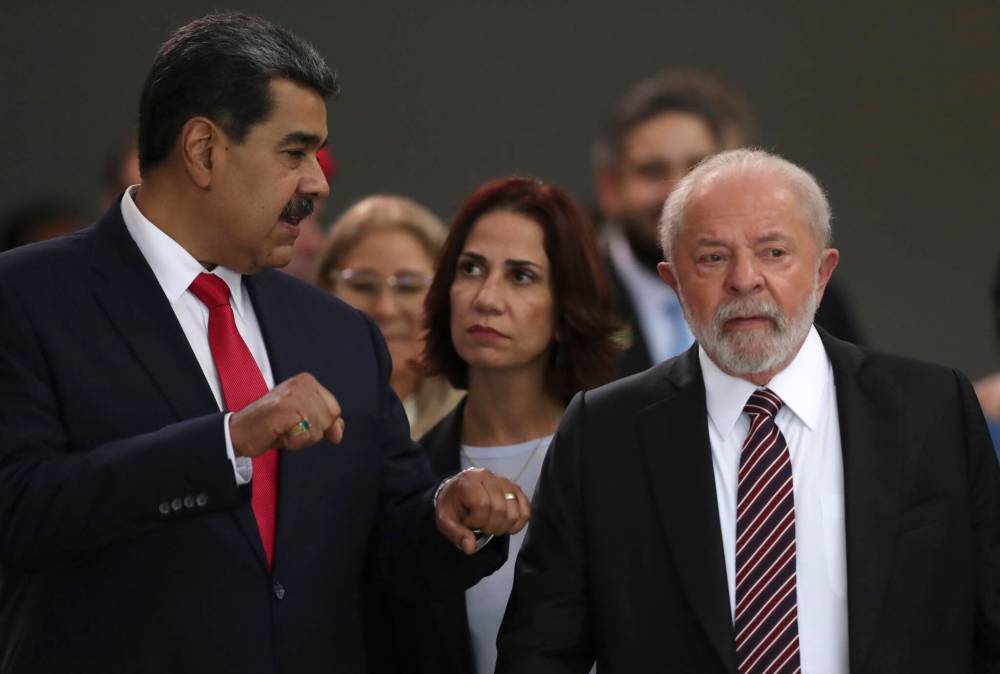
AP Photo/Gustavo Moreno
Brazilian President Luiz Inacio Lula da Silva, right, speaking with Venezuela’s President Nicolas Maduro, with a translator standing between them. Lula is facing a tightening race as he seeks a fourth term leading Brazil.
Not so fast. (The first round of the Oct. 4 presidential election, unless one candidate can eke out a majority, will most likely require a second run-off vote on Oct. 25.)
As of this writing, public opinion surveys are showing a very tight race between the two leading principals. They also show that the 45-year-old Bolsonaro has essentially closed the gap over the last month or so — trailing the left-leaning Lula by six per cent instead of the 10 per cent in early August. What has happened to Lula’s lead?
It is worth noting — although I wouldn’t read too much into this — but there has been a rightward tilt in South America in the last year. In fact, right-wing candidates in Chile, Colombia, Ecuador, Peru and Bolivia (throw in Argentina’s Javier Milei in 2023) have recently secured the keys to their respective presidential palaces.
Lula has tried to situate the October election within the larger context of protecting Brazil’s national sovereignty. Though he has recently sought to bolster trade and diplomatic relations with China — as a counterweight to Donald Trump’s Washington — he has spoken about the sovereignty argument in much broader terms. For example, he made it very clear in one campaign speech that no major power in the world would get its hands on Brazil’s precious natural resources — and especially its large supply of rare earths.
Sure, the “Trump factor” has also played a small role in Lula’s sliding poll numbers. U.S. President Donald Trump has inserted himself into the election by criticizing Lula for various policy decisions, imposed stiff tariffs on Brazilian exports, and intimated that he would like to see Flávio prevail in October.
But the real political headwinds facing Lula are mostly internally generated. There are the typical challenges facing any incumbent: to wit, the desire for change, dissatisfaction over the cost of living, anger over rising crime rates and even Lula’s age (he’s 80). Taken together, you start to understand why Lula’s disapproval numbers are at, or above, 50 per cent, and are putting the fear of God into his tight-knit campaign team.
In addition, the Brazilian electorate is highly polarized — a holdover from the previous far right Bolsonaro government (2018-2022). Brazilians are divided into arguably two blocs: those on the progressive left and voters on the radical right.
This means that the small number of undecided voters could very well determine the final election outcome in October.
Moreover, public safety has been top-of-mind for most Brazilians and Lula’s failure to act decisively has left him wounded politically. Violent criminal gangs, narco traffickers and petty street criminals have been allowed to undermine the personal safety of many Brazilians.
Having said that, economic growth during Lula’s tenure has averaged around three per cent — not bad in a period of global malaise. The unemployment rate is the lowest ever recorded in Brazil, coming in at a healthy 5.1 per cent. And highly-coveted foreign investment is pouring into Brazil’s leading economic sectors: clean energy, AI infrastructure and agribusiness.

So there is still time for Lula to turn things around. But he will undoubtedly need some help from Avante Party Leader Augusto Cury, a psychiatrist and writer, who is presently polling in the 10 per cent range. Lula will certainly need to capture a large share of Cury voters (who tend to lean right) in the second run-off election if he hopes to have any chance of staying on as president. Of course, Bolsonaro will also be fishing for votes in that same Cury pool.
Tilting in favour of Lula’s re-election bid is the recent probe into Flávio Bolsonaro’s alleged involvement in a money-laundering scheme perpetrated by failed Brazilian lender Banco Master. Reportedly, court documents point to his ties to banker Daniel Vorcaro (the owner of Banco Master) and Bolsonaro’s solicitation of a financial investment from Vocaro to help finance a film about his father. This all led to a police investigation of Bolsonaro’s links to alleged corruption, illicit foreign exchange and the cleaning of dirty money.
When Brazilians do enter the polling booth, there’s a good chance that memories of rightist Jair Bolosonaro’s unconstitutional and criminal conduct will turn voters away from his son. They want an experienced and steady hand to negotiate the turbulent waters of Trumpism and the tariff wars.
What they don’t want to see is another Bolsonaro government, and a repeat of all the craziness that came along with it.
Peter McKenna is professor of political science at the University of Prince Edward Island in Charlottetown.