

Middle Eastern version of NATO off to rocky start
Advertisement
Read this article for free:
or
Already have an account? Log in here »
To continue reading, please subscribe:

Digital Subscription
One year of digital access for only $205*
- Enjoy unlimited reading on winnipegfreepress.com
- Read the E-Edition, our digital replica newspaper
- Access News Break, our award-winning app
- Play interactive puzzles
*First annual payment billed as $205.00 + GST for one year. This annual subscription will automatically renew at $233.00 + GST every 52 weeks (10% off the regular annual price of $259.35). Offer available to new and qualified returning subscribers only. Cancel any time.
To continue reading, please subscribe:
Add Free Press access to your Brandon Sun subscription for only an additional
$1 for the first 4 weeks*
- Enjoy unlimited reading on winnipegfreepress.com
- Read the E-Edition, our digital replica newspaper
- Access News Break, our award-winning app
- Play interactive puzzles
*Your next Brandon Sun subscription payment will increase by $1.00 and you will be charged $17.95 plus GST for four weeks. After four weeks, your payment will increase to $24.95 plus GST every four weeks.
Read unlimited articles for free today:
or
Already have an account? Log in here »
Among the Iran war’s domino effects, the Mecca Joint Defence Agreement is one of the biggest. At least, that’s how it seems on paper. The pact — signed in August and dubbed “Muslim NATO” — combines nuclear armed Pakistan, energy behemoth Saudi Arabia and military powerhouse Turkey.
The three Sunni states vow to treat an attack on any of them as an attack on all. It mirrors NATO’s Article 5, building off a prior deal signed by Saudi Arabia and Pakistan in 2025. And some experts believe it precipitates the end of America’s regional influence.
“The U.S.-led Middle East order is over,” declared a senior fellow from the Council on Foreign Relations after the agreement was signed. For decades, Washington has been the security guarantor for wealthy Gulf monarchies, ensuring the free flow of oil onto global markets and keeping Tehran at bay, while dampening hostility toward Israel.
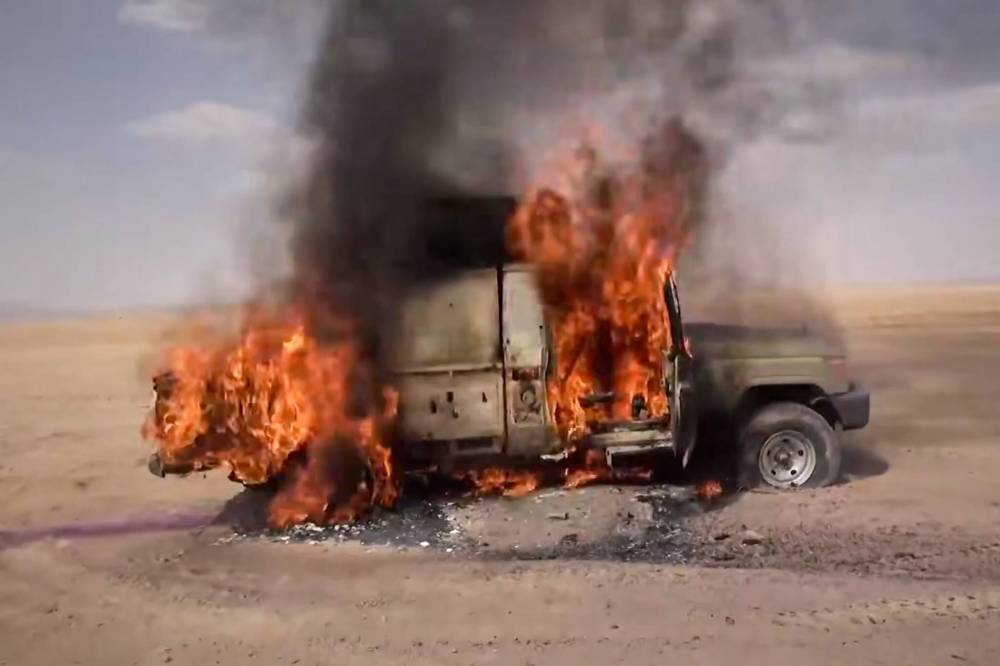
Ansar Allah Media Office via AP
This image taken on Sept. 9 from an undated video released by the Ansar Allah Media Office, the media arm of Yemen’s Houthi rebels, shows a pickup truck in flames following what the Houthis described as an attack on Saudi-backed forces in eastern Al-Jawf province, Yemen.
However, this arrangement has been shattered by America’s inability to halt relentless Iranian drone strikes or re-open the Strait of Hormuz. The Trump administration is meanwhile demanding its longtime partners assume responsibility for their own defence. So, it appears they are now taking matters into their own hands.
Yet the new alliance has stumbled out the gate.
Houthi rebels in Yemen have launched a series of offensives striking military targets and energy infrastructure in Saudi Arabia. They also overtook key ports and strategic islands in the Bab al-Mandeb strait, a chokepoint in the Red Sea — the Middle East’s other vital shipping corridor, a gateway for roughly 12 per cent of global trade.
Drone attacks by Tehran’s proxy militias in Iraq disabled a vast pipeline stretching across northern Saudi Arabia as well. The damage is estimated to keep it offline for several weeks. As a result, global oil market volumes may shrink another four per cent.
As per the Mecca Agreement, Pakistan and Turkey should be rushing to Saudi Arabia’s defence. Yet their support so far has been limited to behind-the-scenes logistical aid and dispatching diplomats to lean on Iran.
“So far, there are no indications that Turkey and Pakistan are preparing to enter the Yemen war directly,” writes a Yemeni journalist for the Quincy Institute for Responsible Statecraft, a left-leaning U.S. think tank. “What does it mean to say that an attack on one is an attack on all?”
Some of this is natural. The Saudis must first request support if they feel their security threats have crossed an unmanageable threshold. Instead, Riyadh has reportedly preferred to solicit help from Britain’s new prime minister. Lawmakers in Pakistan and Turkey must still ratify the deal as well.
Operationalizing the pact will also take time. “The new security architecture that agreements like the Mecca Pact are setting up will take years to mature,” cautioned a Pakistani researcher in a piece for Al Jazeera.
A Turkish official went further, telling the Middle East Eye that criticisms over the lack of joint military response were cynical foreign attempts to belittle the group’s importance. “People don’t want to understand but what we founded is not only a security alliance but actually an international organization,” he vented.
There’s some truth to all this. It’s unrealistic to expect three nations to stamp out a sophisticated, heavily armed non-state actor on its home turf while their treaty’s ink has barely dried. NATO had existed for more than 50 years when member nations deployed to Afghanistan after 9/11 — even then it struggled with coordination.
Plus, support could come in ways that don’t consist of Pakistan or Turkey participating in direct attacks. For example, greater intelligence sharing or re-stocking Saudi Arabia’s domestic air defences and counter-drone systems. Enhanced maritime surveillance around Yemen is another option. Time will tell.

But there’s another possibility too: the pact never achieves its ambitions given the conflicting interests of its members.
“They don’t have that many stability-loving friends to draw upon, partly because of their own poor choices,” Indian political scientist Mihir Sharma argued in Bloomberg last month. “Turkey has its hands in multiple messes across the Caucasus and Mediterranean, Pakistan is far too comfortable thinking of terrorists as ideological fellow travelers and Saudi money has long supported religious extremists around the world, even though it has tried to dial that down in recent years.”
Structural voids also matter. “With no secretariat, no unified command and insufficient trust, it might survive only as a platform to talk shop,” adds Sharma.
But in the world’s roughest neighbourhood, that might still count as progress. It may also be enough to dilute U.S. dominance.
Kyle Volpi Hiebert is a Montreal-based political risk analyst focused on globalization, conflict and emerging technologies.