

Black lives matter in Canada, as well
Fatal police shootings provide telling statistics
Advertisement
Read this article for free:
or
Already have an account? Log in here »
To continue reading, please subscribe:
Digital Subscription
One year of digital access for only $1.44 a week*
- Enjoy unlimited reading on winnipegfreepress.com
- Read the E-Edition, our digital replica newspaper
- Access News Break, our award-winning app
- Play interactive puzzles
*Billed as $5.77 plus GST every four weeks. After 52 weeks, price increases to the regular rate of $19.95 plus GST every four weeks. Offer available to new and qualified returning subscribers only. Cancel any time.
To continue reading, please subscribe:
Add Free Press access to your Brandon Sun subscription for only an additional
$1 for the first 4 weeks*
- Enjoy unlimited reading on winnipegfreepress.com
- Read the E-Edition, our digital replica newspaper
- Access News Break, our award-winning app
- Play interactive puzzles
*Your next Brandon Sun subscription payment will increase by $1.00 and you will be charged $17.95 plus GST for four weeks. After four weeks, your payment will increase to $24.95 plus GST every four weeks.
Read unlimited articles for free today:
or
Already have an account? Log in here »
Hey there, time traveller!
This article was published 11/03/2019 (2783 days ago), so information in it may no longer be current.
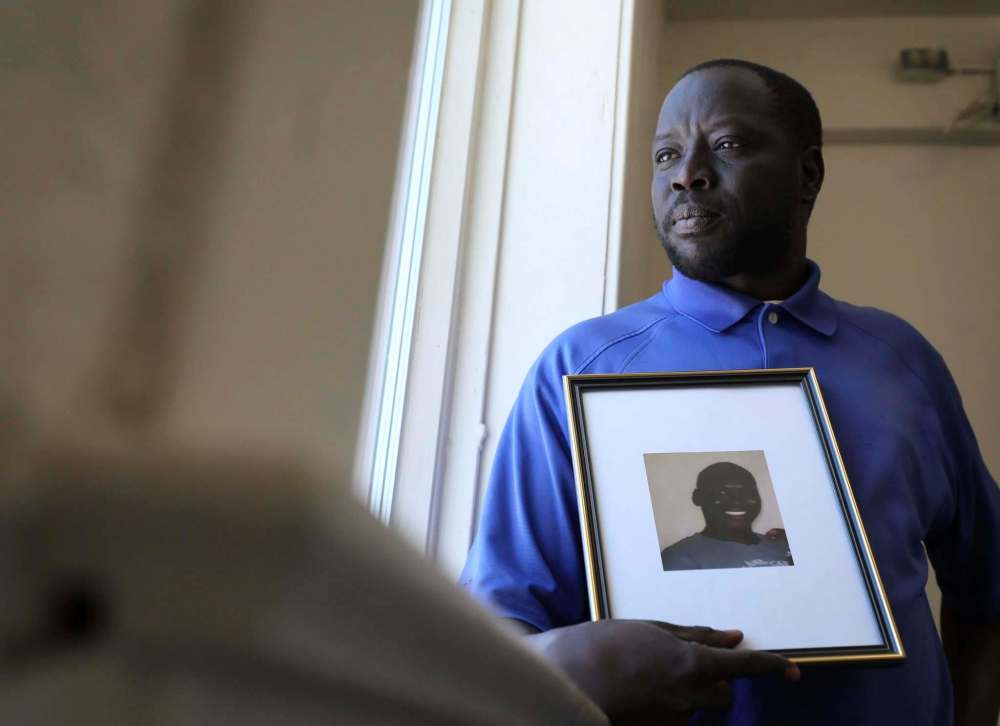
It is not too soon to express the view that the police killing of Machuar Madut — a 43-year-old father of three, living with mental-health issues and facing possible eviction — was unjustifiable and unnecessary.
I am unwilling to entertain the notion that Madut’s death was sad but inevitable. Regardless of the conditions that led to this incident, killing a black man in crisis simply cannot be part of what it means to “contain the scene” (the words of a mental-health expert interviewed by CBC news).
A recent Ontario Human Rights Commission interim report on racial discrimination by the Toronto police services found, to much publicity, that black people make up 70 per cent of police shootings resulting in civilian death. Less discussed, however, was that the study also showed that black victims of police shootings were less likely to have been carrying weapons, less likely to have threatened and attacked police and 50 per cent less likely to have been carrying a gun during the encounter.
What this tells us is that not all people need to be killed in order “to contain the scene.” In fact, only some deaths — black deaths — become cast as unpreventable: white men — even those armed with guns — continue, at far higher rates, to be kept alive when they encounter the police, despite being more frequently armed and violent. The ability to keep one’s life while in crisis is a courtesy and a privilege of whiteness, and a basic form of human dignity that black people continue to be denied.
We can and must collectively refuse the logic that tells us that violent death is an unpreventable turn of events when poor black people need support with mental-health issues. To use the words of York University Prof. Christina Sharpe, “One must be willing to say this is abhorrent.”
In 1977, Ghanian essayist and novelist Ama Ata Aidoo wrote, “Wherever they are and from whatever causes,/My God,/Black peoples still/Die/So/Uselessly!” Nearly half a century later, this dynamic is ongoing. On July 31, 2016, I wrote a piece for the Toronto Star, titled Let death of Abdirahman Abdi be last of its kind. In this piece, I wrote that “far too many black people with mental-health issues have lost their lives to inappropriate police responses across Canada,” and referenced the deaths of O’Brien Christopher-Reid, Reyal Jardine-Douglas, Alain Magoire, Andrew Loku and others.
All were black men living with mental-health issues and/or experiencing a mental-health crisis who were killed by police in Canada. Far from the last of their kind, Pierre Coriolan, Nicholas Gibbs, and now Madut’s names have been added to the seemingly never-ending roll call of those who, in need of support, instead had their lives unnecessarily destroyed by police forces across Canada.
I simply cannot write another opinion piece using studies to prove that we are dying disproportionately and unnecessarily. While the studies make this clear, the weight of continually itemizing our lost lives is simply too heavy. Numbers cannot do enough to describe the loss.
Idil Abdillahi has used the term “anti-black sanism” to describe the array of forces that together work against black people who are, like Madut was, living with mental-health issues. This emerges from the conditions that black people in North America have collectively endured across generations, regardless of when or how we have arrived here.
Certain lives — black lives — have been marked as disposable centuries ago, when black people in pre-Confederation Canada were enslaved and sold at markets and alongside livestock, for more than 200 years. All of us living in Canada are beholden, still, to a past that is not yet in the past.

What would it mean for Canadian society to break with this history and take collective responsibility for the ongoing crisis facing black people’s lives, rather than asking black communities to continue to prove that our lives do, in fact, matter?
As black communities across the country grieve for Madut, Winnipeg’s South Sudanese community, and black folks more broadly, will likely be forced to endure, ad nauseam, the insinuation — or outright assertion — that Madut’s death was tragic but unpreventable, “given the circumstances.”
But we can and must insist that his death — and all killings like this — are unconditionally abhorrent, and further, to demand that we, as a society, can choose differently.
That is to say, we can and must work to build a society in which, at bare minimum, decent housing for all is a given and armed police officers are not seen as an appropriate response for those who need support. Madut’s death was not inevitable, and it is both possible and necessary to demand that he deserved — and that we all deserve — better.
Robyn Maynard is the author of Policing Black Lives: State Violence in Canada from Slavery to Present, and is a research affiliate for the Canadian Centre for Policy Alternatives — Manitoba.