

Blurred ethics in Manitoba politics
Advertisement
Read this article for free:
or
Already have an account? Log in here »
To continue reading, please subscribe:
Monthly Digital Subscription
$1 per week for 24 weeks*
- Enjoy unlimited reading on winnipegfreepress.com
- Read the E-Edition, our digital replica newspaper
- Access News Break, our award-winning app
- Play interactive puzzles
*Billed as $4.00 plus GST every four weeks. After 24 weeks, price increases to the regular rate of $19.95 plus GST every four weeks. Offer available to new and qualified returning subscribers only. Cancel any time.
Monthly Digital Subscription
$4.99/week*
- Enjoy unlimited reading on winnipegfreepress.com
- Read the E-Edition, our digital replica newspaper
- Access News Break, our award-winning app
- Play interactive puzzles
*Billed as $19.95 plus GST every four weeks. Cancel any time.
To continue reading, please subscribe:
Add Free Press access to your Brandon Sun subscription for only an additional
$1 for the first 4 weeks*
*Your next subscription payment will increase by $1.00 and you will be charged $16.99 plus GST for four weeks. After four weeks, your payment will increase to $23.99 plus GST every four weeks.
Read unlimited articles for free today:
or
Already have an account? Log in here »
Hey there, time traveller!
This article was published 14/08/2021 (1694 days ago), so information in it may no longer be current.
Two recent events caused me to reflect on the potentially influential role that political staff play in Manitoba politics and government, and whether there is sufficient guidance and accountability for their behaviour and its consequences.
The first event was a report from the ombudsman documenting a situation in which neutral public servants were enlisted to prepare communications that had partisan, political overtones. That action was inappropriate. It is not the job of public servants to help “sell” government policies.
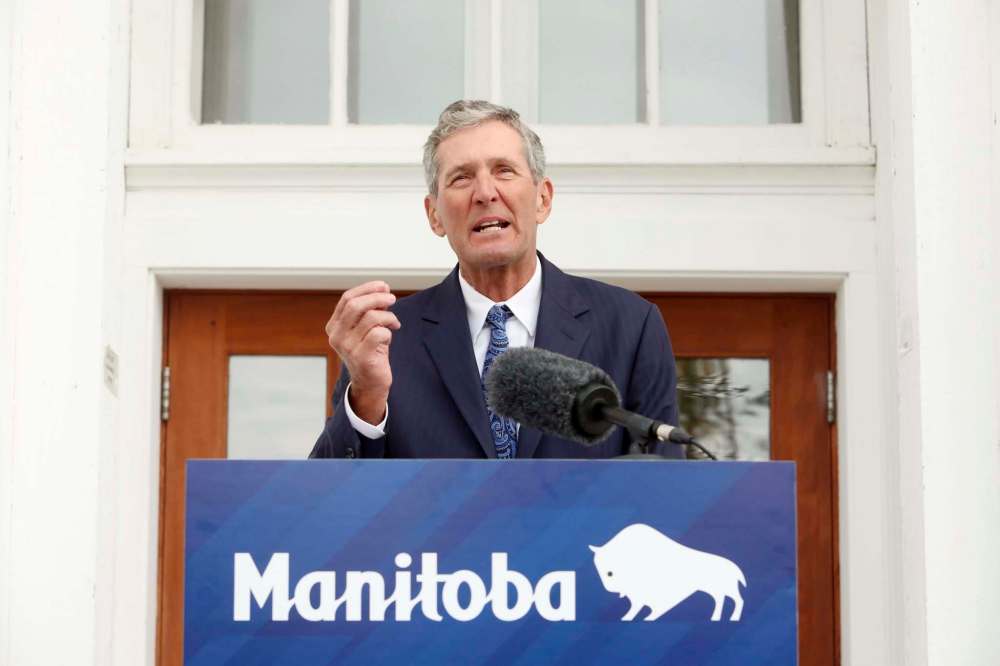
The second development was Free Press columnist Dan Lett’s blockbuster revelation that the premier used Progressive Conservative party funds to hire a detective to gather negative information for the purpose of attacks against Wab Kinew, leader of the NDP opposition. The campaign was directed by high-level political staff in the executive council. It was probably not illegal, but it was sleazy and unethical.
Let me try to explain why these developments are seriously worrisome:
To begin, our constitutional system of cabinet-parliamentary government assigns responsibility and accountability to two main groups of actors: relatively transient politicians and mostly permanent career public servants. Political staff do not fit neatly into this divided universe; instead, they occupy a kind of constitutional twilight zone. In principle, their behaviour falls within the scope of ministerial responsibility, but premiers and other ministers typically do not accept meaningful personal accountability for their actions.
In Manitoba, the premier appoints individuals who are loyal to the governing party to the executive council and to the offices of other ministers, sometimes based on the recommendations of individual ministers. Political staff, including those serving opposition parties, are paid from public funds. This is a recognition that politicians, especially ministers, could not perform their demanding jobs without various types of assistance.
Put simply, the role of political staff is to advance the interests of the politicians they serve and, in the case of the governing party, the agenda of the government. They do this in both substantive and procedural ways.
Policy advisers perform an array of activities, such as: proactively providing policy ideas; filtering advice from the public service; preparing/reviewing communications material; actively participating in meetings with departmental officials and external stakeholders; performing a “bridging” role to promote co-ordination on issues that transcend the boundaries of individual departments; and giving directions and monitoring the implementation of decisions within departments.
Political staff are not granted formal authority. To uphold accountability, they are meant to act at all times based on instructions from the premier or a minister. However, in a relatively small environment such as the Manitoba government, where face-to-face interaction is possible, this important principle can be ignored in the rush to respond to the pressures for immediate action.
This is why political staff, especially senior advisers, need to understand their place in the constitutional order and must demonstrate mature judgment in how they perform their roles.
The private investigation scheme is an example of “oppo research,” a phrase that refers to the practice by political parties of gathering intelligence on the strengths and weakness of their political opponents mainly by combing public records. Sometimes opposition research is based on a candidate’s past policy missteps, at other times it focuses on personal indiscretions.
While opposition research has been around for decades, after the Watergate scandal in the U.S. in 1971 it became a more commonplace tactic and gave rise to a profitable consulting industry that included private investigators. This trend spread to Canada, but with less ferocity and less use of “dirty tricks.”

The fact the scheme to gather dirt on Kinew was initiated by the premier, orchestrated by senior political staff in the executive council and involved the hiring of a detective — reportedly with PC party funds — makes it an unprecedented violation of constitutional norms. Narrow, partisan scheming should not be part of day-to-day government decision-making, which should focus exclusively on the business of serving the public.
The case illustrates the limits of written codes of conduct as constraints on ethically problematic behaviour by political staff when they work for a premier, and in a culture, that emphasizes winning at almost any cost. The revised 2019 code of conduct for the public service contained, for the first time, an annex on how political staff should relate to the public service. Unfortunately, the injunctions about not compromising the impartiality of the public service are highly general, and there is no mention of how enforcement will occur.
To the best of my knowledge, there is no ethical education provided to incoming political staff and no safe forum in which ethical dilemmas can be discussed on ongoing basis. This means that harebrained schemes, such as hiring a PI to gather dirt on a “political enemy,” are allowed to proceed.
It was the latest in a series of dubious tactics that changed, broke or bent the established rules of political competition to gain an advantage. Hopefully, the next leader of the PC party will make a strong commitment to fairness and integrity in political life.
Paul G. Thomas is professor emeritus of political studies at the University of Manitoba.