

Carbon pricing a murky mess
Advertisement
Read this article for free:
or
Already have an account? Log in here »
To continue reading, please subscribe:

Digital Subscription
One year of digital access for only $205*
- Enjoy unlimited reading on winnipegfreepress.com
- Read the E-Edition, our digital replica newspaper
- Access News Break, our award-winning app
- Play interactive puzzles
*First annual payment billed as $205.00 + GST for one year. This annual subscription will automatically renew at $233.00 + GST every 52 weeks (10% off the regular annual price of $259.35). Offer available to new and qualified returning subscribers only. Cancel any time.
To continue reading, please subscribe:
Add Free Press access to your Brandon Sun subscription for only an additional
$1 for the first 4 weeks*
- Enjoy unlimited reading on winnipegfreepress.com
- Read the E-Edition, our digital replica newspaper
- Access News Break, our award-winning app
- Play interactive puzzles
*Your next Brandon Sun subscription payment will increase by $1.00 and you will be charged $17.95 plus GST for four weeks. After four weeks, your payment will increase to $24.95 plus GST every four weeks.
Read unlimited articles for free today:
or
Already have an account? Log in here »
Hey there, time traveller!
This article was published 31/12/2018 (2839 days ago), so information in it may no longer be current.
The Free Press editorial board was premature to suggest the federal Liberals have won over the business community on carbon taxation, and that detractors thus should cease opposition (The business case for carbon pricing, Dec. 18). The statements by the Business Council of Canada and the Canadian Chamber of Commerce have been hardly ringing endorsements; indeed, the latter took the unusual step of issuing a further clarification of its many caveats and concerns.
Any support is guarded at best, subject to ongoing re-evaluation. The two groups also differ significantly in how they respectively feel carbon tax revenue would be best applied — returning it to individuals and companies, or using it to fund decarbonization efforts.
The federal Liberal plan for carbon-tax rebates was mentioned in the editorial. This can be characterized as clever electioneering, but whether it is fair to limited-income Canadians remains questionable. Not in doubt, however, is that the federal tax will do little to actually reduce emissions.
Conspicuously absent from announcements has been any mention of exactly how much will be reduced, not surprising given it will be embarrassingly small. As I have already noted in the past, carbon taxation is not bogus, but it is also not magic. It has limits, a point strongly reiterated by the Canadian Chamber of Commerce.
The editorial astutely picked up on the contradiction in public attitudes toward carbon taxes. While noted as a conundrum, this behaviour can be readily explained in terms of well-observed phenomena in marketing research. When asked about a new product or a conceptual idea, such as “Should polluters pay?” consumers invariably are supportive.
Polls have shown more than 60 per cent of Canadians in favour in this case. But add a price, such as a specific carbon tax at the pump, and support quickly drops. Indeed, polls have shown Canadians to be more than 70 per cent against, regarding it as a “blatant tax grab.”
As such, poll results depend very much on how the question is framed. While we have not seen any extremes, like the riots in France, it is true that Canadians are more opposed to carbon taxes when they see the actual price.
Lastly, in terms of emission reductions, it is important to restate that there are legitimate alternatives to carbon taxes. In the case of Manitoba, highly notable has been our longtime leadership in elevated biofuels. Recent work by MBA students from the I.H. Asper School of Business was published in the fall edition of the local Eco-Journal. The analysis shows an equivalent carbon tax market price can be estimated. The results are variable, given uncertainty in how people will react to a carbon tax; however, the variability is less important given that at minimum, elevated biofuels here are worth at least $25 per tonne.

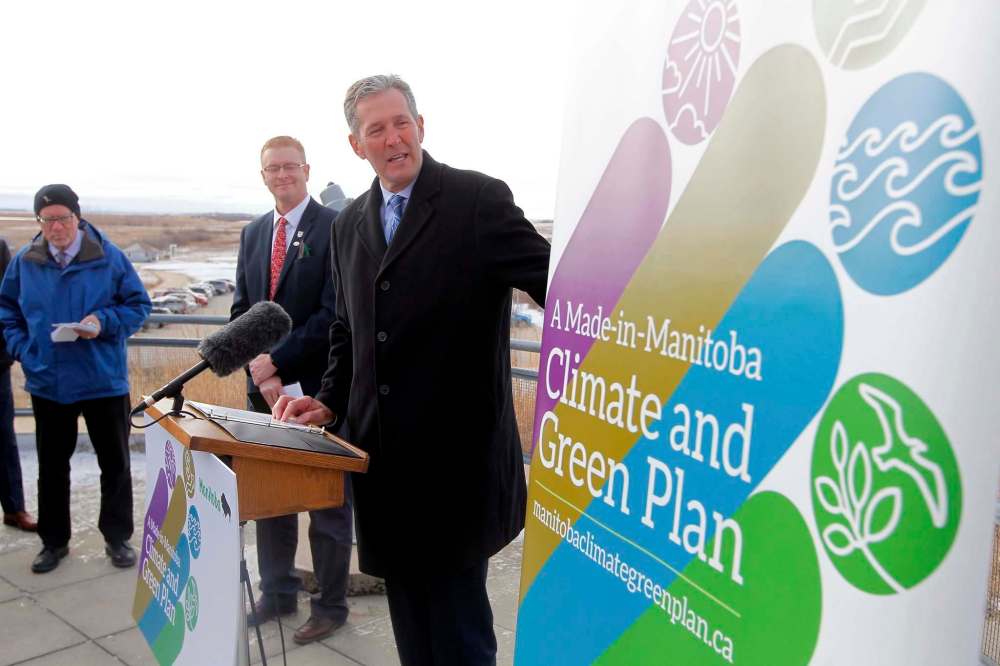
Considering this high value, it could have and should have been very easy for the prime minister to have said “yes” to Manitoba’s proposed Climate and Green Plan in September, and to create a truly national coalition. The federal government missed the opportunity, and now we are in a different situation.
Not only has the monetary value of Manitoba’s leadership been ignored, it has become apparent that the proposed federal carbon tax will be levied on Manitoba’s elevated levels of renewable biofuels. This was never stated outright, but becomes obvious in the detailed tax calculations. It also directly contradicts earlier stated federal principles.
The amounts involved are not trivial: roughly $3 million in the first year and $6 million in the second. Regrettably, there is a hint of spite, validating the accusation the levy is about taxation, not emissions.
While there certainly can be disagreements on how best to tackle emissions, taxing renewable biofuels is a bad idea. A smart move for the federal government, in order to treat Manitoba fairly, would be to immediately correct this unfortunate situation.
Robert Parsons teaches sustainability economics in the I.H. Asper School of Business, University of Manitoba.