

Climate is changing, but there’s still cause for hope
Advertisement
Read this article for free:
or
Already have an account? Log in here »
To continue reading, please subscribe:
Digital Subscription
One year of digital access for only $1.44 a week*
- Enjoy unlimited reading on winnipegfreepress.com
- Read the E-Edition, our digital replica newspaper
- Access News Break, our award-winning app
- Play interactive puzzles
*Billed as $5.77 plus GST every four weeks. After 52 weeks, price increases to the regular rate of $19.95 plus GST every four weeks. Offer available to new and qualified returning subscribers only. Cancel any time.
To continue reading, please subscribe:
Add Free Press access to your Brandon Sun subscription for only an additional
$1 for the first 4 weeks*
- Enjoy unlimited reading on winnipegfreepress.com
- Read the E-Edition, our digital replica newspaper
- Access News Break, our award-winning app
- Play interactive puzzles
*Your next Brandon Sun subscription payment will increase by $1.00 and you will be charged $17.95 plus GST for four weeks. After four weeks, your payment will increase to $24.95 plus GST every four weeks.
Read unlimited articles for free today:
or
Already have an account? Log in here »
Hey there, time traveller!
This article was published 01/10/2019 (2471 days ago), so information in it may no longer be current.
Our hearts break when we hear the fear in young voices as they describe facing their future with despair. They deserve better.
They should know, though, there is also reason for hope. There’s evidence-based optimism that people can rise up and do the right thing when the matter is vitally important.
Before we make the case for hope, it’s important to reinforce two critical points that were made repeatedly in the past weeks by Manitoba youth who joined a global protest against inaction on climate change.
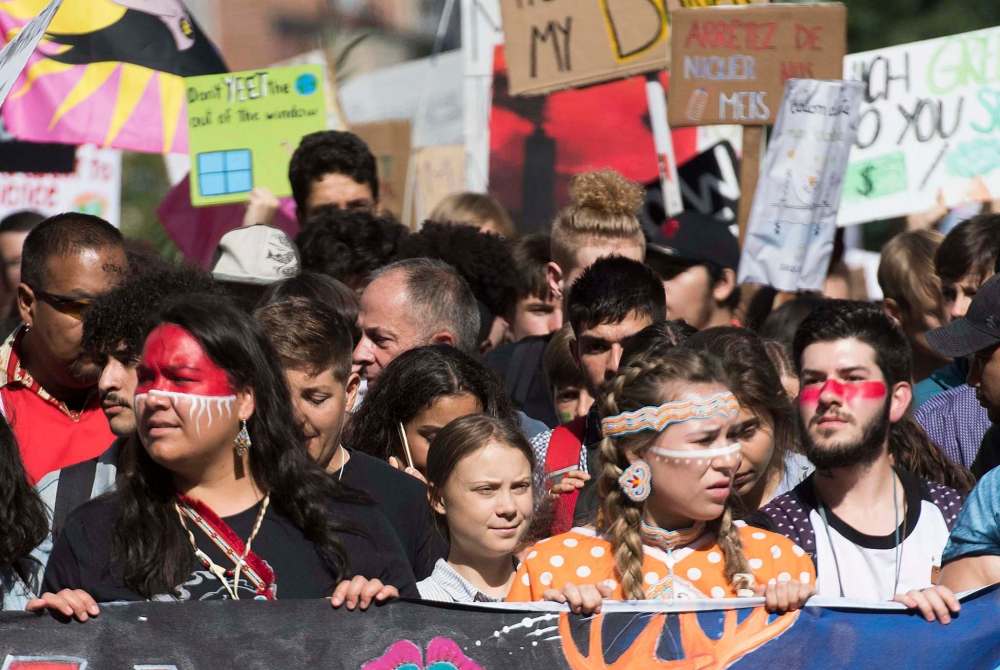
First, the prognosis for the planet is dire. That’s not opinion. That’s fact. If adults think the youth are exaggerating with sensational stunts like holding a “die-in” on the steps of the Manitoba legislature, signing a pledge not to bear children and holding signs like “There is no Planet B,” it’s because those adults don’t understand the irrefutable facts reported to the United Nations by the world’s top climate scientists.
Second, the youth are saying it’s not just climate change that is worrisome. It’s that the older generations who currently hold political and economic power have been too selfish to take the tough measures necessary to care for this sick planet. The youth are calling out their elders as hypocrites because Canada makes big promises but is one of the worst offenders in breaking its climate pledges.
As the sign of one young man read: “If you really think the economy is more important than the environment, try holding your breath while you count your money.”
So, where is the optimism?
It’s in the way Canadians during wartime put the greater good ahead of their personal comfort. Governments during both the First World War and the Second World War imposed extreme measures that demanded considerable sacrifices by Canadians in the name of patriotism.
It’s remarkable how those generations accepted hardships because the country needed it. And that’s the attitude shift that will be needed to slow the rise in global warming.
Granted, Canadian democracy has changed considerably since then, and we’re now conditioned to vote for politicians who appeal to our selfishness. In both the recent Manitoba election campaign and the current federal campaign, politicians tailored their campaign promises to attract demographic groups that vote with a “what’s in it for me?” calculation.
For instance, none of the current politicians would pledge, “We will slow global warming by raising the price of gasoline to $5 a litre, and tax beef so highly that it will be a rare treat instead of a staple.” Such major measures would benefit the planet, but such a promise would be political suicide for a Canadian party in 2019. But, during wartime, citizens accepted personal hardships because they viewed the cause as vital.
In 1917, Canada introduced compulsory military service, introduced personal taxation for the first time, expanded restrictions on alcoholic beverages and launched propaganda campaigns that encouraged people on the home front to ration meat or fuel.
In 1942, Canada introduced rationing of sugar, tea, coffee, butter and meat. Citizens collected meat fat and bones because it could be used for munitions production. The Winnipeg Patriotic Salvage Corps collected 690,554 pounds of bones and 323,001 pounds of fat during the war.
Today’s challenge is to inspire Canadians into a warlike mentality, with climate change as the enemy. Environmentalism can be the new patriotism.
We need a tipping point of Canadians who feel the same passion the war effort invoked in previous generations. Only then will politicians introduce the necessary tough love.
To offer three practical examples, social engineering by legislators — using taxation and marketplace restrictions — could influence whether our next new vehicle is electric, whether we will still vacation in exotic places that require air travel and whether we will continue to demand fruit such as bananas and oranges even though they must be trucked thousands of kilometres.

The good news from wartime precedents is that most Canadians approved of the hardships imposed on them as long as their imposition was equitable. Opinion surveys in 1944 and 1945 showed the vast majority of Canadians agreed rationing was fair, and they even supported the continuation of wartime controls into peacetime.
Intriguingly, histories of the home front during wars tell how a social stigma dogged cheaters who ignored rationing restrictions and used the black market to get more than their share. A modern-day equivalent would be climate-cause boosters calling out a neighbour whose new vehicle is an eight-cylinder gas guzzler.
Manitoba owes gratitude to today’s youth whose protests are sounding the alarm on climate change. Even more than that, we owe them action.
Carl DeGurse is a member of the Free Press editorial board.
carl.degurse@freepress.mb.ca