

Election timing treated as plaything
Advertisement
Read this article for free:
or
Already have an account? Log in here »
To continue reading, please subscribe:
Digital Subscription
One year of digital access for only $1.44 a week*
- Enjoy unlimited reading on winnipegfreepress.com
- Read the E-Edition, our digital replica newspaper
- Access News Break, our award-winning app
- Play interactive puzzles
*Billed as $5.77 plus GST every four weeks. After 52 weeks, price increases to the regular rate of $19.95 plus GST every four weeks. Offer available to new and qualified returning subscribers only. Cancel any time.
To continue reading, please subscribe:
Add Free Press access to your Brandon Sun subscription for only an additional
$1 for the first 4 weeks*
- Enjoy unlimited reading on winnipegfreepress.com
- Read the E-Edition, our digital replica newspaper
- Access News Break, our award-winning app
- Play interactive puzzles
*Your next Brandon Sun subscription payment will increase by $1.00 and you will be charged $17.95 plus GST for four weeks. After four weeks, your payment will increase to $24.95 plus GST every four weeks.
Read unlimited articles for free today:
or
Already have an account? Log in here »
Hey there, time traveller!
This article was published 14/06/2019 (2553 days ago), so information in it may no longer be current.
Any Manitoban who regularly reads the news has likely become familiar with fixed-date election laws over the past few months. For the information of those just returning from sojourns in sunnier locales, these laws require governments to hold elections on certain dates rather than leave their timing to the discretion of the premier.
And Manitoba’s fixed-date election law has been causing Premier Brian Pallister, the man with the itchy election finger, heaps of trouble.
The reasoning behind fixed-date election law is obvious: when premiers have the power to call early elections, they can be expected to do so in such a way that gives their parties an advantage in the subsequent campaign. Fixed-date elections take the incumbent government’s thumb off the scale.
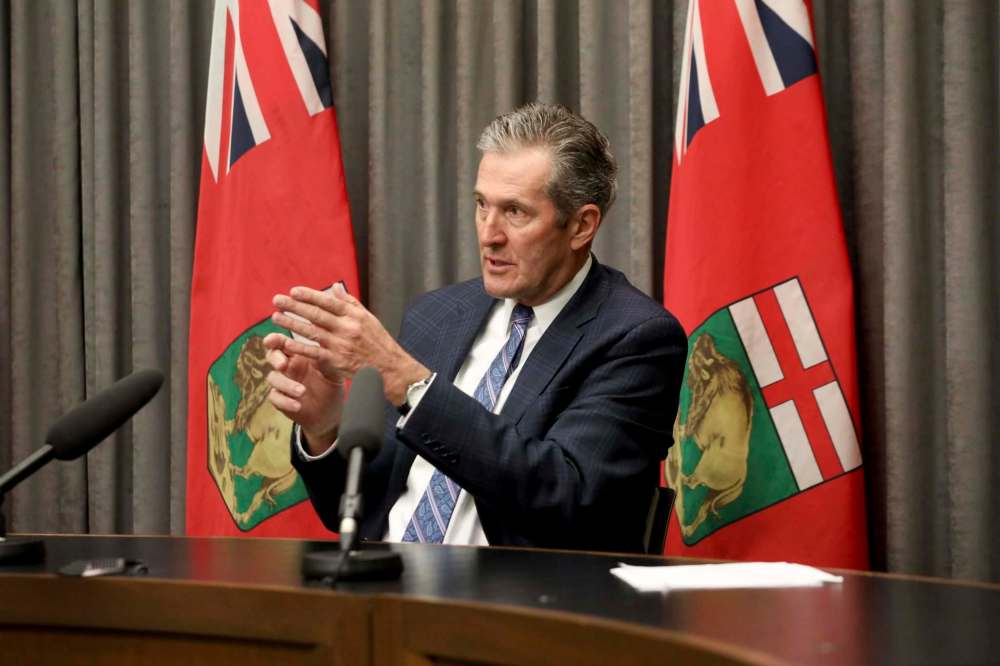
In general, people like to know when elections will be held. When pollsters ask Canadians what they think of fixed-date elections, these laws receive an overwhelmingly positive response.
But there is also a tension at the heart of these laws. In our parliamentary system, the lieutenant-governor almost always does what the premier asks him or her to do. If that weren’t the case, we would be living in a monarchical dictatorship rather than a democracy. So if premiers can simply ignore the law and call an election when they want, what is the point of the law?
This is why I’ve always been indifferent to fixed-date election laws. But I’ve recently had a change of heart, and that’s all thanks to Pallister.
For months, we’ve watched the premier engage in rhetorical gymnastics to justify holding an early election that he clearly wants to have. It has been quite the spectacle.
First, he admitted an early election would provide him with an advantage over his opponents. In December, Pallister said, “I was in sports too long. I’m not giving away whatever minor advantages I may have.” On fixed-date elections, Pallister asked rhetorically, “Why would I give my opponent that advantage?”
Apparently, someone whispered in Pallister’s ear that this self-serving rationale might not sit well with voters. So the premier employed a new approach, claiming that the fixed-date election law did not actually mandate an election on a specific date; instead, the fixed date was, Pallister claimed, a “drop dead date” by which an election had to be called.
Critics pointed out that this interpretation of the law makes little sense, so Pallister moved on to a new and novel explanation for why an election couldn’t be held in 2020: because it would conflict with the province’s 150th birthday celebration. Manitobans, the premier claimed, were telling him it would be horrible to hold an election during the province’s sesquicentennial.
Now, the premier has voluntarily created a blackout period prior to an anticipated early election. Statutory blackouts prior to fixed-date elections ensure that government announcements are non-partisan in nature. So the provincial government will now operate under a blackout that is not required by any law, but which is there because Pallister might call an early election.
Over the past several months, an early election has often been seen as right around the corner, but it never materialized. First there was going to be a spring election, with journalists at one point assuming the premier would drop the writ the next day. Pallister promised not to hold an election while a flood warning was in effect. So now, after other false starts, we are now anticipating a September election.
Will there actually be one? Who knows? Maybe the premier will change his mind. Maybe he won’t.
When asked when the election would be, Infrastructure Minister Ron Schuler joked, “The election will be in and around the time the premier calls it.” And that’s precisely the problem: election timing should not be the premier’s plaything. It’s exactly this kind of thinking that leads to fixed-election laws in the first place.

That’s one reason why I’ve warmed up to fixed-date election laws, but there’s another: for several months now, the premier has appeared at pains to avoid the perception that he is violating the spirit of the law.
He has misread the text of the law, formulated dubious reasons for why an early election is necessary, and pre-emptively made decisions designed to shield him from accusations of giving himself an unfair advantage.
All this when the premier could simply have walked outside the legislature and called an early election whenever he wished.
The fixed-date election law may not prevent an early election, and Pallister may not suffer electorally as a result of his early election call, but the presence of the law has forced the premier to justify himself repeatedly and ensured accountability. It has generated substantial media coverage of his decisions and raised public awareness of how early elections can favour the government. That’s all positive.
Royce Koop is an associate professor and head of the political studies department at the University of Manitoba.