

Electric vehicle study misfires on Canada

Advertisement
Read this article for free:
or
Already have an account? Log in here »
To continue reading, please subscribe:
Monthly Digital Subscription
$1 per week for 24 weeks*
- Enjoy unlimited reading on winnipegfreepress.com
- Read the E-Edition, our digital replica newspaper
- Access News Break, our award-winning app
- Play interactive puzzles
*Billed as $4.00 plus GST every four weeks. After 24 weeks, price increases to the regular rate of $19.95 plus GST every four weeks. Offer available to new and qualified returning subscribers only. Cancel any time.
Monthly Digital Subscription
$4.99/week*
- Enjoy unlimited reading on winnipegfreepress.com
- Read the E-Edition, our digital replica newspaper
- Access News Break, our award-winning app
- Play interactive puzzles
*Billed as $19.95 plus GST every four weeks. Cancel any time.
To continue reading, please subscribe:
Add Free Press access to your Brandon Sun subscription for only an additional
$1 for the first 4 weeks*
*Your next subscription payment will increase by $1.00 and you will be charged $16.99 plus GST for four weeks. After four weeks, your payment will increase to $23.99 plus GST every four weeks.
Read unlimited articles for free today:
or
Already have an account? Log in here »
Hey there, time traveller!
This article was published 19/01/2019 (2611 days ago), so information in it may no longer be current.
A new research study paints a rather misleading picture of Canada’s adoption of electric vehicles, using data that are essentially correct but portrayed to grab headlines more than convey truth.
The study, by the Welsh think tank GoCompare, first inserts the dagger with the observation that Canada’s 23,620 electric cars puts it 13th out of 30 member countries the International Energy Agency studied, and then goes on to twist the blade just a bit, saying there are more electric cars in each of such countries as Norway, the Netherlands, Sweden, Belgium and Switzerland — “all smaller than Canada.”
Coming around for a second swing, the press release says “Canada, the second-largest country in the world by area,” has 5,841 charging stations, making in the ninth-best-equipped country studied. “In comparison, the tiny Netherlands comes third with 32,875 charging points. This means Canada has the seventh-worst charging point network, with just 0.56 charging points every 100 kilometres, compared to 23.25 in the Netherlands.”
The insinuation, of course, is as a large country, Canada should do better than smaller countries. Ignored in all of that, however, is a basic understanding of geography.
The very things that make the Netherlands, one of the stars of the study, so ripe for the EV movement are the very things that make it exponentially more difficult for Canada.
The Netherlands and many of its European Union partners have the perfect environment in which to nourish a change to an electrified world: fossil fuels are very expensive, alternative transportation options abound and cities are very close to each other. As well, cities in Europe don’t seem afraid to use sound urban-planning principles to minimize citizens’ need to drive.
Consider some geography: the Netherlands packs 423 people, on average, per square kilometre; with that kind of population density, almost any business model can thrive. In Canada, that density is 3.6 people per square kilometre.
Canada’s land mass is 236 times that of the Netherlands, essentially meaning that to equal the Dutch success in installing charging stations, we’d need 7.7 million charging stations.
On that last point, consider the range of the Nissan Leaf, arguably one of the best examples of fully electric vehicles at a reasonable price point. It will do 243 kilometres, on average, on a single charge, in summer. Which means you could take a trip from Amsterdam to Antwerp, Belgium, and have range to spare. There are parts of Europe where you could easily visit three countries on a single charge.
In Canada, 243 kilometres means you proceed past Brandon without recharging at your peril.
But perhaps more important than the short distances between major cities in Europe is this: they have trains. Canada does, too, but not like Europe. In other words, if you are planning a trip outside your European home city, there’s a very good chance you’re going by train instead of by car. Once again, the still-limited range of EVs is less of an issue.
So if you don’t need a car to travel, and are within range of enough places if you do, the odds you will look favourably on an electric vehicle are high, particularly set against Europe’s panoply of punishing taxes, fees and surcharges, all deliberately set to discourage fossil-fuel use.

Touting China’s success in becoming an EV powerhouse is equally misleading: China may have the most EVs, but, according to worldatlas.com, is also the world’s biggest user of coal for electrical generation. Oops.
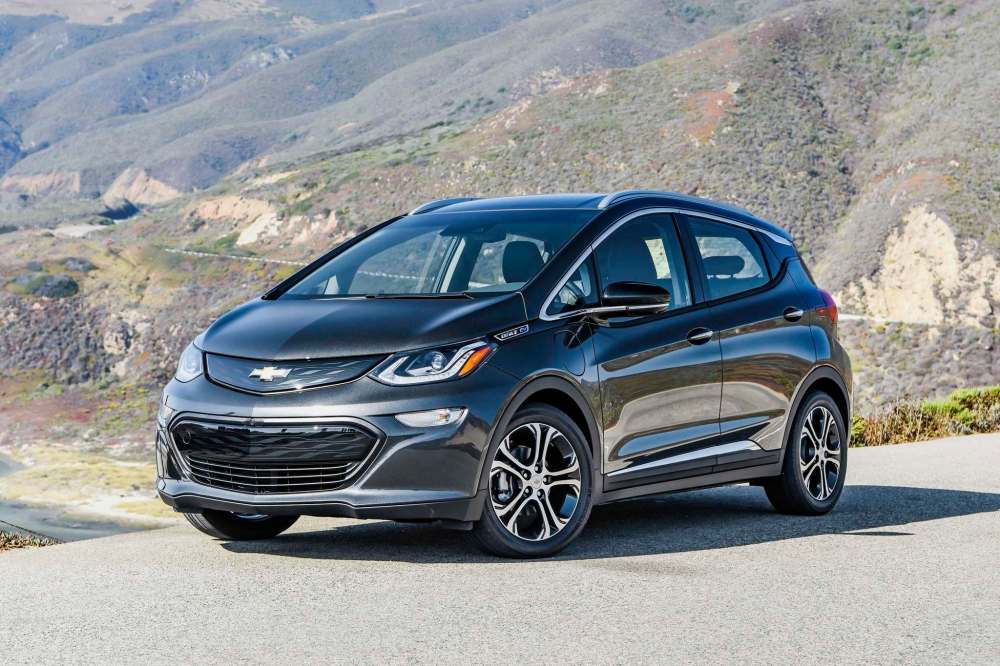
Electric vehicles and the networks to charge them are making great strides in Canada. The Chevrolet Bolt, for instance, now promises up to 353 kilometres of range under ideal conditions. As well, data from CAA suggest drivers of all EVs now on the market should be able to drive from coast to coast, at least when sticking to the Trans-Canada Highway.
Today, pretty much all the EVs for sale will cover the commuting needs of as many as 95 per cent of Canadians, and save about $1,200 to $2,500 per year in fuel and maintenance, according to Plug’N Drive, a Canadian advocacy group. But the Bolt sells for $44,900 and the Leaf for $36,798. Even with fuel savings, price is a big hurdle to clear. With gas below $1 per litre, that hurdle stands even higher.
Canada can do more to encourage EV adoption, from preferred rates for electricity to premium parking and incentives to install charging stations at homes and businesses. But absent the transportation options and relative proximity of European cities, expecting Canada to instantly approach Europe’s success is simply disingenuous virtue-signalling and should be ignored.
Kelly Taylor is a Free Press copy editor and an award-winning automotive journalist.
Kelly Taylor
Copy Editor, Autos Reporter
Kelly Taylor is a copy editor and award-winning automotive journalist, and he writes the Free Press‘s Business Weekly newsletter. Kelly got his start in journalism in 1988 at the Winnipeg Sun, straight out of the creative communications program at RRC Polytech (then Red River Community College). A detour to the Brandon Sun for eight months led to the Winnipeg Free Press in 1989. Read more about Kelly.
Every piece of reporting Kelly produces is reviewed by an editing team before it is posted online or published in print — part of the Free Press‘s tradition, since 1872, of producing reliable independent journalism. Read more about Free Press’s history and mandate, and learn how our newsroom operates.
Our newsroom depends on a growing audience of readers to power our journalism. If you are not a paid reader, please consider becoming a subscriber.
Our newsroom depends on its audience of readers to power our journalism. Thank you for your support.
Kelly Taylor
Copy Editor, Autos Reporter
Kelly Taylor is a copy editor and award-winning automotive journalist, and he writes the Free Press‘s Business Weekly newsletter. Kelly got his start in journalism in 1988 at the Winnipeg Sun, straight out of the creative communications program at RRC Polytech (then Red River Community College). A detour to the Brandon Sun for eight months led to the Winnipeg Free Press in 1989. Read more about Kelly.
Every piece of reporting Kelly produces is reviewed by an editing team before it is posted online or published in print — part of the Free Press‘s tradition, since 1872, of producing reliable independent journalism. Read more about Free Press’s history and mandate, and learn how our newsroom operates.
Our newsroom depends on a growing audience of readers to power our journalism. If you are not a paid reader, please consider becoming a subscriber.
Our newsroom depends on its audience of readers to power our journalism. Thank you for your support.
Advertisement Advertise With Us
Advertisement Advertise With Us