

Food-industry upheaval headed for a full boil
Advertisement
Read this article for free:
or
Already have an account? Log in here »
To continue reading, please subscribe:

Digital Subscription
One year of digital access for only $205*
- Enjoy unlimited reading on winnipegfreepress.com
- Read the E-Edition, our digital replica newspaper
- Access News Break, our award-winning app
- Play interactive puzzles
*First annual payment billed as $205.00 + GST for one year. This annual subscription will automatically renew at $233.00 + GST every 52 weeks (10% off the regular annual price of $259.35). Offer available to new and qualified returning subscribers only. Cancel any time.
To continue reading, please subscribe:
Add Free Press access to your Brandon Sun subscription for only an additional
$1 for the first 4 weeks*
- Enjoy unlimited reading on winnipegfreepress.com
- Read the E-Edition, our digital replica newspaper
- Access News Break, our award-winning app
- Play interactive puzzles
*Your next Brandon Sun subscription payment will increase by $1.00 and you will be charged $17.95 plus GST for four weeks. After four weeks, your payment will increase to $24.95 plus GST every four weeks.
Read unlimited articles for free today:
or
Already have an account? Log in here »
Hey there, time traveller!
This article was published 03/07/2018 (2988 days ago), so information in it may no longer be current.
Campbell Soup Co. stocks soared after news suggesting the company could be bought by Kraft Heinz Co., one of 3G Capital and Warren Buffett’s pet projects in the food sector.
Even though the deal is highly unlikely, the rumours point to a much larger story in food processing.
Since 2013, the acquire-and-cut modus operandi has worked well, and made Kraft Heinz a more profitable enterprise. The 3G Capital-Buffett duo acquired Heinz in 2013, and Kraft two years later.
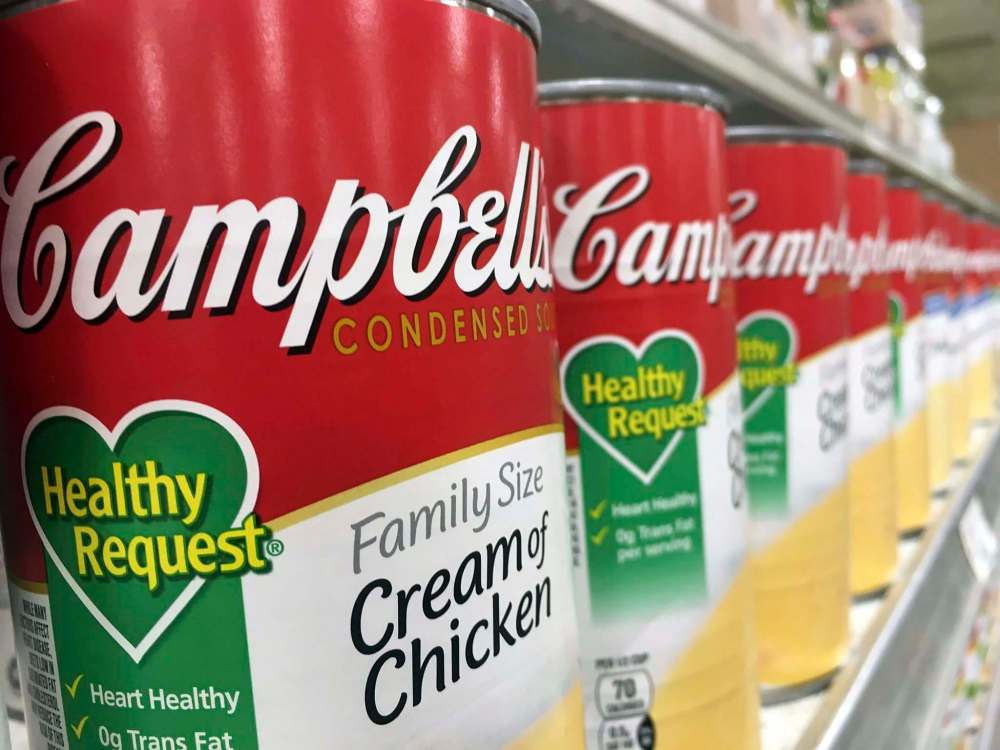
Cost management and rising margins were key to making these businesses profitable. But organic growth is painfully absent, meaning Kraft Heinz needs another deal, and fast. After its epic failure to purchase Unilever in 2017, it’s back on the hunt.
But a Kraft Heinz and Campbell Soup deal doesn’t make sense from a strategic perspective.
Campbell Soup, with its iconic brand, is essentially a North American player with inside ownership.
The founding family still owns a good portion of the company, and would need to concede to any deal.
To grow, Kraft Heinz needs more global brands in its portfolio.
Campbell Soup is a relatively small company with major issues in its primary business. Soup is essentially impractical for consumers who want to eat on the go.
Additionally, most product lines offer unhealthy and unnatural alternatives by modern standards. That’s two strikes in today’s demanding food landscape.
Campbell Soup has tried, unsuccessfully, to revitalize the category in many ways.
Most packaged-food companies would be happy to see their top line grow by one per cent yearly.
But Campbell Soup sales have declined for the last three years, and it’s desperate to keep its sales stable.
And Kraft Heinz sales fell by more than US$200 million in the last year, and are expected to fall even further this year.
The broader picture signals troubled waters ahead. Times are tough in food packaging.
Campbell Soup recently announced its chief executive, Denise Morrison, was retiring and the company would conduct a strategic renewal process over its entire portfolio.
Morrison became the 15th CEO to leave the helm of a major food-processing company in two years.
The turnover is painfully high.
More broadly, the trade wars triggered by the United States threaten to worsen the situation for the industry. So far, most trade sanctions have not been related to agriculture or commodities.
New tariffs have spared the food packaging sector and haven’t forced companies to alter their global food supply chain strategy.
But that could change.
Like Campbell Soup, Kraft Heinz’s dependency on North American business is acute. Retaliatory measures against the United States could affect these companies over the next 18 months.
That’s why time is of the essence.
Kraft Heinz not only wants to expand its portfolio and grow globally, it also needs to hedge against Washington’s erratic trade policies.
The Kraft Heinz/Campbell Soup deal may not happen, if only for financial reasons.
For Kraft Heinz, Campbell Soup is a relatively small player which wouldn’t make much of a difference. Its market capitalization is barely US$13 billion.
But this could be an interesting stepping stone for Kraft Heinz as it looks for its next target.
Rumours are rampant in food packaging. Everyone wants to grow — Kraft Heinz most of all.
The company missed a US$140-billion deal to purchase Unilever last year, and is still looking for the next opportunity.
Perhaps, in the grocery business, that deal will bring Kraft Heinz closer to consumers who are slowly moving away from major national brands.
Given the economic climate, chances are that rumours of acquisitions will continue for some time.
Mondelez International Inc. and Kellogg Co. are both possible targets for Kraft Heinz. Certainly, fewer big players will remain in the sector a few years from now.

This gives new hope to smaller, regional players.
As the giants swallow each other up, a new crop of food companies is emerging. That’s not necessarily a bad thing, because consumers want something different, which major players seemingly can’t deliver.
Sylvain Charlebois is dean of the management faculty and a professor in the agriculture faculty at Dalhousie University, senior fellow with the Atlantic Institute for Market Studies, and author of Food Safety, Risk Intelligence and Benchmarking.
— Troy Media