

I’m a white residential school survivor
Advertisement
Read this article for free:
or
Already have an account? Log in here »
To continue reading, please subscribe:

Digital Subscription
One year of digital access for only $205*
- Enjoy unlimited reading on winnipegfreepress.com
- Read the E-Edition, our digital replica newspaper
- Access News Break, our award-winning app
- Play interactive puzzles
*First annual payment billed as $205.00 + GST for one year. This annual subscription will automatically renew at $233.00 + GST every 52 weeks (10% off the regular annual price of $259.35). Offer available to new and qualified returning subscribers only. Cancel any time.
To continue reading, please subscribe:
Add Free Press access to your Brandon Sun subscription for only an additional
$1 for the first 4 weeks*
- Enjoy unlimited reading on winnipegfreepress.com
- Read the E-Edition, our digital replica newspaper
- Access News Break, our award-winning app
- Play interactive puzzles
*Your next Brandon Sun subscription payment will increase by $1.00 and you will be charged $17.95 plus GST for four weeks. After four weeks, your payment will increase to $24.95 plus GST every four weeks.
Read unlimited articles for free today:
or
Already have an account? Log in here »
Hey there, time traveller!
This article was published 27/09/2018 (2909 days ago), so information in it may no longer be current.
I am a residential school survivor, and yet I am white. So, when I heard that the Frontier Centre for Public Policy was asking whether Canadians were being told the whole truth about residential schools, my ears pricked up. Because many are unaware that some residential schools also had students who were non-Indigenous.
Recently, the Frontier Centre ran a two-minute radio spot telling people that they haven’t been given the truth about residential schools. The Winnipeg organization’s ad disputes the harm done to Indigenous kids by residential schools, harm that has been passed down through generations. Needless to say, the paid spot and its message sparked outrage, and thankfully, the corporate owner of the radio stations that ran the ads has since apologized.
As someone who has survived the residential school system, with all my white privilege, I still bear enormous scars. And yet, I consider myself lucky. The school system wasn’t attempting to eradicate my culture, my spirituality, my language — which leads me to ask the question: if I have difficulty getting over this trauma, how can we expect Indigenous Peoples who spent time in the system (whether five years or five minutes) to grapple with the hurt?
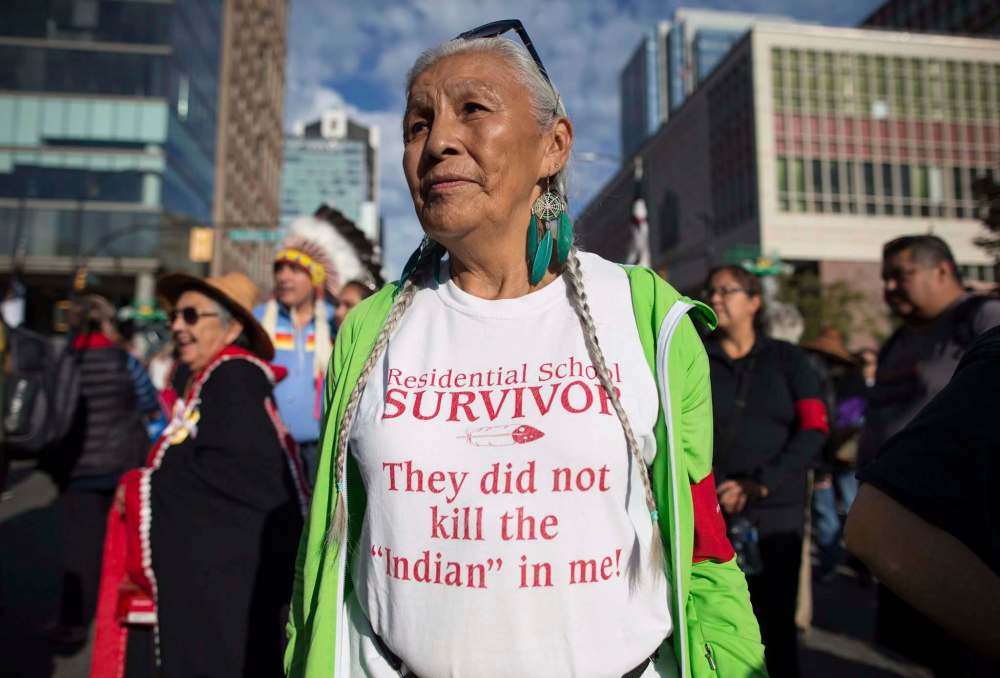
The government of Canada doesn’t really have a number for how many non-Indigenous students attended residential schools, but they are just as much a part of this country’s racist past. They are witnesses, too.
In some cases, residential schools were the only schools available in the area for non-Indigenous kids to attend. Or those kids may have attended the schools because their parents were principals or teachers, or government employees working in the area. In my case, my brother and I were in the Northwest Territories because my father was employed with what was then called the department of transport, working on the airport serving Snag, then Beaton River, Fort Smith and Fort Simpson.
It was at Fort Simpson that I began my journey into a federal day school, which housed two residential hostels for Indigenous kids: the Bompas Hall, run by the Anglican Church; and Lapointe Hall, operated by the Roman Catholics. This was the residential school system in Fort Simpson. Because the airport and our housing were located some distance away from Fort Simpson, when the river was breaking up in the spring, our causeway would become impassable because of ice. My brother and I would be forced to live in the hostel until the road was driveable again. We would then stay amongst the other little boys and girls, who were also separated from their moms and dads. My brother and I knew that we got to go home again just as soon as the ice cleared.
Ry Moran, the director of the National Centre of Truth and Reconciliation at the University of Manitoba, said for both Indigenous and non-Indigenous students, residential schools were a frightening experience.
In one case, a white student, who was the son of a school principal, had such a difficult time that “even until his mom was well into her 80s, she still could not talk about it. It was so difficult on the family’s lives.”
But Moran points out that, because I was white, I was not viewed through highly racist and demeaning eyes by some of the teachers and staff. Unfortunately, Moran said, that’s how Indigenous kids were seen by some of those in charge, “which made things like the brutal abuse become easier for the twisted minds of the pedophile rapist. They did not view them as human, and so, they could completely disassociate themselves from what they were doing to these children.”
For my brother and I, much of the violence we experienced was at the hands of the older boys in the school, something Moran said was not unusual in the residential school system, in which 40 per cent of the cases related to student-on-student abuse. Moran said in some residential schools, different nations were pitted against each other and Indigenous groups from different backgrounds and cultures were forced to live together. And, of course, violence begets violence.
The research is clear: childhood trauma, including exposure to violence, causes long-term neurobiological changes.

Research has demonstrated over and over that taking children away from their parents breaks an important emotional bond and creates profound physical, social and emotional trauma. Studies point to heightened drug use, alcohol abuse, diminished cognitive abilities, an inability to set boundaries and difficulties in establishing healthy interpersonal relationships.
As a white kid, I got to go home to my mom and dad, who could tuck me into bed and tell me bedtime stories and reassure me that I was going to be OK. I had lots of food to eat, clean clothes to wear and long hair that no one tried to cut.
Even with all of that, as non-Indigenous individuals who spent just a small time in a residential school environment, both my brother and I suffer from the effects of violence and the trauma we experienced in the North. It’s not something either of us will ever “just get over.”
Can we at least try to understand why this is not an issue that is going to go away just because we wish it would, no matter how many times people with specific agendas try to deny it happened?
Shannon Sampert is the director of the media centre for public policy and knowledge mobilization at the University of Winnipeg.