

King’s dream remains unrealized
Advertisement
Read this article for free:
or
Already have an account? Log in here »
To continue reading, please subscribe:
Monthly Digital Subscription
$1 per week for 24 weeks*
- Enjoy unlimited reading on winnipegfreepress.com
- Read the E-Edition, our digital replica newspaper
- Access News Break, our award-winning app
- Play interactive puzzles
*Billed as $4.00 plus GST every four weeks. After 24 weeks, price increases to the regular rate of $19.95 plus GST every four weeks. Offer available to new and qualified returning subscribers only. Cancel any time.
Monthly Digital Subscription
$4.99/week*
- Enjoy unlimited reading on winnipegfreepress.com
- Read the E-Edition, our digital replica newspaper
- Access News Break, our award-winning app
- Play interactive puzzles
*Billed as $19.95 plus GST every four weeks. Cancel any time.
To continue reading, please subscribe:
Add Free Press access to your Brandon Sun subscription for only an additional
$1 for the first 4 weeks*
*Your next subscription payment will increase by $1.00 and you will be charged $16.99 plus GST for four weeks. After four weeks, your payment will increase to $23.99 plus GST every four weeks.
Read unlimited articles for free today:
or
Already have an account? Log in here »
Hey there, time traveller!
This article was published 04/04/2018 (2899 days ago), so information in it may no longer be current.
Fifty years ago today, April 4, 1968, Martin Luther King Jr. was assassinated in Memphis, Tenn. A man named James Earl Ray was convicted, but as activist Angela Davis said, “Racism was Martin Luther King’s assassin.”
King was a brilliant leader in the African-American struggle for freedom in America’s Deep South. His name forever will be associated with courageous victories in Montgomery, Ala., where he rose to prominence leading a successful 381-day boycott of segregated buses, and Birmingham, Ala., where young people marched in the face of police chief Bull Conner’s vicious dogs, fire hoses and mass imprisonment.
By the mid-1960s, America was exploding with huge anti-war demonstrations and urban rebellions in Watts, Newark, Detroit and elsewhere. As King pointed out, although these were typically called riots, “a riot is the language of the unheard.” The unheard were expressing their rage. The Black Panthers were expanding rapidly, Malcolm X was winning converts and it was feared that a revolution was in the making, even though the Kerner Commission, established to investigate these urban uprisings, found that “white racism is essentially responsible.”
African-Americans’ massive struggle for freedom produced a fierce backlash. King was assassinated; Medgar Evers was assassinated; Robert Kennedy, who had turned to the political left in response to Vietnam and racism and poverty, was assassinated; Malcolm X was assassinated; Fred Hampton, along with other Black Panther leaders, was assassinated.
King made his famous “I have a dream” speech at the March on Washington in August 1963, when a quarter of a million people gathered in support of the civil rights movement. Three weeks later, members of the Ku Klux Klan bombed a church in Birmingham, killing four African-American children. The racist hatred was unrelenting.
White voters in the South, angered by the Democrats’ success in securing passage of the Civil Rights Act and the Voting Rights Act, moved to the Republicans, as did much of the white working class, leading to the election first of Richard Nixon in 1968 and then Ronald Reagan in 1980. Reagan launched a war on drugs and on the poor, especially the African-American poor — symbolized by his bitterly racist attack on “welfare queens.”
There followed deep cuts to social assistance, astonishing levels of black imprisonment and deepening levels of despair and violence in urban ghettoes.
King was radicalized by his experience in an urban ghetto when he moved with his family into a run-down apartment in Chicago’s west side in 1966 to take his campaign to the urban north. The poverty was overwhelming; the racism worse than in the Deep South. He said, “I had never seen, even in Mississippi, as much hatred and hostility on the part of so many people” as he faced in Chicago.
Something more radical than the campaign in the Deep South was needed, King believed. In a speech at New York’s Riverside Church on April 4, 1967, exactly one year before his assassination, King said: “A nation that continues year after year to spend more money on military defence than on programs of social uplift is approaching spiritual death… this madness must cease.” He called for a “radical revolution of values” and an all-out assault on the three evils: “poverty, racism and militarism.”
By this time King had been jailed 30 times, the FBI had recorded some 50 assassination plots directed at him, had harassed and falsely discredited him and had labelled him “the most dangerous man in America.” When he went to Memphis, Tenn., in March and again in April 1968, in support of black sanitation workers striking for the right to form a union, he was beset from every side.
Black urban youth thought his non-violent direct action too timid; the establishment saw him as a threat to the nation’s stability; most non-black Americans despised him.
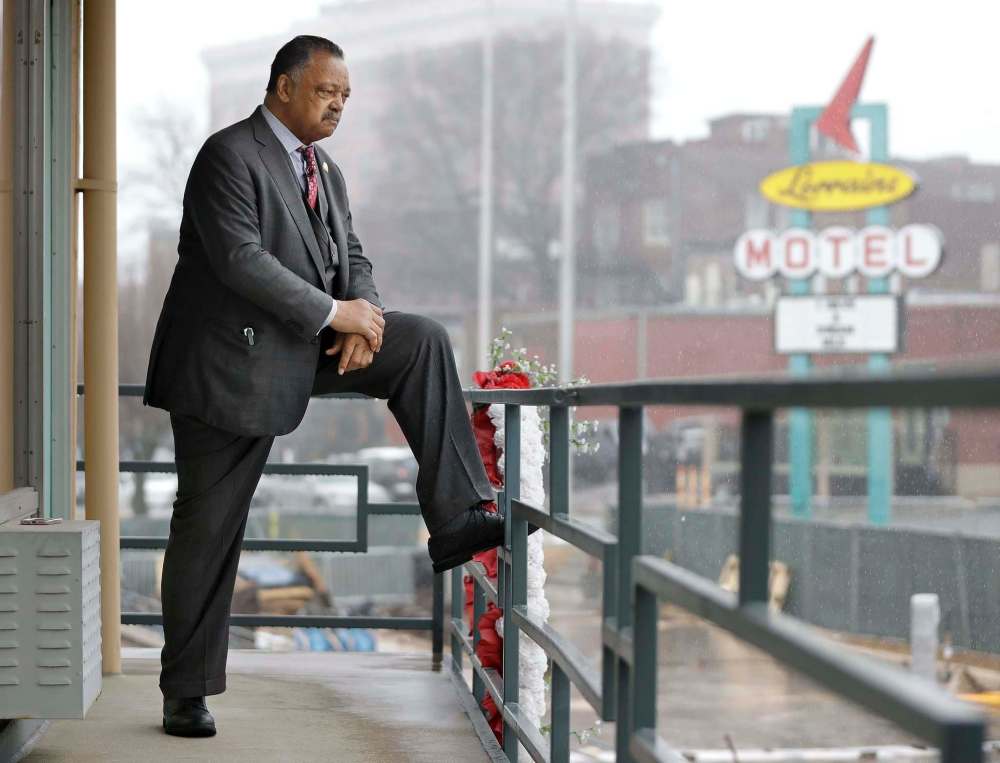
Late in the afternoon of April 4, 1968, while standing on the balcony of Room 306 at the Lorraine Motel in Memphis, he was assassinated. Racism, his unrelenting foe, took his life. He was 39 years old.
King had reached the conclusion that America’s racism, poverty and militarism could only be overcome by a massive redistribution of wealth and power. This has not happened. On the contrary, since his assassination, wealth and power have been further concentrated in the hands of an elite few. The most recent U.S. federal budget features a massive redistribution of wealth — to the already wealthy.

Racism remains: Dylann Roof, a 21-year-old white supremacist, murdered nine African-American people worshipping in a church in Charleston, S.C.; white supremacists and Klan members descended upon Charleston, Va., killing one person and spewing racist hatred, in response to which U.S. President Donald Trump extolled the “very fine people” on “both sides;” a seemingly endless list of African-Americans — Eric Garner, Sandra Bland, Tamir Rice, Michael Brown, Treyvon Martin and many more — have been killed by police.
Slavery — brutally inhumane and massively profitable as it was — made racism necessary in America. King’s call to rise up against injustice and to redistribute the country’s wealth to overcome poverty and racism, was his death sentence.
King’s dream — of “that day when all God’s children… will be able to join hands and sing in the words of the old Negro spiritual, ‘Free at last! Free at last! Thank God almighty, we are free at last!’” — is no closer today than it was 50 years ago. The dream has been shattered by the racist, right-wing assault on the African American fight for freedom and equality, leaving a trail of chaos and violence and an ever-widening gap between rich and poor.
More than ever, America needs what Martin Luther King Jr. called “a radical revolution of values” and an attack not on the African-American poor, but on the triple evils: poverty, racism and militarism.
Jim Silver is a professor in the University of Winnipeg’s urban and inner city studies program and a research associate for the Canadian Centre for Policy Alternatives (Manitoba).