

King’s letter resonates in current crisis
Advertisement
Read this article for free:
or
Already have an account? Log in here »
To continue reading, please subscribe:

Digital Subscription
One year of digital access for only $205*
- Enjoy unlimited reading on winnipegfreepress.com
- Read the E-Edition, our digital replica newspaper
- Access News Break, our award-winning app
- Play interactive puzzles
*First annual payment billed as $205.00 + GST for one year. This annual subscription will automatically renew at $233.00 + GST every 52 weeks (10% off the regular annual price of $259.35). Offer available to new and qualified returning subscribers only. Cancel any time.
To continue reading, please subscribe:
Add Free Press access to your Brandon Sun subscription for only an additional
$1 for the first 4 weeks*
- Enjoy unlimited reading on winnipegfreepress.com
- Read the E-Edition, our digital replica newspaper
- Access News Break, our award-winning app
- Play interactive puzzles
*Your next Brandon Sun subscription payment will increase by $1.00 and you will be charged $17.95 plus GST for four weeks. After four weeks, your payment will increase to $24.95 plus GST every four weeks.
Read unlimited articles for free today:
or
Already have an account? Log in here »
Hey there, time traveller!
This article was published 28/02/2020 (2383 days ago), so information in it may no longer be current.
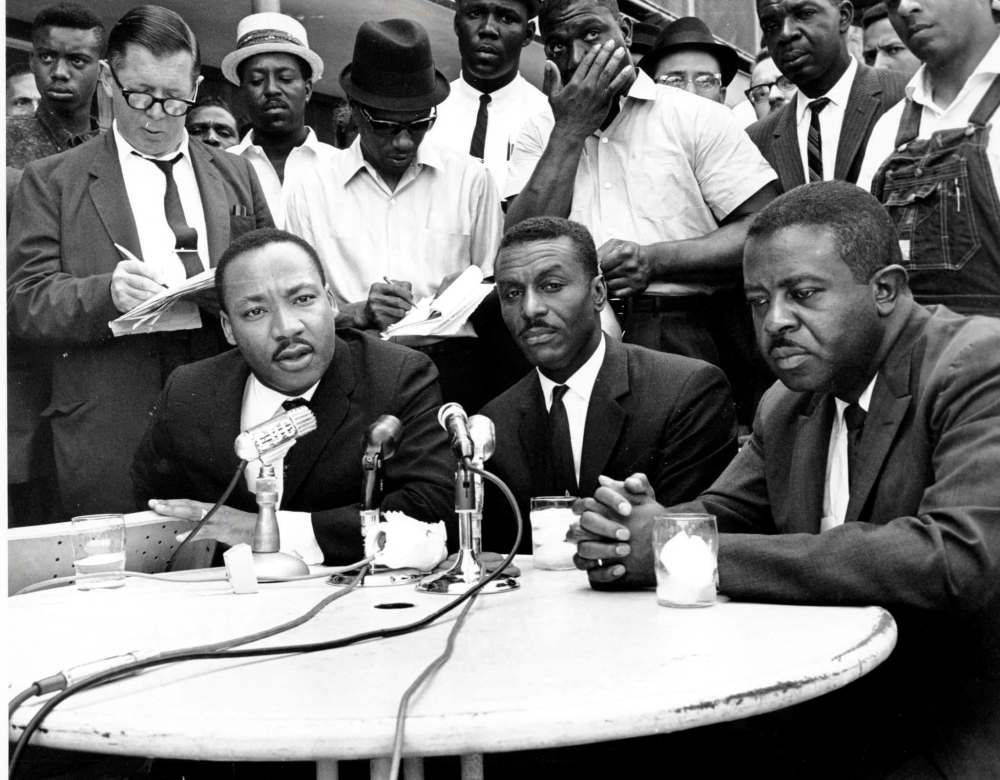
IN April, 1963, Martin Luther King Jr. named Birmingham, Ala., as the most segregated city in the United States and made it the target of civil-rights demonstrations. As a response, Birmingham’s police commissioner got an injunction against all demonstrations from a state court. King announced that he would ignore the court injunction, and led a march of some 1,000 people toward the city’s business district.
He was arrested and thrown in jail. A group of religious leaders wrote an open letter calling for “the rule of law,” stating that concerns should be addressed through negotiations rather than in the streets. Time magazine was also critical of King’s decision to ignore the court injunction banning demonstrations.
While King was in jail, he wrote a response to the public statement of concern and caution issued by the white religious leaders. His famous “Letter from Birmingham Jail” provides timeless wisdom, particularly relevant in Canada today, regarding the role of non-violent direct action and civil disobedience as a catalyst for profound change in society.
The letter states, “You may well ask: Why direct action? Why sit ins, marches and so forth? Isn’t negotiation a better path? You are quite right in calling for negotiation. Indeed, this is the very purpose of direct action. Non-violent direct action seeks to create such a crisis and foster such a tension that a community which has constantly refused to negotiate is forced to confront the issue. It seeks so to dramatize the issue that it can no longer be ignored.”
King goes on to say, “I must confess that I am not afraid of the word tension. I have earnestly opposed violent tension, but there is a type of constructive non-violent tension which is necessary for growth. Just as Socrates felt that it was necessary to create a tension in the mind so that individuals could rise from the bondage of myths and half-truths to the unfettered realm of creative analysis and objective appraisal, we must see the need for non-violent gadflies to create the kind of tension in society that will help people rise from the dark depths of prejudice and racism to the majestic heights of understanding and brotherhood.
“The purpose of our direct action program is to create a situation so crisis-packed that it will inevitably open the door to negotiation. I therefore concur with you in your call for negotiation. Too long has our beloved Southland been bogged down in a tragic effort to live in monologue rather than dialogue.”
King’s letter further pointed out that “not a single gain for civil rights has been made without determined legal and non-violent pressure. Lamentably, it is an historical fact that privileged groups seldom give up their privileges voluntarily. We know through painful experience that freedom is never voluntarily given by the oppressor; it must be demanded by the oppressed.”
In the summer of 1963, after King’s release from jail, he organized the March on Washington, which involved some 200,000 people and was the site of his legendary “I Have a Dream” speech.

Although Time magazine initially criticized King for ignoring the court injunction in Birmingham, its editors came to understand the foundational impact of his work and named Martin Luther King Jr. its Person of the Year for 1963.
King told Time that strategic economic leverage through direct action is required in order to get those in power to the negotiating table. “You don’t win against a political power structure where you don’t have the votes,” he said. “But you can win against an economic power structure to make the difference between a merchant’s profit and loss.”
In 1983, U.S. president Ronald Reagan, after initial opposition to the idea, signed into law the Martin Luther King Jr. Day national holiday to honour the political activism and civil-rights legacy of his work. Consistent with the struggle for change, it was not until 2000 that all 50 states officially observed Martin Luther King Jr. Day.
History teaches us that civil disobedience and non-violent direct action play a critical role in promoting fundamental change in a democratic society. “The rule of law” must be viewed in this context. King’s insight about the distinction between “order and justice; a negative peace which is the absence of tension; and a positive peace which is the presence of justice” provides an enduring message for our country about the journey of building a peaceful and just society.
Tom Simms has been an inner-city community organizer in Winnipeg for the past 40 years.