

Leaders wrong to accede to Quebec’s symbols-ban demand
Advertisement
Read this article for free:
or
Already have an account? Log in here »
To continue reading, please subscribe:

Digital Subscription
One year of digital access for only $205*
- Enjoy unlimited reading on winnipegfreepress.com
- Read the E-Edition, our digital replica newspaper
- Access News Break, our award-winning app
- Play interactive puzzles
*First annual payment billed as $205.00 + GST for one year. This annual subscription will automatically renew at $233.00 + GST every 52 weeks (10% off the regular annual price of $259.35). Offer available to new and qualified returning subscribers only. Cancel any time.
To continue reading, please subscribe:
Add Free Press access to your Brandon Sun subscription for only an additional
$1 for the first 4 weeks*
- Enjoy unlimited reading on winnipegfreepress.com
- Read the E-Edition, our digital replica newspaper
- Access News Break, our award-winning app
- Play interactive puzzles
*Your next Brandon Sun subscription payment will increase by $1.00 and you will be charged $17.95 plus GST for four weeks. After four weeks, your payment will increase to $24.95 plus GST every four weeks.
Read unlimited articles for free today:
or
Already have an account? Log in here »
Hey there, time traveller!
This article was published 11/10/2019 (2464 days ago), so information in it may no longer be current.
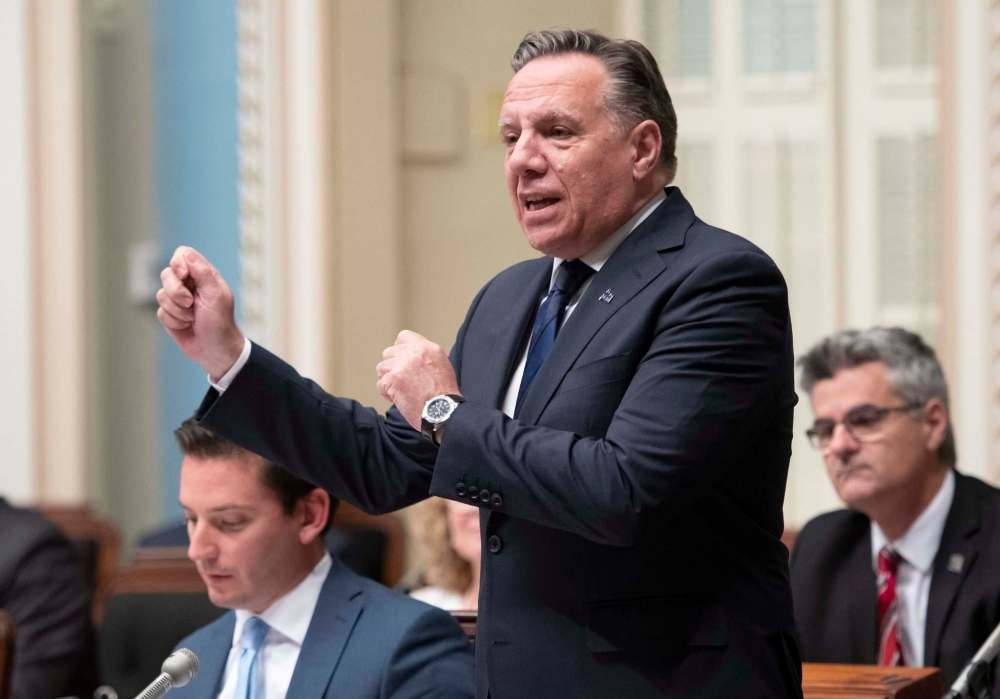
In the early days of the federal election campaign, Quebec Premier François Legault called on leaders of Canada’s federal parties to pledge not to take part in any legal challenges against the province’s Act respecting the laicity of the State, the secularism law that bars public servants in positions of authority from wearing religious symbols such as a hijab, turban or kippah.
Justin Trudeau, the Liberal leader, was the first to promise that he would reserve the right to intervene at a later date. Following Monday night’s English leaders’ debate, NDP leader Jagmeet Singh stated that he might consider intervening if the challenge were heard by the Supreme Court of Canada. For their part, Conservative leader Andrew Scheer and People’s Party leader Maxime Bernier acceded to Premier Legault’s request. Their decision to commit in advance not to participate in a legal challenge is wrongheaded.
A decision whether to intervene should be made only once the federal government has had the opportunity to assess all constitutional arguments raised by the parties to the litigation and decide whether it is in the public interest to participate in the proceedings.
Well-established procedural rules provide that interested attorneys general must receive notice of litigation that raises the constitutional validity of a law to ensure they have the opportunity to address this question. On an appeal to the Supreme Court, a notice of constitutional question must be sent to all attorneys general that are not already parties to the appeal, including the attorney general of Canada and attorneys general of the provinces and territories.
As noted by several constitutional law experts, the invocation of the Canadian Charter of Rights and Freedoms’ notwithstanding clause in the Act respecting the laicity of the State would not prevent a reviewing court from reviewing that law’s constitutionality.
While the court could not declare that the secularism law has no force and effect, rendering it inoperative, nothing would prevent it from declaring that the law nevertheless violates the rights to freedom of religion and freedom of expression and equality, and that the limits it imposes on these rights are not reasonable and demonstrably justified in a free and democratic society.
The scope of these fundamental rights and the operation of the charter’s notwithstanding clause are clearly legal questions that would be of great interest to all attorneys general in Canada. They should be free to decide whether to participate in litigation before the Supreme Court involving the constitutionality of the secularism law if, in their opinion, intervention is in the public interest and necessary to ensure that the court benefits from the complete record and exhaustive legal submissions indispensable for a rigorous review of the law’s validity and a just interpretation of the charter’s provisions.

Legault’s demand that federal leaders commit not to participate in litigation on the constitutionality of Quebec’s secularism law also reveals a double standard, because Quebec regularly intervenes in constitutional litigation that originates outside of that province. In 2015, for example, Quebec’s attorney general intervened against the position advanced by the Yukon francophone school commission in a case pitting it against the Yukon government on the question of the scope of the right to education in the language of the minority guaranteed by Section 23 of the charter.
While many were disappointed that Quebec chose to support a restrictive interpretation of Section 23 to the detriment of minority francophone communities, no one contested the right of its attorney general to put before the Supreme Court a legal argument that she judged to be in Quebec’s public interest.
The argument that litigation bearing on the Act respecting the laicity of the State concerns only Quebec and that federal politicians should “mind their own business” does not hold water. While it bears on the constitutionality of a Quebec law, such litigation will likely have significant and long-standing national implications on the scope of the fundamental rights protected by the charter — a question of interest to every Canadian.
By undertaking not to intervene before even getting an opportunity to review the legal arguments advanced by the parties for and against the law’s constitutional validity and without weighing the possible repercussions on Canadians’ fundamental Charter rights and freedoms, Andrew Scheer and Maxime Bernier have abdicated their responsibility to make an informed decision in the interest of all Canadians
Gerald Heckman is an associate professor in the faculty of law at the University of Manitoba.
History
Updated on Friday, October 11, 2019 3:17 PM CDT: Updates two paragraphs with info based on remarks from English-language debate