

May’s departure solves nothing
Advertisement
Read this article for free:
or
Already have an account? Log in here »
To continue reading, please subscribe:
Monthly Digital Subscription
$1 per week for 24 weeks*
- Enjoy unlimited reading on winnipegfreepress.com
- Read the E-Edition, our digital replica newspaper
- Access News Break, our award-winning app
- Play interactive puzzles
*Billed as $4.00 plus GST every four weeks. After 24 weeks, price increases to the regular rate of $19.95 plus GST every four weeks. Offer available to new and qualified returning subscribers only. Cancel any time.
Monthly Digital Subscription
$4.99/week*
- Enjoy unlimited reading on winnipegfreepress.com
- Read the E-Edition, our digital replica newspaper
- Access News Break, our award-winning app
- Play interactive puzzles
*Billed as $19.95 plus GST every four weeks. Cancel any time.
To continue reading, please subscribe:
Add Free Press access to your Brandon Sun subscription for only an additional
$1 for the first 4 weeks*
*Your next subscription payment will increase by $1.00 and you will be charged $16.99 plus GST for four weeks. After four weeks, your payment will increase to $23.99 plus GST every four weeks.
Read unlimited articles for free today:
or
Already have an account? Log in here »
Hey there, time traveller!
This article was published 27/05/2019 (2469 days ago), so information in it may no longer be current.
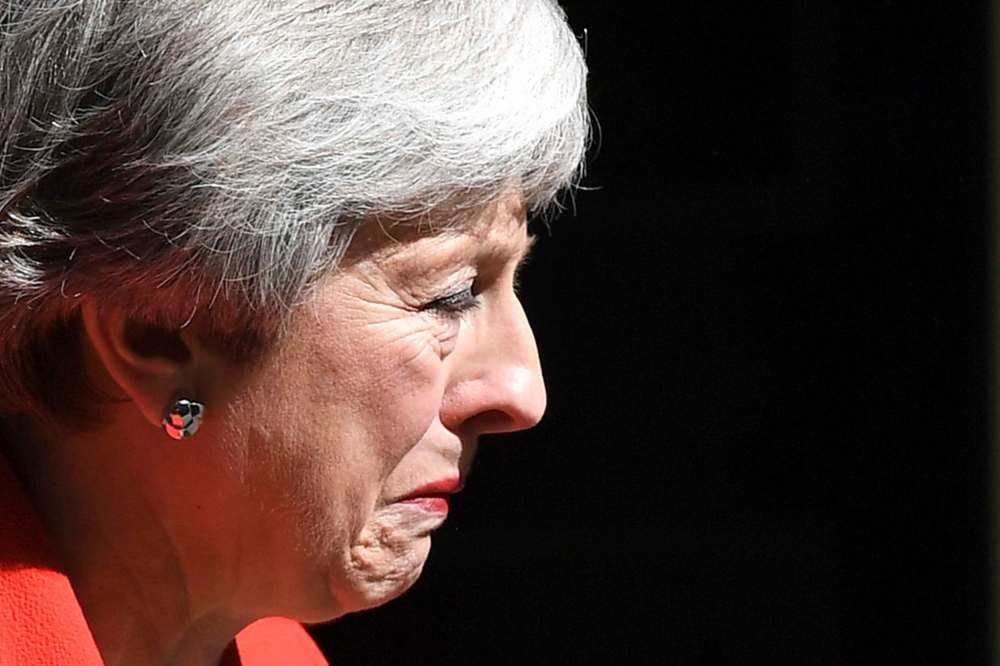
And, just like that, she’s gone. Theresa May, the least successful British prime minister in living memory, has resigned. So much agonizing, so much plotting, so many secret plans to get rid of her over so many months have failed. But following a European parliamentary election that saw her Conservative Party crash to historic lows, she has finally thrown in the towel.
Bizarrely, she wants to hang around so that she can host U.S. President Donald Trump in early June — her reasoning here, as in so many other areas, is unfathomable — and then she will go.
The race to replace her is already on. Boris Johnson’s leadership campaign has been hiring staff for many weeks. Dominic Raab, another candidate — there are at least a dozen — has had himself photographed, with his wife, in his lovely pastel kitchen. Several of May’s cabinet ministers have already started to hit the television studios. It’s an odd campaign, though: the only people who get to vote in this election are the paid-up members of the Tory party, some 124,000 people.
According to the rules, they will choose between two people nominated by Conservative members of Parliament. This tiny group of people will decide who runs the nation. Will it be a so-called hard Brexiteer who will break all of the United Kingdom’s trade relationships overnight, or perhaps a “Remainer” who will seek a way back into the European Union? Or perhaps a compromise between the two?
But although that seems like a big choice to give to a small number of people, the reality is rather more banal. In truth, whoever replaces May will face exactly the same choices and exactly the same dilemmas she did. A British prime minister who decides to crash out of the EU with no treaty arrangements on a Monday will wake up on Tuesday to discover that his immediate priority is… to write a new treaty with the EU.
A British prime minister who wants to forge a reasonable compromise will discover that there is no majority for any compromise, reasonable or unreasonable, in the current House of Commons. A British prime minister who wants to remain in the EU will immediately face a wave of outrage from the one-third of Britons who have just voted for the brand-new Brexit Party.

All of the constraints remain. All of the conundrums are unresolved. It is still the case that the U.K. cannot both exit the all-European customs union and keep open the border between Northern Ireland and the Irish republic. It is still the case that there is no Brexit “deal” that makes the U.K. richer, and certainly not 350 million pounds a week richer, as the Brexit referendum slogan in 2016 claimed.
It’s not a coincidence that none of the Tory leadership contenders can present a concrete plan, because there can’t be one. The only conceivable game-changers are another referendum — which “Remain” might win, thus alienating a part of the Conservative Party forever — or another general election, one that the Conservative Party, on current performance, will lose.
There’s not much point in wishing good luck to May’s successor, in other words, because it’s unlikely to help.
Anne Applebaum is a Washington Post columnist, covering national politics and foreign policy, with a special focus on Europe and Russia. She is also a Pulitzer Prize-winning historian and a professor of practice at the London School of Economics. She is a former member of the Washington Post’s editorial board.
— Washington Post
Related Articles
Farage claims pro-Brexit momentum after divisive UK vote

Advertisement Advertise With Us
Advertisement Advertise With Us