

Missing perk for ‘gold status’ passengers: a carbon tax
Advertisement
Read this article for free:
or
Already have an account? Log in here »
To continue reading, please subscribe:

Digital Subscription
One year of digital access for only $205*
- Enjoy unlimited reading on winnipegfreepress.com
- Read the E-Edition, our digital replica newspaper
- Access News Break, our award-winning app
- Play interactive puzzles
*First annual payment billed as $205.00 + GST for one year. This annual subscription will automatically renew at $233.00 + GST every 52 weeks (10% off the regular annual price of $259.35). Offer available to new and qualified returning subscribers only. Cancel any time.
To continue reading, please subscribe:
Add Free Press access to your Brandon Sun subscription for only an additional
$1 for the first 4 weeks*
- Enjoy unlimited reading on winnipegfreepress.com
- Read the E-Edition, our digital replica newspaper
- Access News Break, our award-winning app
- Play interactive puzzles
*Your next Brandon Sun subscription payment will increase by $1.00 and you will be charged $17.95 plus GST for four weeks. After four weeks, your payment will increase to $24.95 plus GST every four weeks.
Read unlimited articles for free today:
or
Already have an account? Log in here »
Hey there, time traveller!
This article was published 04/01/2019 (2834 days ago), so information in it may no longer be current.
I will soon earn “gold status” for life on a major airline. I’ll be eligible for seats with extra legroom, the opportunity to board planes while there’s hope of finding overhead storage and other perks. I’m ecstatic but also remorseful, because to achieve this dubious milestone, I will have flown one million miles.
My daily life leaves a modest carbon footprint (I walk to work, eat a lot of plants and live in a modest townhouse that requires little heat or air conditioning), but my life in the air is gross and extravagant. Every time I fly economy from Los Angeles International Airport to Sydney, Australia, and back, I release an estimated 1.31 metric tonnes of climate-heating carbon dioxide into the atmosphere. For such a ticket, I’ve recently paid less than US$1,000.
Flying one million miles in economy makes me personally responsible for at least 254 metric tonnes of emissions. Compare this with the average annual carbon footprint of an American — about 16.5 metric tonnes per person. Am I an eco-criminal?
In fact, I am a field biologist and conservation scientist. While I do fly for occasional holidays and vacations, nearly all of my travel is for work. I travel throughout the world to teach, conduct field research, attend workshops, share my discoveries at conferences and give public and university talks.
I know collaboration can happen over the internet and I’ve written many papers with people and consulted with conservation scientists that way. But new ideas emerge more naturally in a face-to-face discussion while walking through the habitats we’re dedicated to conserving, or when talking late into the evening over dinner and drinks. On trips like this, I’ve become part of a global network of like-minded conservation biologists, and I believe outcomes for wildlife have improved because of these interactions.
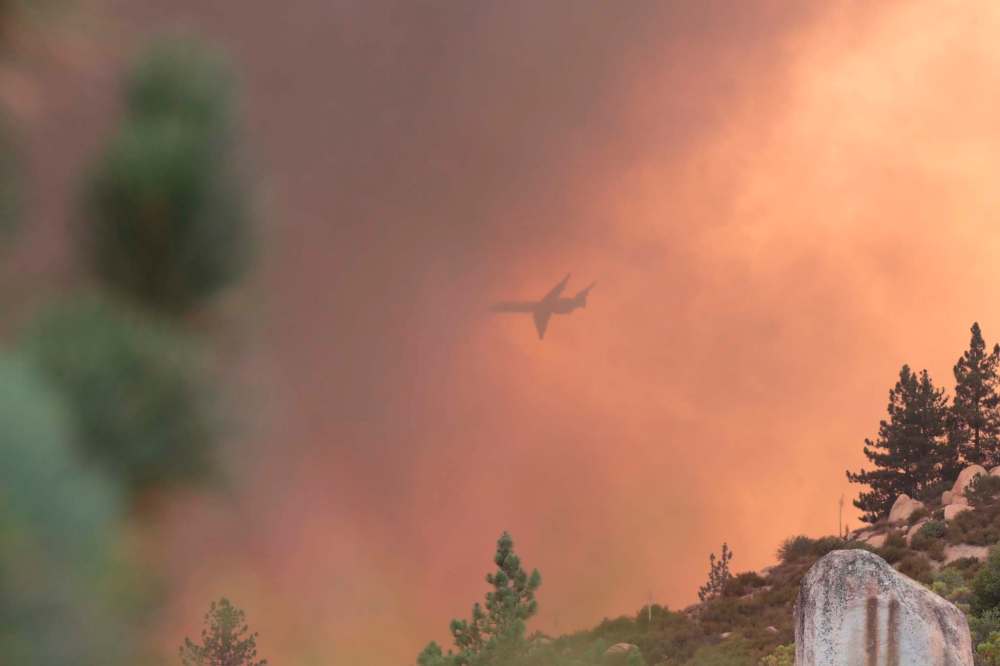
At the same time, I have to acknowledge that climate change is driving hurricanes like Katrina, Harvey and Maria, as well as firestorms such as the Thomas, Camp and, in my backyard, Woolsey fires. It’s causing sea-level rise and droughts and is killing coral reefs and driving species toward extinction. These are, in part, the cumulative effects of a small segment of the human population that is particularly profligate in its consumption of fossil fuels, releasing unprecedented amounts of CO2 and other greenhouse gases into the atmosphere. People like me.
When I raise the air travel quandary with other conservation scientists (many of whom travel even more than I do), I’ve been greeted by, “Well, um, it’s important to share our knowledge.” We justify our travel by the net benefits we believe we produce. And for some, this is certainly true. Jane Goodall’s inspirational messages about peace, wildlife conservation and human and animal welfare are undeniably connected to her lifetime of travel.
If we want to keep travelling across continents and oceans, we have to immediately reduce the climate change impacts of air travel. A carbon tax — a government-mandated surcharge on anything that produces greenhouse gases — is the only way to spur the drastic change needed.
A carbon tax would take into account all the environmental costs of air travel. That includes much more than simply jet fuel; it also would have to encompass the cost of mining the metals for planes, building airports, launching navigation satellites, etc.
Carbon tax models vary wildly. A recent United Nations report showed anywhere from US$135 (in 2010 dollars) to US$6,050 per metric tonne to keep global temperature increases below the 1.5 C goal. This would drive up the price of my Sydney-to-LAX ticket by a modest US$177 or a whopping US$7,925. Clearly, airline tickets would cost more, potentially much more, for a while.

A carbon tax needs to be high enough to drive airlines to become greener — and quickly — but not so high that it kills the industry. Airlines might start by directly purchasing CO2 offsets from companies that have created technologies to remove carbon from the atmosphere for US$100 to US$200 a ton. Production of renewable fuels, such as algae-based diesel, might become viable and readily available if carbon taxes are higher. At least one company is working to produce jet fuel from carbon removed from the air. Importantly, by making these products economically competitive with fossil fuels, a tax supports the development and scaling up of technologies from which we will all benefit.
I want to continue to fly. Indeed, I wrote the first draft of this essay on a plane. I want to be able to explore — and work to save — some of the Earth’s biodiversity. I want to meet colleagues around the world. We live in a golden age of interconnectedness and I genuinely believe many good things emerge from this.
But I want future generations to have those opportunities, too. So I know I need to start paying a carbon tax on my plane tickets now.
Daniel T. Blumstein is a professor in the department of ecology and evolutionary biology and the Institute of the Environment and Sustainability at UCLA. He co-edited Ecotourism’s Promise and Peril: A Biological Evaluation.
— Los Angeles Times