

Save the whales, save the planet
Advertisement
Read this article for free:
or
Already have an account? Log in here »
To continue reading, please subscribe:
Monthly Digital Subscription
$1 per week for 24 weeks*
- Enjoy unlimited reading on winnipegfreepress.com
- Read the E-Edition, our digital replica newspaper
- Access News Break, our award-winning app
- Play interactive puzzles
*Billed as $4.00 plus GST every four weeks. After 24 weeks, price increases to the regular rate of $19.95 plus GST every four weeks. Offer available to new and qualified returning subscribers only. Cancel any time.
Monthly Digital Subscription
$4.99/week*
- Enjoy unlimited reading on winnipegfreepress.com
- Read the E-Edition, our digital replica newspaper
- Access News Break, our award-winning app
- Play interactive puzzles
*Billed as $19.95 plus GST every four weeks. Cancel any time.
To continue reading, please subscribe:
Add Free Press access to your Brandon Sun subscription for only an additional
$1 for the first 4 weeks*
*Your next subscription payment will increase by $1.00 and you will be charged $16.99 plus GST for four weeks. After four weeks, your payment will increase to $23.99 plus GST every four weeks.
Read unlimited articles for free today:
or
Already have an account? Log in here »
Hey there, time traveller!
This article was published 15/02/2020 (2239 days ago), so information in it may no longer be current.
AT the first Earth Day 50 years ago, crowds of protesters across the United States held up signs calling for the world to “Save the Whales.” Much has changed since then, but one thing has remained clear: whales are crucial parts of the planet’s carbon cycle and ecosystem engineering.
So isn’t it time to demand that our leaders commit to fully protecting these magnificent species?
Covering 71 per cent of the Earth’s surface, the ocean is the keystone to life on our planet. The ocean provides services that support communities around the globe. Our world’s oceans not only provide resources for food and livelihoods, but also regulate climate and produce about 80 per cent of the planet’s oxygen.
By now, the world is familiar with the havoc climate change wreaks on our oceans. Warming waters, acidification and sea-level rise all threaten the survival of the species, ecosystems and infrastructure that support our planet.
Recently, scientists and policy-makers have begun to understand how the oceans can contribute solutions to climate change. As some of the largest species on the planet, whales can make a significant contribution.
Whales sequester significant amounts of carbon throughout their lives via feeding, while their waste also fertilizes phytoplankton, tiny oceanic plants that store carbon and produce oxygen. Upon their deaths, they continue to store this carbon and support organisms on the seabed.
According to a recent report by the International Monetary Fund, even a one per cent increase in phytoplankton productivity from whale activity would capture hundreds of millions of tons of additional carbon dioxide every year — equivalent to what could be accomplished by two billion mature trees.

Whales also provide nutrient mixing: when diving to deeper, cooler waters to feed, whales bring those cool, nutrient-rich waters to the surface. This allows for increased phytoplankton blooms and, thus, increased oxygen production and carbon sequestration. While seemingly insignificant, these interactions provide a constant stream of nutrients to the phytoplankton — a service no other species can provide.
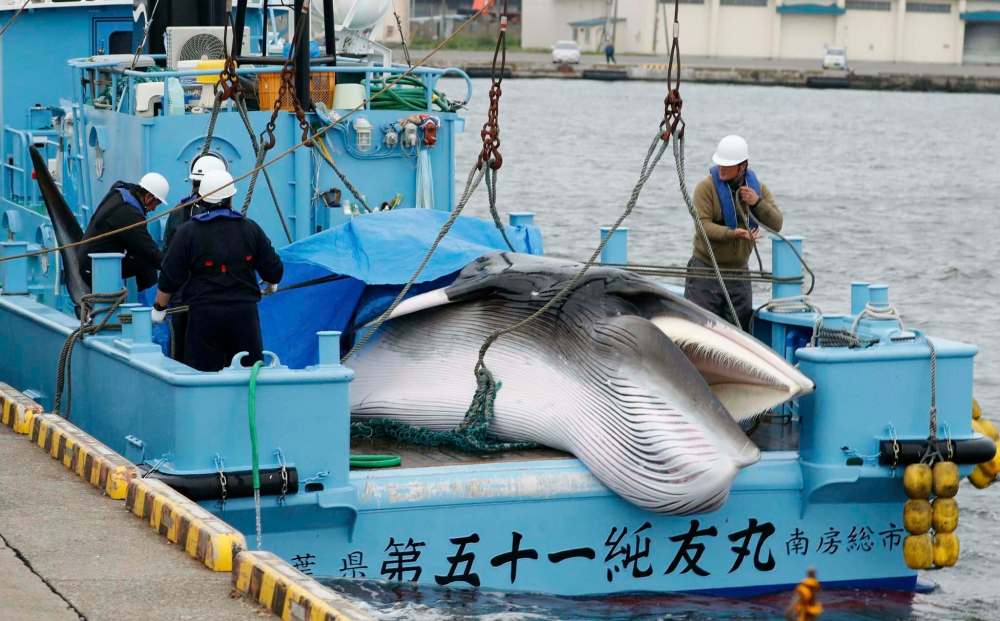
Experts estimate that commercial whaling in the 20th century wiped out almost three million whales — by animal biomass, perhaps the worst destruction to any species in the Anthropocene. In 1982, the International Whaling Commission, charged with the proper conservation of whale populations, enacted a global freeze on commercial whaling starting in 1985, and in 2016 passed a resolution recognizing the contribution of whales to their ocean ecosystems. Despite the freeze and resolution, three countries — Norway, Iceland and Japan — continue to whale.
The tide may finally be turning in favour of the whales. In 2019, despite having a quota to hunt for around 200 whales, Iceland abstained from any whaling activity. The year 2020 marks 35 years since the IWC implemented the whaling moratorium. With World Whale Day on Feb. 15 and the 50th anniversary of Earth Day on April 22, the global spotlight is on our oceans as a fundamental tool for addressing climate change.
Now is the time to encourage forward-thinking behaviour and demand the leaders of Norway, Iceland and Japan make commitments to renounce commercial whaling. There’s no better occasion than the 50th anniversary of Earth Day to finally save the whales and with them, the planet.
Sir Robert Watson is former chair of Intergovernmental Science-Policy Platform on Biodiversity and Ecosystem Services and a member of Earth Day Network’s global advisory committee.