

Suppression is alive and unwell in Manitoba
Advertisement
Read this article for free:
or
Already have an account? Log in here »
To continue reading, please subscribe:
Monthly Digital Subscription
$1 per week for 24 weeks*
- Enjoy unlimited reading on winnipegfreepress.com
- Read the E-Edition, our digital replica newspaper
- Access News Break, our award-winning app
- Play interactive puzzles
*Billed as $4.00 plus GST every four weeks. After 24 weeks, price increases to the regular rate of $19.95 plus GST every four weeks. Offer available to new and qualified returning subscribers only. Cancel any time.
Monthly Digital Subscription
$4.99/week*
- Enjoy unlimited reading on winnipegfreepress.com
- Read the E-Edition, our digital replica newspaper
- Access News Break, our award-winning app
- Play interactive puzzles
*Billed as $19.95 plus GST every four weeks. Cancel any time.
To continue reading, please subscribe:
Add Free Press access to your Brandon Sun subscription for only an additional
$1 for the first 4 weeks*
*Your next subscription payment will increase by $1.00 and you will be charged $16.99 plus GST for four weeks. After four weeks, your payment will increase to $23.99 plus GST every four weeks.
Read unlimited articles for free today:
or
Already have an account? Log in here »
Hey there, time traveller!
This article was published 15/01/2021 (1905 days ago), so information in it may no longer be current.
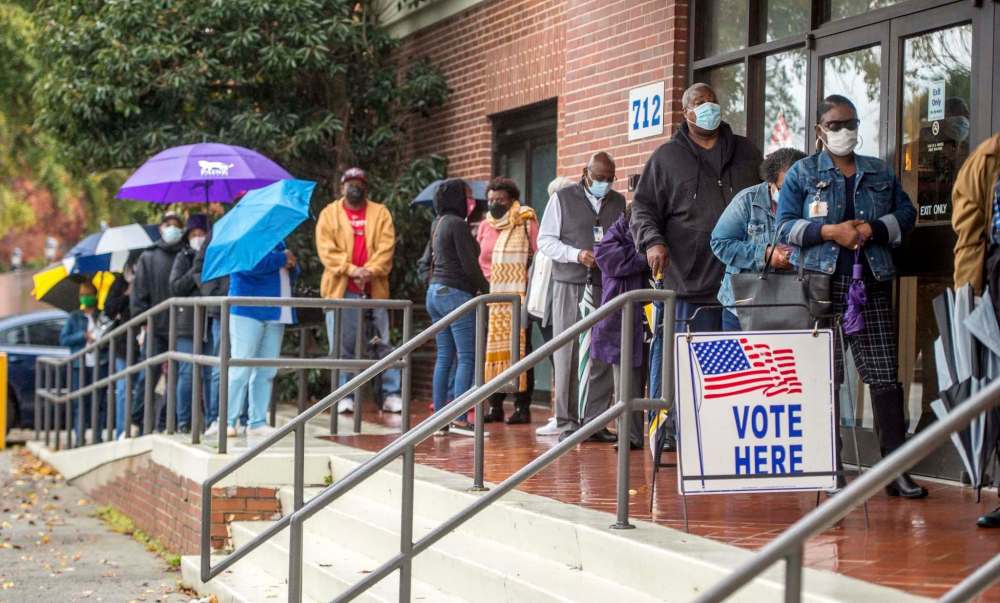
Many Canadians I talk to are horrified by the prospect of voter suppression such as that which played out in the Georgia Senate runoffs in the U.S. The fact deliberate attempts would be made to keep people from voting, by limiting or distancing polling stations, or that roadblocks to registration rather than assistance would be offered to eligible voters, is seen as dishonest and undemocratic.
But before we are too quick to judge, we might acknowledge that we also experience some rather unsophisticated, but conscious and pervasive, efforts at citizen suppression. The Manitoba government, particularly in health care and education, is becoming very adept at thwarting legitimate and necessary citizen participation.
In fact, like the Republicans in the U.S., our government does not even bother to cover its tracks or hide its intentions. It was hard to watch our premier barely hiding his glee as he proclaimed — falsely, again — that our education system was failing and that the system was too top-heavy, and that he could hardly wait to see the “modernizations” he was about to introduce in education.
The pattern has been set in health care, and the script is being followed in education.
Citizen suppression takes many forms, all of which are used to some degree in our current political situation. Among other things, they include manufactured crises, downplaying real issues, secrecy and discouraging reasonable and rightful participation.
While this government knows there is no current crisis in education, it continues to peddle the myth that Manitoba students are somehow shortchanged, based on international test results. The facts are that more than 85 per cent of the students actually do very well on the tests, and the remainder’s performance can be attributed to other reasons, such as child poverty, which have little to do with schooling but which are summarily dismissed or avoided.
In health care, when governments cut positions and salaries at the top, if there are any savings, they do not necessarily find their way to the hospitals. Similarly, education cuts are unlikely to find their ways to classrooms. In both cases, health and education, consolidations simply mean people have to travel further to access the same services.
Both of these concerns are no doubt a cover for the real agenda, which appears to be, plain and simple, cutting government expenditures in two essential services in spite of public will. Poll after poll shows that is more a reflection of a premier’s not-so-secret private agenda than a public priority.
Deceit and secrecy also extend to the legislation currently slated for government consideration. Bill 64, ostensibly part of education’s modernization, is just the latest example in which a bill passes first reading without its details being made public. It seems obvious that if legislation and policy — indeed, all public decisions affecting the public good — are too sensitive to pass rigorous public scrutiny, they have no business being enacted.
But secrecy is also achieved through other means.
Perhaps the most offensive means, and also the most destructive of public trust and participation, is to undertake reviews that are sham consultations with foregone conclusions, and to shut out the very people who know most about the enterprise and will have to live with the consequences.

The very questions in the “education review” signalled the government’s biases and its pronouncements anticipated the likely conclusions, reinforced by the hiring of an external consultant who shares those public predispositions. And, as in health care, the people most affected — in this case, educators — are portrayed as problems with self interests rather than knowledgeable and caring public servants and partners who should be part of any problem-solving.
They, and their leaders, have reason to rightfully fear that there are targets on their backs. The consequence is a deafening silence from trustees, superintendents and teachers and their organizations in the face of attacks on their integrity and their livelihood. This is not what a healthy functioning democracy looks like.
Democracies at their liveliest are messy and noisy – sometimes chaotic – with a reasonable dose of moral disagreement on how best to serve the interests of individuals and society. What makes them special is their agreement on the overall goals – the best interests of everyone, and the fact that everyone is encouraged, if they wish, to express how that is best to be accomplished. It does not mean shutting down dissent and getting your way unchallenged.
Deliberately and consciously leaving anyone or any group out, legally or illegally, is citizen suppression, plain and simple, and an attack on democracy.
John R. Wiens is dean emeritus at the faculty of education, University of Manitoba. A lifelong educator, he has served as a teacher, counsellor, work education co-ordinator, principal, school superintendent and university professor.