

The tale of two mayors
Advertisement
Read this article for free:
or
Already have an account? Log in here »
To continue reading, please subscribe:

Digital Subscription
One year of digital access for only $205*
- Enjoy unlimited reading on winnipegfreepress.com
- Read the E-Edition, our digital replica newspaper
- Access News Break, our award-winning app
- Play interactive puzzles
*First annual payment billed as $205.00 + GST for one year. This annual subscription will automatically renew at $233.00 + GST every 52 weeks (10% off the regular annual price of $259.35). Offer available to new and qualified returning subscribers only. Cancel any time.
To continue reading, please subscribe:
Add Free Press access to your Brandon Sun subscription for only an additional
$1 for the first 4 weeks*
- Enjoy unlimited reading on winnipegfreepress.com
- Read the E-Edition, our digital replica newspaper
- Access News Break, our award-winning app
- Play interactive puzzles
*Your next Brandon Sun subscription payment will increase by $1.00 and you will be charged $17.95 plus GST for four weeks. After four weeks, your payment will increase to $24.95 plus GST every four weeks.
Read unlimited articles for free today:
or
Already have an account? Log in here »
Hey there, time traveller!
This article was published 17/09/2014 (4412 days ago), so information in it may no longer be current.
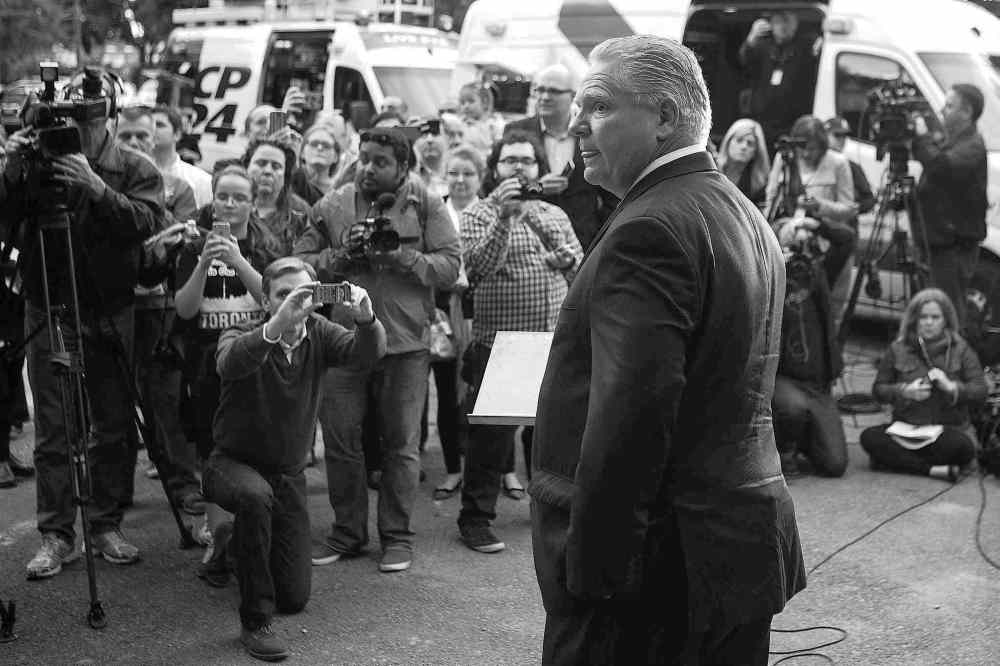
With Rob Ford’s hospitalization and his brother taking his place in the mayoral race, the election in Toronto will continue to garner both national and international headlines. With Mayor Sam Katz choosing not to run again, and the issues of corruption likely taking a back seat until the election is over, the mayoral campaign in Winnipeg seems a staid affair compared with the circus in Toronto. However, despite the intervention of Hollywood stars and the shenanigans of the Ford brothers, the choice of mayor in Toronto is unlikely to have the same significance on the direction of the city as the choice of mayor in Winnipeg.
In Toronto, there are now three lead candidates: Doug Ford, who will likely maintain the policies of his younger brother Rob; John Tory, who outside of his unique plan for transit in the city, is running a fiscally conservative campaign in keeping with the city’s outgoing mayor; and Olivia Chow, a former NDP MP with a socially progressive agenda. If Tory or Chow is elected, they will likely change the tone of politics in the city, but once they’re in office, it’s unlikely they’ll be able to make sweeping changes.
Although the mayor of Toronto nominates councillors for the city’s executive committee (EC), the final decision of its composition remains with council. What’s more, the members of the EC only account for a quarter of the votes on council. As a result, the mayor of Toronto is institutionally weaker than that of Winnipeg’s. More to the point, Rob Ford’s tenure in Toronto led council to re-establish its position of supremacy in city politics.
Following Rob Ford’s strong win in 2010, there was a brief period where city councillors went along with his plans. His unexpected electoral success was interpreted as a mandate for change at the city, which it may well have been. As a result, in his first few weeks in office, Rob Ford was able to unravel a fully funded transit plan.
However, by the end of his first year in office, Ford had already used up much of his political capital, and former allies began to turn on him. His own executive committee members began abandoning him, and the council began to work together to redo what he had undone. By the end of his term in office, council had stripped Ford of his powers and vested them in the city’s deputy mayor, who used them at the behest of council.
Toronto’s city councillors aren’t likely to forget this episode and are unlikely to award the victorious mayoral candidate the unconditional support Ford received when he first entered office. As a result, on issues such as transit policy the made-in-council solution will likely stand after the election.
In Winnipeg, the choice of mayor will likely have a much more significant effect on the direction of the city. Winnipeg’s mayor is strong relative to his or her counterpart in Toronto. The new mayor will be able to appoint his or her own executive policy committee without the intervention of council, and will command almost half of the seats on council as a result.

Under Mayor Katz’s tenure, some EPC members did defect. However, most of these defections came very late in Katz’s most recent term in office, when his support was at an all-time low. Unlike Toronto, where defectors can often keep their positions on the EC and their roles as committee chairs despite the ire of the mayor, the decision to stop supporting the mayor usually means stripping oneself of positions of influence in the city. As a result, the new Winnipeg mayor will likely be able to create a strong coalition of councillors beholden to his or her political agenda once they take office.
The mayor of Winnipeg’s authority is not absolute. Economic forces will limit his or her ability to realize an agenda, and the whim of the province and federal government can upend any well-placed plans. However, when Gord Steeves promises to freeze property taxes, he may well be able to, whether for the good or ill of the city. As well, the fate of Winnipeg’s fledging bus rapid transit system will likely be shaped by the choice of mayor.
In Toronto, many voters seem to be voting to prevent the election of a Ford. The fact that voters can rely on council to curtail the authority of the mayor in Toronto makes the decision to vote strategically for the mayor seem less consequential. In Winnipeg, voters do not have that luxury. However, they do have the ability to choose a mayor with a strong vision for the future of the city and the authority to realize much of that vision.
Aaron Moore is an assistant professor of political science at the University of Winnipeg. See more of his work at www.torontoelectionstudy.com.