

Time for Canadian hardball on NAFTA
Advertisement
Read this article for free:
or
Already have an account? Log in here »
To continue reading, please subscribe:

Digital Subscription
One year of digital access for only $205*
- Enjoy unlimited reading on winnipegfreepress.com
- Read the E-Edition, our digital replica newspaper
- Access News Break, our award-winning app
- Play interactive puzzles
*First annual payment billed as $205.00 + GST for one year. This annual subscription will automatically renew at $233.00 + GST every 52 weeks (10% off the regular annual price of $259.35). Offer available to new and qualified returning subscribers only. Cancel any time.
To continue reading, please subscribe:
Add Free Press access to your Brandon Sun subscription for only an additional
$1 for the first 4 weeks*
- Enjoy unlimited reading on winnipegfreepress.com
- Read the E-Edition, our digital replica newspaper
- Access News Break, our award-winning app
- Play interactive puzzles
*Your next Brandon Sun subscription payment will increase by $1.00 and you will be charged $17.95 plus GST for four weeks. After four weeks, your payment will increase to $24.95 plus GST every four weeks.
Read unlimited articles for free today:
or
Already have an account? Log in here »
Hey there, time traveller!
This article was published 02/04/2018 (3081 days ago), so information in it may no longer be current.
Has the U.S. just blinked at the NAFTA table?
It now looks as if the NAFTA negotiations are entering a pivotal stage. In the hopeful words of U.S. Trade Representative Robert Lighthizer, “We’re finally starting to converge. I think we’re in a pretty good space.”
Admittedly, it’s tough to know for sure whether states, like human beings, have “tells”— words and body language that unwittingly reveal signs of behaviour or intent. But it’s tough not to think that Lighthizer’s remarks are tantamount to the U.S. “blinking” on the NAFTA file.
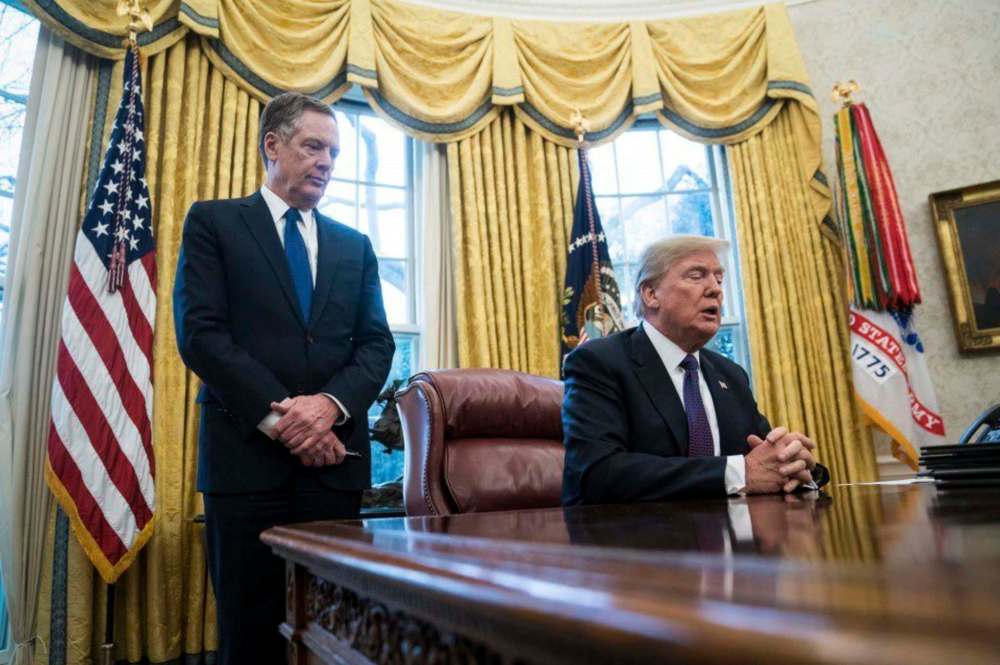
There is no mistaking that the U.S. negotiating posture has shifted dramatically. They badly want a revised NAFTA agreement.
Moreover, the Trump administration’s tough talk on trade and the NAFTA negotiations has been exposed as little more than bluster and blowing smoke. And to their credit, both the Canadians and the Mexicans have seen through the noise and empty threats.
This has also highlighted the fact that Canada is far better off when it works in concert with its Mexican counterparts. The reality is that both countries have effectively choreographed their respective positions and responses at the NAFTA negotiating table to diminish, or at least neutralize, the bargaining leverage of the U.S.
The turning point came late last month, when the U.S. side agreed to adjust substantially its position on U.S. content for North American automobiles (involving a demand for 50 per cent U.S. content to qualify for duty-free access to the U.S. marketplace). It was a major climb-down for the U.S. and a very telling sign of what their endgame is: that is, a renegotiated NAFTA in short order.
That’s critical because Canada is now in the enviable position of having something that is often in very short supply when it comes to the management of Canadian-American disputes or conflicts — namely, the all-important leverage. Officialdom in Ottawa knows that the U.S. wants a modernized NAFTA pact in the next four or five weeks. If it is smart, Canada can now use that to its advantage.
It can, for instance, stand firm at the bargaining table and make demands of its own (such as a watering down of Buy America clauses) or offer better protection against U.S. requests to eliminate agricultural supply management and the crucially important Chapter 19 provisions on dispute resolution.
The U.S. desire for a quick deal and the reasons for the change in bargaining strategy are many and varied. First, the possibility of poll-leading Mexican presidential candidate Andrés Manuel López Obrador winning the July 1 election in Mexico has spooked the Americans. They have obviously calculated that an Obrador Mexico spells bad news for a re-negotiated NAFTA.
Perhaps the most significant driver of the new U.S. NAFTA strategy is embattled U.S. President Donald Trump. Clearly, he wants a big “win” to deflect attention away from the chaos and storm clouds engulfing the White House. And he most assuredly wants all the NAFTA strings to be tied up before the November 2018 mid-term congressional elections.
What Trump has come to realize, or knew all along, is that members of Congress — especially those of a trade-favouring Republican stripe — want the NAFTA negotiations successfully concluded so that they can campaign on the trade pact in November.
He has also come to understand that the U.S. business community wants NAFTA to remain in place. That message, you can be sure, has been bluntly imparted to both the Trump administration and U.S. congressional representatives — who rely heavily on corporate donations to run their re-election campaigns.

Additionally, there is the fact that Canada has remained very firm and determined at the NAFTA negotiating table. The American side knows only too well that it won’t be able to steamroll or brow-beat the Canadians into making fundamental concessions. As Trump himself even admitted this month, “They (the Canadians) negotiate tougher than Mexico.”
Of course, we are not out of the NAFTA woods entirely. And there are plenty of uncertainties around a sunset clause, dispute resolution, culture and intellectual property issues and dairy.
But Canada is now in a very strong bargaining position vis-à-vis the U.S. It has something that the Americans desperately want — a NAFTA win. We should judiciously and shrewdly play our NAFTA cards and squeeze the Americans to accede to some of Canada’s demands.
Most important, Canada does not have to give away the store to get the Americans to agree to a revamped trade deal. Indeed, there is no need for us to make major concessions to the U.S. at all.
Peter McKenna is professor and chair of political science at the University of Prince Edward Island in Charlottetown.