

Trudeau’s climate failures continue
Advertisement
Read this article for free:
or
Already have an account? Log in here »
To continue reading, please subscribe:

Digital Subscription
One year of digital access for only $205*
- Enjoy unlimited reading on winnipegfreepress.com
- Read the E-Edition, our digital replica newspaper
- Access News Break, our award-winning app
- Play interactive puzzles
*First annual payment billed as $205.00 + GST for one year. This annual subscription will automatically renew at $233.00 + GST every 52 weeks (10% off the regular annual price of $259.35). Offer available to new and qualified returning subscribers only. Cancel any time.
To continue reading, please subscribe:
Add Free Press access to your Brandon Sun subscription for only an additional
$1 for the first 4 weeks*
- Enjoy unlimited reading on winnipegfreepress.com
- Read the E-Edition, our digital replica newspaper
- Access News Break, our award-winning app
- Play interactive puzzles
*Your next Brandon Sun subscription payment will increase by $1.00 and you will be charged $17.95 plus GST for four weeks. After four weeks, your payment will increase to $24.95 plus GST every four weeks.
Read unlimited articles for free today:
or
Already have an account? Log in here »
Hey there, time traveller!
This article was published 29/04/2022 (1618 days ago), so information in it may no longer be current.
Canada’s most recent National Inventory Report, showing official greenhouse gas emissions for 2020, was released this month, as outlined in the Free Press (“Canada’s emissions plummet during first year of COVID-19 pandemic,” April 14). The results are not good.
Overall emissions did decline, from 738 to 672 million tonnes, but we know this was almost entirely attributable to COVID-19, which caused devastating economic decline in Canada and unemployment approaching 14 per cent. Even worse, these painful emission reductions of only about nine per cent are temporary, and not enough to make any long-term difference, given the International Energy Agency already indicates emissions for 2021 have come storming dramatically back.
This is not just a singular bad sign, but an ongoing pattern of failure by Prime Minister Justin Trudeau’s Liberal government, which has made and broken promise after promise on the environment for five years in a row. As recently reported by Canada’s Environmental Commissioner, we now hold the dubious distinction of the “Worst Performer of the G7” on emissions, with Trudeau at one point in the recent past even being outperformed by Donald Trump.
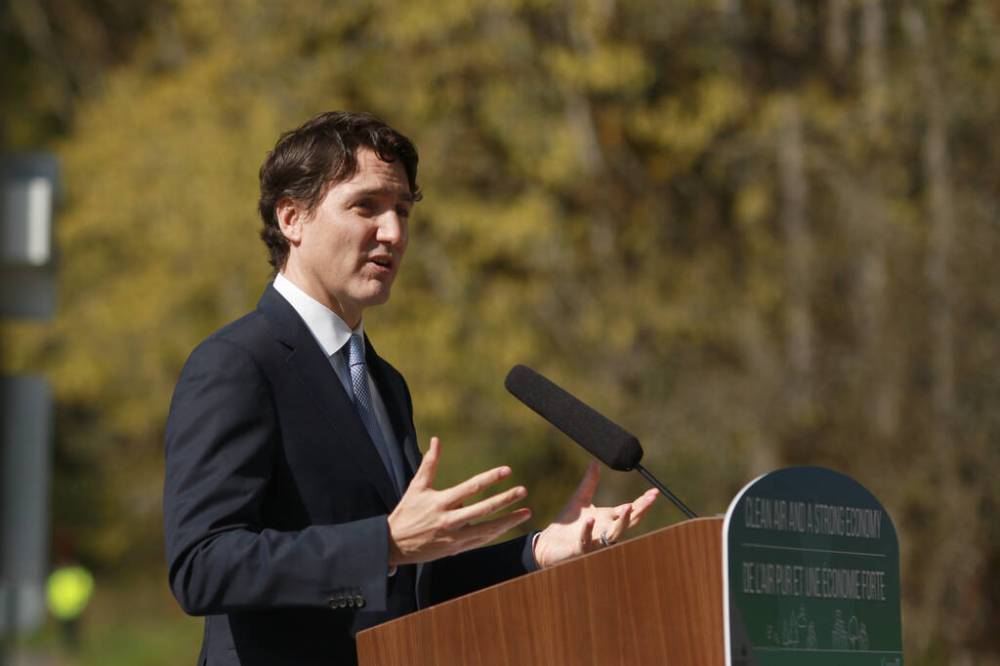
That says a lot. It is difficult to apply more lipstick to this particular pig, so there’s no one else left to blame.
Various missteps contribute, such as new coal mines in British Columbia and newly approved offshore oil developments, but a nagging and underlying problem has been doctrinaire over-reliance on the Liberals’ carbon-tax policy. Sure, carbon taxes involve elegant economic theory, and yes, they can be efficient in terms of ready integration into our economy.
But at the same time, this policy is easy to oppose for a more basic reason: it simply does not work in practice to reduce emissions. It may be efficient, but it is not effective. Back in 2018, for example, Environment and Climate Change Canada strongly touted that carbon taxes would yield decisive, large and rapid emission reductions on the order of 80 to 90 million tonnes by 2022 alone. This is obviously not happening.
A year ago, in a peer-review journal article, I examined emission trends and reduction policies at the provincial level across Canada over a 15-year period. I found neither carbon taxation nor cap-and-trade produced any significant ongoing emission reduction trend in any province, including B.C. and Quebec.
I even outlined valid technical reasons why these have not worked. On a positive note, my research identified a policy that actually provides long-term reductions: grid decarbonization (the transition to low-carbon power generation). This can be seen in practice in Canada’s three leading provinces, which are, in order, New Brunswick, Nova Scotia and Ontario.
Over the past few years, MBA students at the Asper School have continued examining the federal carbon tax based on the cost per tonne of reduction actually achieved. Last year, students found the tax to be ineffective during 2019, with negligible emission declines and a cost of reduction more than $6,000 per tonne.
This year, students confirmed for 2020 the cost of reduction to be still high, somewhat under $200 per tonne, except this result was only achieved by ascribing all reductions to the carbon tax, and ignoring COVID-19. As such, it is obvious the real cost per tonne of reduction for the carbon tax remains dramatically higher.
Not only is a carbon tax ineffective for reducing overall emissions, it continues to be unpopular and divisive, and to be unfair, especially to lower-income Canadians. The latter is obvious when you look at actual results rather than computer-model projections. Based on data for 2020, average per-household carbon tax in Manitoba was $526, while average per-household rebate was only $457.
It is mathematically impossible for “eight out of 10 households to have received more back.” This is an utter fabrication.

Yet despite growing evidence of failure, the federal Liberals have doubled down, signalling the intention to escalate the tax dramatically to $170 per tonne by 2030. The extent of achievable reductions remains dubious, but the increasing pain will be real. Even the Bank of Canada governor acknowledges the carbon tax will noticeably accelerate inflation, spreading the misery.
If anyone doubts the folly of carbon taxes, I have a simple response: “Please show me what exactly and where exactly are the reductions that have been achieved so far.”
Poor results by the Liberals also highlight an important problem for Canada’s media: allowing failure to continue unabated. Media across the country appear seduced by the siren claim that all we need is a government that “believes in climate change.” Except we have that already, and emissions have not adequately gone down. All we have to show for it, regrettably, are just more unachievable promises.
Who cares whether or not politicians believe? All that counts now is that emissions be reduced.
Robert Parsons teaches sustainability economics at the I.H. Asper School of Business, University of Manitoba. In 2021 he authored the paper entitled “Canada as a case study for balanced presentation to address controversy on emission reduction policies,” published in the open-access journal Sustainability.