

U.S. midterms (usually) predictable
Advertisement
Read this article for free:
or
Already have an account? Log in here »
To continue reading, please subscribe:
Monthly Digital Subscription
$1 per week for 24 weeks*
- Enjoy unlimited reading on winnipegfreepress.com
- Read the E-Edition, our digital replica newspaper
- Access News Break, our award-winning app
- Play interactive puzzles
*Billed as $4.00 plus GST every four weeks. After 24 weeks, price increases to the regular rate of $19.95 plus GST every four weeks. Offer available to new and qualified returning subscribers only. Cancel any time.
Monthly Digital Subscription
$4.99/week*
- Enjoy unlimited reading on winnipegfreepress.com
- Read the E-Edition, our digital replica newspaper
- Access News Break, our award-winning app
- Play interactive puzzles
*Billed as $19.95 plus GST every four weeks. Cancel any time.
To continue reading, please subscribe:
Add Free Press access to your Brandon Sun subscription for only an additional
$1 for the first 4 weeks*
*Your next subscription payment will increase by $1.00 and you will be charged $16.99 plus GST for four weeks. After four weeks, your payment will increase to $23.99 plus GST every four weeks.
Read unlimited articles for free today:
or
Already have an account? Log in here »
Hey there, time traveller!
This article was published 22/10/2018 (2700 days ago), so information in it may no longer be current.
You can rest assured that with the U.S. midterm elections on Nov. 6, U.S. President Donald Trump and his staff are busy preparing their long list of false and ludicrous excuses to explain away the Democratic party’s predicted retaking of control of the House of Representatives and perhaps gaining enough seats in the Senate to replace the Republicans as the majority party. (In a midterm election, all 435 seats in the House of Representatives are contested for a two-year term, as well as 33, or one-third, of the Senate seats for a six-year term.)
The last time the Democrats had full control of both houses was following the 2008 election and the start of Barack Obama’s presidency. But that dominance had been established two years earlier in the midterms of 2006, when a voter backlash against Republican president George W. Bush and the U.S. invasion of Iraq had first given the Democrats a sweeping victory in both houses.
Trump will no doubt point to left-wing conspiracies, rigged elections, Chinese interference, voting by illegal immigrants, etc. About the only factors he will not offer are the two main ones: his own outrageous bullying behaviour, serial lying and objectionable policies, and the actions of Mitch McConnell, Paul Ryan and nearly all of the other Republican senators and congressmen and the dereliction of their constitutional duty to “check” the power of the president.
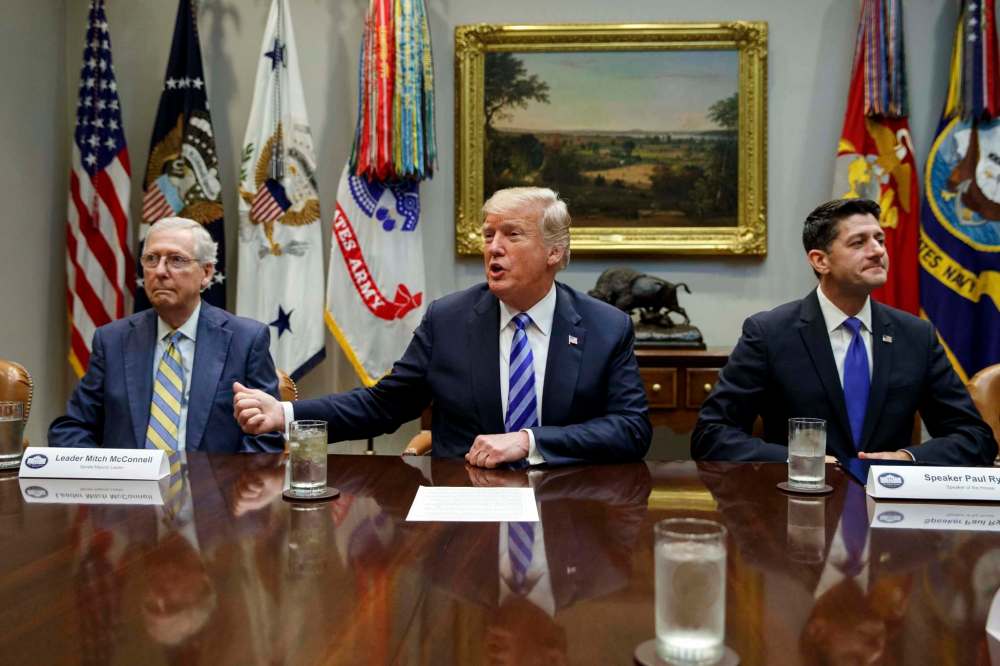
Blinded by extreme partisanship, hungry for power and obsessed with tax cuts and environmental and financial deregulation, the Republicans have permitted Trump to recklessly exercise executive power — such as instituting tariffs on Canadian steel and aluminum under the bogus guise of protecting U.S. national security — contrary to their own party’s policies and the interests of the citizens they represent. They have taken greater comfort in the appointment of two conservative judges in the past 18 months, Neil Gorsuch and the controversial Brett Kavanaugh, to the U.S. Supreme Court.
A reckoning of sorts is coming for the Republicans. There is a built-in “counter-tendency inherent in midterm elections,” according to the late U.S. political scientist Barbara Hinckley, and they provide “yet another check on the president.”
Since 1894, there have been 31 midterm elections. In that period, the party of the president has lost control in the House of Representatives eight times — most recently in 2010, two years after Barack Obama’s presidential election, when the Democrats lost 63 seats to the Republicans — and seven times in the Senate, the last time being when the Democrats gave up control in the midterm elections of 2014.
Most often, the power transfer has been in midterms that take place during a president’s second term, when voter apathy with the president and his party tends to surface. This occurred, for example, in 1938 during Franklin Roosevelt’s second term, when dissatisfaction with FDR’s Depression-era policies was high in certain parts of the country.
Though Roosevelt went on to win a third term in 1940 and then a fourth in 1944 — when it was still possible for a president to run for more than two terms — in the 1938 midterms, the Republicans gained 72 seats in the House of Representatives. This was not enough at the time to supplant Democratic control, but the GOP built on its success and finally did become the majority power in the 1946 midterms.
Midterms held during a president’s first term, such as the one this year, also can be decisive. In 1992, after more than a decade of presidential Republican rule, Democratic contender Bill Clinton soundly defeated the Republican incumbent, George H.W. Bush. Democrats also controlled both the House and the Senate, but their hold on power was short-lived: two years later in the midterms, owing mainly to the rise of the conservative wing of the GOP under Newt Gingrich and its “Contract with America,” the Republicans recaptured both houses of Congress.

In general, the average number of seats lost in the House of Representatives by the president’s party in midterms since 1910 has been about 30; in 1994, the Democrats lost 54 seats. Nothing, however, is written in stone in American politics: in the 1998 midterms, the Republicans maintained control of both houses, but lost seats to the Democrats in the House of Representatives despite questions about Clinton’s moral and ethical conduct.
The 2018 midterms will also be a referendum on the president’s conduct. To reclaim control of the House of Representatives, the Democrats need to hold all of their seats plus win 23 more, which is definitely possible. In the Senate, only a few seats separate the two parties, yet because of the seats being contested, the chances of a Democratic majority is slim, according to the most recent polls.
Overall, Democrats have a greater percentage of the popular vote in the Senate, but hold fewer seats since Republicans control states with small populations. It should also be kept in mind that Republicans in many states have rejigged, or “gerrymandered,” electoral districts and instituted voter suppression laws to their advantage. And a Supreme Court dominated by conservatives has and will continue to uphold such manipulations.
Nonetheless, should the midterm results unfold as expected, Democratic control of one house will certainly alter the way things work in Trump World, and the “check” in the “check and balance” system that defines the U.S. government will actually mean something once again.
Now & Then is a column in which historian Allan Levine puts the events of today in a historical context. His most recent book, Seeking the Fabled City: The Canadian Jewish Experience, will be published on Oct. 30.
History
Updated on Monday, October 22, 2018 1:13 PM CDT: Corrects byline