

Willing participants in puck-therapy study
Advertisement
Read this article for free:
or
Already have an account? Log in here »
To continue reading, please subscribe:

Digital Subscription
One year of digital access for only $205*
- Enjoy unlimited reading on winnipegfreepress.com
- Read the E-Edition, our digital replica newspaper
- Access News Break, our award-winning app
- Play interactive puzzles
*First annual payment billed as $205.00 + GST for one year. This annual subscription will automatically renew at $233.00 + GST every 52 weeks (10% off the regular annual price of $259.35). Offer available to new and qualified returning subscribers only. Cancel any time.
To continue reading, please subscribe:
Add Free Press access to your Brandon Sun subscription for only an additional
$1 for the first 4 weeks*
- Enjoy unlimited reading on winnipegfreepress.com
- Read the E-Edition, our digital replica newspaper
- Access News Break, our award-winning app
- Play interactive puzzles
*Your next Brandon Sun subscription payment will increase by $1.00 and you will be charged $17.95 plus GST for four weeks. After four weeks, your payment will increase to $24.95 plus GST every four weeks.
Read unlimited articles for free today:
or
Already have an account? Log in here »
Hey there, time traveller!
This article was published 02/10/2021 (1816 days ago), so information in it may no longer be current.
A UNIVERSITY of Manitoba research team led by associate Prof. Ben Schellenberg wants to find 500 Jets fans who agree to be interviewed for a study. OK, I’ll volunteer, so they will only need 499 more.
If they question Jets fans after this week’s exhibition games, the researchers will get an earful about new annoyances such as long lineups to check vaccination status, the mandatory wearing of mask, and the new no-bag policy that prohibits purses and backpacks.
Such relatively minor irritants are not the aim of the researchers’ study, though. They want to investigate the “passion and motivation” of Jets fans.
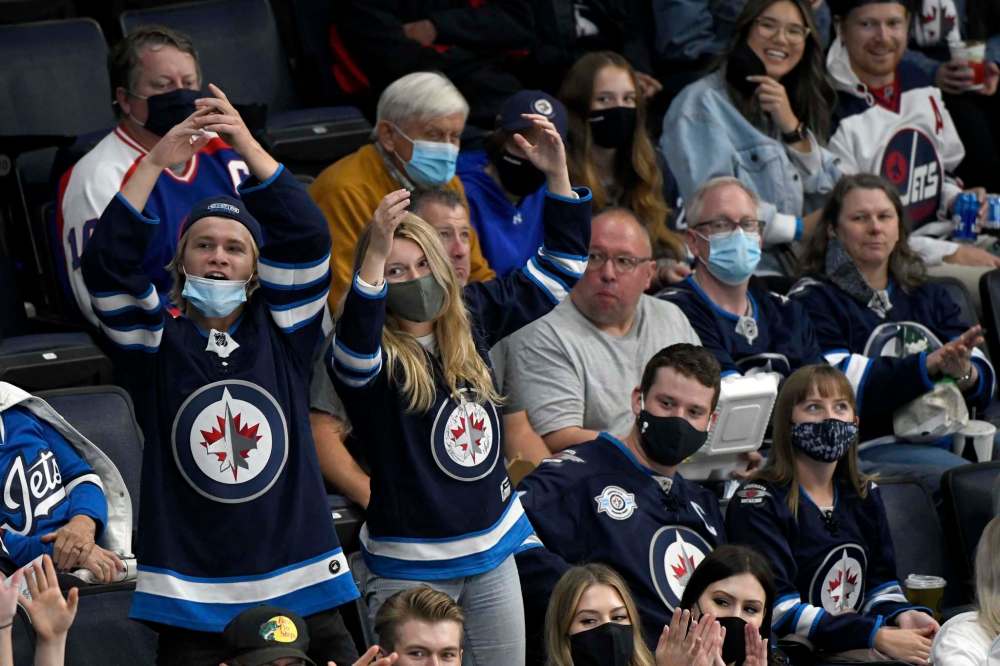
For some of us, the single word that best describes the motivation of attending Jets games is “therapeutic.”
Professional therapists commonly say their office is a safe place where emotions can be freely expressed. It’s like that at Jets games: it’s a safe place to express emotions, even emotions not permitted in the various roles we occupy outside the rink.
It’s always a bad idea to scream at your spouse, your kids or your boss, but at Jets games, screaming is not just allowed, it’s encouraged. We’re egged on by an excited announcer who exhorts us to make noise, by snippets of music carefully chosen for raucous rhythm, by a siren, and by the vibes of our fellow fans, some of whom shriek like banshees.
Even people who prize politeness might be surprised to find themselves joining the infectious chants of “Go, Jets, go!” and “Ref, you suck!” If they overcome inhibitions and shout it out, they’ll find a deep feeling of exhilaration. It feels good to let loose a primal roar.
Another way Jets games are therapeutic is the fellowship of fans. Professional therapists find the emotional problems of their clients are often rooted in loneliness, which will be more common than ever after 19 months of pandemic restrictions on socializing. Loneliness, however, is not a problem at Jets games, where everyone has 15,392 friends, at least for two hours. By donning our Jets jerseys, we wear the colours that show we’re one of the gang. We belong.
Groups of friends have in-jokes and private rituals. When we exclaim “True North!” at the appropriate point of the national anthem, when we rub the left shoe of the bronze statue of Timothy Eaton statue at a rink entrance, we’re signalling our membership in the fellowship.
Inside the rink, we honour the seat that used to be filled by 98-year-old Len (Kroppy) Kropioski. The Second World War veteran made the 2½-hour drive from Kenora to most Jets game, even when winter weather was harsh. Because he was one of us, Kroppy’s death in 2016 makes us ponder our own mortality, reminding us that there is not always a next season.
Trained therapists know that a particularly powerful form of communication is physical touch. Outside of the rink, Jets fans are like everyone else, careful to stay a respectful distance from strangers. But inside the rink, we’re crammed so close that it’s OK to touch other fans, as long as it’s not with creepy intent.
We forfeit our personal space when we join the river of jam-packed people flowing slowly along the concourses and then take our seats pressed shoulder-to-shoulder between fans, so near we can smell the flavour of our neighbour’s chewing gum.
When we accidentally touch elbows on armrests, or brush someone’s knees with our legs as we squeeze past to fetch a drink, it’s OK. In moments of jubilation, such as when the Jets score, it’s encouraged to high-five the hands of strangers in the immediate vicinity. If high-fiving becomes a relic of a pre-pandemic past, if seatmates now keep their hands in their pockets because of COVID-19 anxiety, we would lose a small but significant way of keeping in touch with our fellow fans.

Finally, constructive therapy offers positive strategies to improve our lives. We might roll our eyes at the predictability of such cornball clichés as “There’s no ‘I’ in team” or “Overcoming adversity made him stronger,” but the hockey players’ code displayed at every game offers immutable lessons of how to live a good life outside the rink.
To succeed, put in the work. Play well with others. When you break rules, pay the penalty without whining. Be a good loser and don’t sulk. And, even more difficult, be a good winner and don’t let it swell your head.
Understanding those simple truths is easy, but it’s harder to live them. For those of us who need a refresher, the Jets are at home on Wednesday for another pre-season game. Let the group therapy resume.
carl.degurse@freepress.mb.ca
Carl DeGurse is a member of the Free Press editorial board.