

Sleep that knits the ravelled sleeve of care
Advertisement
Read this article for free:
or
Already have an account? Log in here »
To continue reading, please subscribe:

Digital Subscription
One year of digital access for only $205*
- Enjoy unlimited reading on winnipegfreepress.com
- Read the E-Edition, our digital replica newspaper
- Access News Break, our award-winning app
- Play interactive puzzles
*First annual payment billed as $205.00 + GST for one year. This annual subscription will automatically renew at $233.00 + GST every 52 weeks (10% off the regular annual price of $259.35). Offer available to new and qualified returning subscribers only. Cancel any time.
To continue reading, please subscribe:
Add Free Press access to your Brandon Sun subscription for only an additional
$1 for the first 4 weeks*
- Enjoy unlimited reading on winnipegfreepress.com
- Read the E-Edition, our digital replica newspaper
- Access News Break, our award-winning app
- Play interactive puzzles
*Your next Brandon Sun subscription payment will increase by $1.00 and you will be charged $17.95 plus GST for four weeks. After four weeks, your payment will increase to $24.95 plus GST every four weeks.
Read unlimited articles for free today:
or
Already have an account? Log in here »
Hey there, time traveller!
This article was published 11/08/2012 (5108 days ago), so information in it may no longer be current.
If you ask city dwellers why they love being outdoors, you’re bound to hear otherwise serious people wax poetic about solitude, communion with nature, or the chance to simply slow down.
Those are romantic reasons leading many of us to choose to go outside. But in this overstimulated age, there’s also a far more pragmatic motivation to get the proverbial heck out of Dodge: Only in the wilderness can you be assured of obtaining that most precious of modern commodities, sleep.
Sad as it may seem, part of the attraction to wilderness travel these days is the chance to crash for eight uninterrupted hours, with no Twitter or TV to delay the onset of sleep and no alarm clock, other than the sun, to hasten its end.
Sleep comes easily to the exhausted, which is what many paddlers, backpackers and cyclists tend to be after a full day of activity. Even if you’re just camping on a beach or alongside a vehicle, the sound of waves crashing or the rustling leaves can have a hypnotizing effect at dusk.
But just falling asleep in a tent does not mean you will stay asleep. Many of us are far too accustomed to our cushy beds to find comfort on the ground.
So we swaddle ourselves in snuggly mummy bags to ensure we don’t get cold and check the seams of our tents to ensure we don’t get wet. But staying warm and dry may not be enough.
The key to a comfortable sleep outside is finding the right sleeping pad, a choice that’s not as easy as it used to be.
As a 15-year-old kid, I spent 26 days on a canoe trip without a sleeping pad, somehow managing to slumber in spite of the roots and rocks that protruded from the ground below my back. I’m not capable of such spartan heroics any more.
Even when the demands for travelling light are extreme, it’s always worth packing a sleeping pad, which should not count as a luxury item. And during the winter, you’ll need two to ensure you’re insulated from the cold.
Before you plunk down big bucks on expensive portable bedding, it’s worthwhile to spend some time online scouting out the sleeping-pad options. Generally speaking, they break down into three categories:
Closed-cell foam sleeping pads
Price range: $11 to $72
Weight range: 175 to 540 grams
Pros: Closed-cell foam is inexpensive, light and durable. It can also be cut to fit your needs.
Cons: It’s bulky, inflexible and not that comfortable. In fact, some people can’t sleep on the stuff.
The goods: If you aren’t sure whether camping is your thing or simply don’t want to spend a lot of money, closed-cell foam mats — typically blue or yellow — start around $11 at places like Canadian Tire. More expensive foam mats may be lined with a non-slip coating or have ridges to prevent you from sliding off. Therm-O-Rest sells its popular RidgeRest model for $27 at most outdoor retailers.
Closed-cell foam is also very useful as an inexpensive second sleeping pad to use in the winter, as it doesn’t conduct heat well at all. Place it below your regular sleeping pad as an extra layer of insulation between you and the snow.
Inflatable sleeping pads
Price range: $55 to $250
Weight: 450 grams to 1.5 kilograms
Pros: Most people sleep very well on inflatable pads, which can also serve double-duty inside the home as a short-term mattress for an unexpected guest.
Cons: Inflatable pads can be punctured and eventually require repair. As well, the most luxurious inflatables tend to be bulky, heavy and expensive.
The goods: The wide variety of inflatable pads on the market are a testament to the popularity of the devices, which can be inflated with a few breaths. Most of them pack down to a reasonable size, although the larger, more deluxe pads can be space hogs. Personally, I’m partial to the smallest of the bunch – a three-quarter-length, extra-narrow Therm-O-Rest pad that takes up no more space than a bundle of tent poles.
The drawback is you must maintain this type of pad, which tends to wear down and tear if placed anywhere other than on a smooth surface. If you like sleeping outside, without a tent, you should probably stick to closed-cell foam. Inflatable pads can also be layered with foam for winter use.
Ultralight inflatable pads
Price range: $86 to $190
Weight: 230 to 260 grams

Pros: Ultralights barely add any weight to your pack and some models take up amazingly little space.
Cons: Comfort can be an issue. Also not great for winter use.
The goods: If you’re a backpacker, a sleeping pad that weighs an entire pound may seem too heavy. In this case, shell out for an ultralight pad and be very careful with it, as you’re sacrificing durability for low mass.
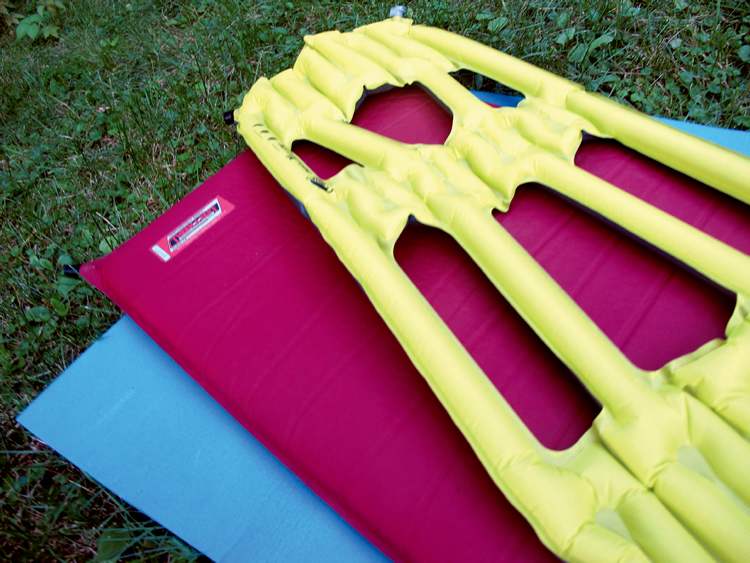
One of the funkier new pads on the market, the Klymit Inertia XFrame, packs down to the size of a pair of rolled-up wool socks, thanks to its skeletal structure, which is supposed to be placed inside of your sleeping bag, not below it. The obvious drawback is this thing is useless for side sleepers.
bartley.kives@freepress.mb.ca