

Nigeria, fellow Africans surprise
Advertisement
Read this article for free:
or
Already have an account? Log in here »
To continue reading, please subscribe:

Digital Subscription
One year of digital access for only $205*
- Enjoy unlimited reading on winnipegfreepress.com
- Read the E-Edition, our digital replica newspaper
- Access News Break, our award-winning app
- Play interactive puzzles
*First annual payment billed as $205.00 + GST for one year. This annual subscription will automatically renew at $233.00 + GST every 52 weeks (10% off the regular annual price of $259.35). Offer available to new and qualified returning subscribers only. Cancel any time.
To continue reading, please subscribe:
Add Free Press access to your Brandon Sun subscription for only an additional
$1 for the first 4 weeks*
- Enjoy unlimited reading on winnipegfreepress.com
- Read the E-Edition, our digital replica newspaper
- Access News Break, our award-winning app
- Play interactive puzzles
*Your next Brandon Sun subscription payment will increase by $1.00 and you will be charged $17.95 plus GST for four weeks. After four weeks, your payment will increase to $24.95 plus GST every four weeks.
Read unlimited articles for free today:
or
Already have an account? Log in here »
Hey there, time traveller!
This article was published 11/06/2015 (4131 days ago), so information in it may no longer be current.
At a Thursday lunch, I was asked to divulge what, for me, had been the biggest surprise of the FIFA Women’s World Cup to date.
I don’t do well on the spot. I prefer time to think — typically alone — before revealing my verdict, especially when extremes such as “most, best, toughest and biggest” figure into the question.
But on this occasion I didn’t hesitate.
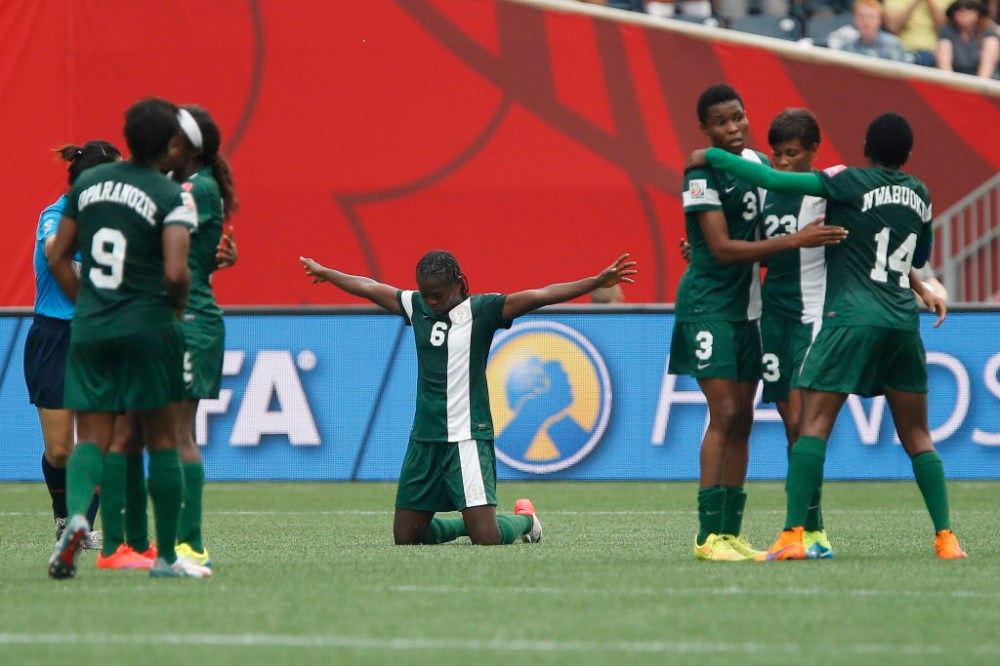
The biggest surprise of this tournament? Its unforeseen revelation? The storyline that presently has me enthralled, has me enthused for today’s matches in Winnipeg?
Easy: Nigeria, and the performances of the African participants generally.
Because — let’s be honest — we didn’t anticipate what would happen after halftime on Monday. And even if we expected the section to be competitive, the 3-3 draw between Nigeria and Sweden only further complicated the Group of Death.
Incidentally, Cameroon added a twist of their own to Group C the same day when they trounced Ecuador 6-0 in Vancouver. Three of the goals were penalties, mind, but a much-touted Switzerland side that opened their schedule with a loss to Japan is suddenly feeling the heat.
The bracket might even send three teams through to the Round of 16 — a surprise in its own right.
Of course, we also have to mention Ivory Coast’s dismantling by Germany. They simply couldn’t contend with the two-time champions on Sunday in Ottawa, and not surprisingly their 10-0 defeat caused some to question Africa’s qualification quota.
(This is the first Women’s World Cup to include 24 teams, and with the increase from 16, Africa’s allocation was boosted from two to three.)
But that’s the sort of thinking produced by the jerk of a knee, the on-the-spot reaction best prevented by a moment’s quiet deliberation. The status quo, after all, has rarely been helpful to the cause of African soccer.
Between 1934 and 1970, the continent was completely shut out of the Men’s World Cup (although former FIFA president Sir Stanley Rous advocated the inclusion of apartheid-era South Africa), and it wasn’t until the 1982 edition — the first under former FIFA president Joao Havelange — that Africa was assigned a second berth in the competition.
Havelange and his successor, the soon-departing Sepp Blatter, did much to enfranchise FIFA’s non-European members, and while corruption allegations followed both men throughout their tenures, they nevertheless inspired the goodwill of their constituencies.
As United States men’s national team manager Jurgen Klismann remarked last month, “In order to progress you have to look at the best teams and try to get closer to them.”
Ivory Coast played one of the best in their Group B opener, and while they came out on the wrong end of a hiding, their results won’t always be so disappointing.
On Thursday, for instance, they competed admirably with a Thailand outfit ranked 32 places better in the FIFA rankings, losing 3-2 in Ottawa. And they can also point to Nigeria, which has won only three of their 20 World Cup matches to date, as an example.
If the knockout stages began today, the Super Falcons would not only be involved but also pose a significant threat to their opponents in the last 16.
Yes, they’re a bit wobbly at the back, and there are those questions about the goalkeeping, but as Asisat Oshoala and Ngozi Okobi demonstrated on Monday the nine-time African champions have elite-level talent up front and enough pure athleticism to cause problems on the break.
They also have a brass band that just won’t quit.

While Sweden-United States might be the most high-profile match of the day, it’s Nigeria-Australia that has my full attention.
Speaking of surprises, China sprung one on the Netherlands in Thursday’s early Group A contest.
Despite the disappointment of a late, 1-0 loss to Canada — and on a debatable penalty, to boot — the 1999 runners-up are back in the mix for progression to the Round of 16 following their own, stoppage-time win in Edmonton.
jerradpeters@gmail.com
Twitter @JerradPeters
Our newsroom depends on a growing audience of readers to power our journalism. If you are not a paid reader, please consider becoming a subscriber.
Our newsroom depends on its audience of readers to power our journalism. Thank you for your support.
Our newsroom depends on a growing audience of readers to power our journalism. If you are not a paid reader, please consider becoming a subscriber.
Our newsroom depends on its audience of readers to power our journalism. Thank you for your support.
Related Articles
No.1 ranked Germans expect difficult match against speedy Team Thailand






Advertisement Advertise With Us
Advertisement Advertise With Us