

Final shines unflattering spotlight on Azerbaijan
Player's withdrawal raises question about politics and awarding of major events
Advertisement
Read this article for free:
or
Already have an account? Log in here »
To continue reading, please subscribe:

Digital Subscription
One year of digital access for only $205*
- Enjoy unlimited reading on winnipegfreepress.com
- Read the E-Edition, our digital replica newspaper
- Access News Break, our award-winning app
- Play interactive puzzles
*First annual payment billed as $205.00 + GST for one year. This annual subscription will automatically renew at $233.00 + GST every 52 weeks (10% off the regular annual price of $259.35). Offer available to new and qualified returning subscribers only. Cancel any time.
To continue reading, please subscribe:
Add Free Press access to your Brandon Sun subscription for only an additional
$1 for the first 4 weeks*
- Enjoy unlimited reading on winnipegfreepress.com
- Read the E-Edition, our digital replica newspaper
- Access News Break, our award-winning app
- Play interactive puzzles
*Your next Brandon Sun subscription payment will increase by $1.00 and you will be charged $17.95 plus GST for four weeks. After four weeks, your payment will increase to $24.95 plus GST every four weeks.
Read unlimited articles for free today:
or
Already have an account? Log in here »
Hey there, time traveller!
This article was published 24/05/2019 (2686 days ago), so information in it may no longer be current.
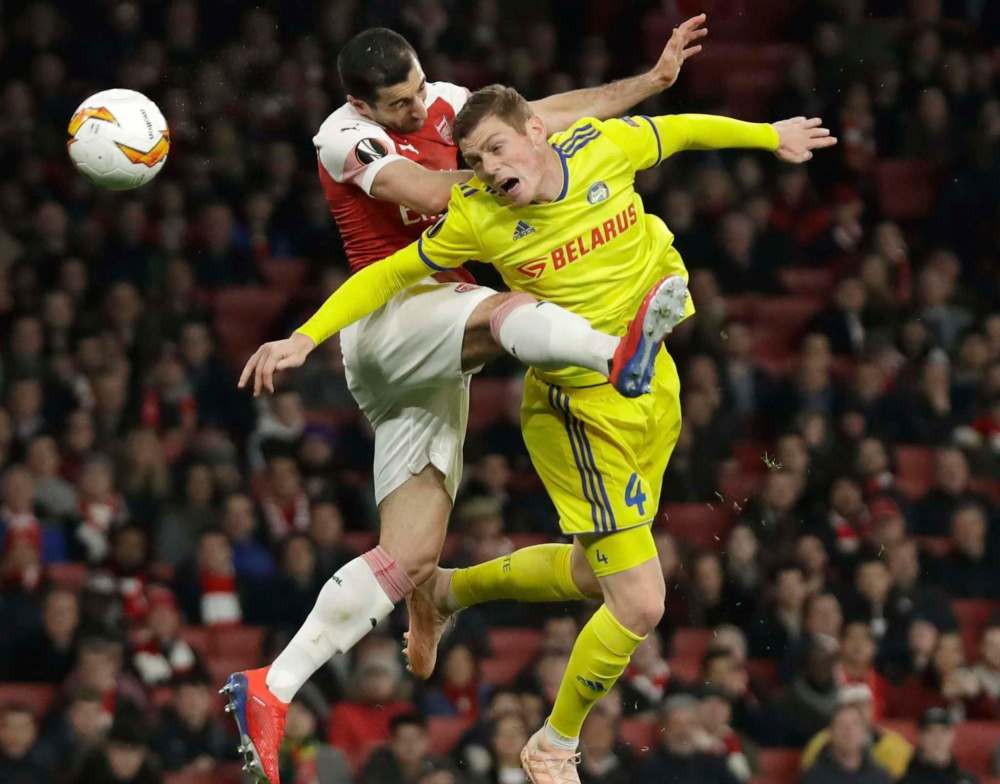
Henrikh Mkhitaryan will not travel to Baku, Azerbaijan, with his Arsenal teammates for Wednesday’s Europa League final against Chelsea. The playmaker, who is Armenian, reportedly feared for his safety on the pitch at Olympic Stadium, and given that Azerbaijan routinely rejects travel applications from anyone with a “-yan” surname — that ethnic giveaway — it was reasonable for him to be wary of not only the 90 minutes but also the duration of his time in the Azeri capital.
“Having considered all current options, we had to take the tough decision for me not to travel with the squad to the Europa League final,” he said in a statement. “It’s the kind of game that doesn’t come along very often, and I admit it hurts a lot to miss it.”
Added his club: “We have written to UEFA expressing our deep concerns about this situation.”
Still technically at war following a 1994 ceasefire, Armenia, mostly Christian, and Azerbaijan, predominantly Muslim, divide along familiar religious and ethnic fissures, but the really exacerbating factor in all this is the disputed Nagorno-Karabakh region, claimed and largely recognized as part of Azerbaijan but almost entirely ethnically Armenian.
Armenia and Azerbaijan do not maintain diplomatic relations, and it is entirely understandable that Mkhitaryan, perhaps the most recognizable Armenian in the world, would want to keep well clear of a country that for much of much of this long and ongoing conflict has generally been the aggressor.
Not surprisingly, much of the blame for the 30-year-old’s ordeal has been placed squarely at the feet of UEFA, which awarded the upcoming match to Baku back in 2017. How could European football’s governing body, the argument goes, have placed a major final in a country that is actively hostile toward one of its neighbours, that maintains an “appalling human-rights record,” according to Human Rights Watch, and that is difficult and expensive for fans of the participating teams to get to in the first place?
It’s worth mentioning that the latter complaint was already making the rounds earlier this spring, when it began to look likely that that the pair of London clubs would progress to the Europa League showpiece, and some weeks before English football punditry sufficiently brushed up on its geopolitics to realize that there may be a bigger issue at play. Don’t forget, the same, pitiable grumbles about distance and expense were being bleated in 2008, when Chelsea and Manchester United booked their tickets to Moscow for the Champions League final. Moscow, seemingly overnight, became the most violent place on Earth, as if the real motivation behind the whingeing wasn’t that Russia isn’t the typical stop on a long-weekend Ryanair booze tour.
Similar motivations underline much of the dissatisfaction this time around with Baku, although far more thoughtful, politically sensitive reasoning also arrives at the same conclusion: that the Europa League final shouldn’t be played there. The thing is, neither approach to the argument is particularly defensible.
As a member of UEFA, Azerbaijan has as much right to bid on a European club final — or European Championship contest, for that matter — as anyone else. It was impossible to foresee the game’s participants two years ago — that they’d be from the same western European capital — but the first priority was always, and should always be, to provide a spectacle for local and regional fans, the travelling supporters, as harsh as it sounds, coming a distant second.
Of course, human-rights abuses present an entirely different, complicated and troubling element to the debate.
Azerbaijan’s elections can hardly be called free and fair, and it routinely jails journalists and political activists, and interferes in the work of non-governmental organizations. Its hosting of the Europa League final, as well as a handful of Euro 2020 matches next summer, is an obvious attempt to launder its actions through “sportwashing.” That it has so resoundingly backfired is due to the international gaze that inevitably follows events of this magnitude. Sometimes, it takes popular phenomena such as high-profile football matches to move that gaze and awaken conscience, even action. Even so, this is all incidental from football’s perspective.
But — and perhaps this is the fundamental question — should governance bodies such as UEFA and FIFA take more into account than simply stadia and aspirations to further grow and monetize the sport when awarding their signature events? Both organizations claim to be entirely apolitical, which is complete nonsense.
Then again, does either have an earned, moral right to make such discrepancies? Certainly not. If FIFA, for example, was an above-board model of transparency and ethics, could it not employ an agency of its own to ensure political stability and respect for human rights among a pool of potential host countries? For a time, maybe, until world football splintered into blocs more highly politicized than before. And besides, what nation doesn’t have a moral case to be made against it? Does football draw an arbitrary behavioural line?

These are not enjoyable questions to ponder ahead of, because of, a European final. No doubt even less so for Mkhitaryan, who is the immediate victim. But he’s not going to Baku because of a football problem; he’s staying away because of problems faced daily by millions of people in the region.
Football doesn’t create geopolitical tensions, but it often reveals them. And it’s OK to be uncomfortable, even mournful, of that.
jerradpeters@gmail.com
Twitter: @JerradPeters
Our newsroom depends on a growing audience of readers to power our journalism. If you are not a paid reader, please consider becoming a subscriber.
Our newsroom depends on its audience of readers to power our journalism. Thank you for your support.
Our newsroom depends on a growing audience of readers to power our journalism. If you are not a paid reader, please consider becoming a subscriber.
Our newsroom depends on its audience of readers to power our journalism. Thank you for your support.
Related Articles
Earthquakes' Wondolowski scores 149th and 150th MLS goals





Advertisement Advertise With Us
Advertisement Advertise With Us