

Move over, T. Rex
As oldest tyrannosaur found in Alberta, here's a look at Canada's most fearsome early inhabitants
Advertisement
Read this article for free:
or
Already have an account? Log in here »
To continue reading, please subscribe:
Monthly Digital Subscription
$1 per week for 24 weeks*
- Enjoy unlimited reading on winnipegfreepress.com
- Read the E-Edition, our digital replica newspaper
- Access News Break, our award-winning app
- Play interactive puzzles
*Billed as $4.00 plus GST every four weeks. After 24 weeks, price increases to the regular rate of $19.95 plus GST every four weeks. Offer available to new and qualified returning subscribers only. Cancel any time.
Monthly Digital Subscription
$4.99/week*
- Enjoy unlimited reading on winnipegfreepress.com
- Read the E-Edition, our digital replica newspaper
- Access News Break, our award-winning app
- Play interactive puzzles
*Billed as $19.95 plus GST every four weeks. Cancel any time.
To continue reading, please subscribe:
Add Free Press access to your Brandon Sun subscription for only an additional
$1 for the first 4 weeks*
*Your next subscription payment will increase by $1.00 and you will be charged $16.99 plus GST for four weeks. After four weeks, your payment will increase to $23.99 plus GST every four weeks.
Read unlimited articles for free today:
or
Already have an account? Log in here »
Hey there, time traveller!
This article was published 15/02/2020 (2239 days ago), so information in it may no longer be current.
Move over maple syrup, hockey, and bone-chilling winters, because Western Canada has something better — and bigger — to brag about.
It turns out that some of the world’s most fearsome saw-toothed predators stomped — and flew — around this part of the country long before the Conservative party was invented.
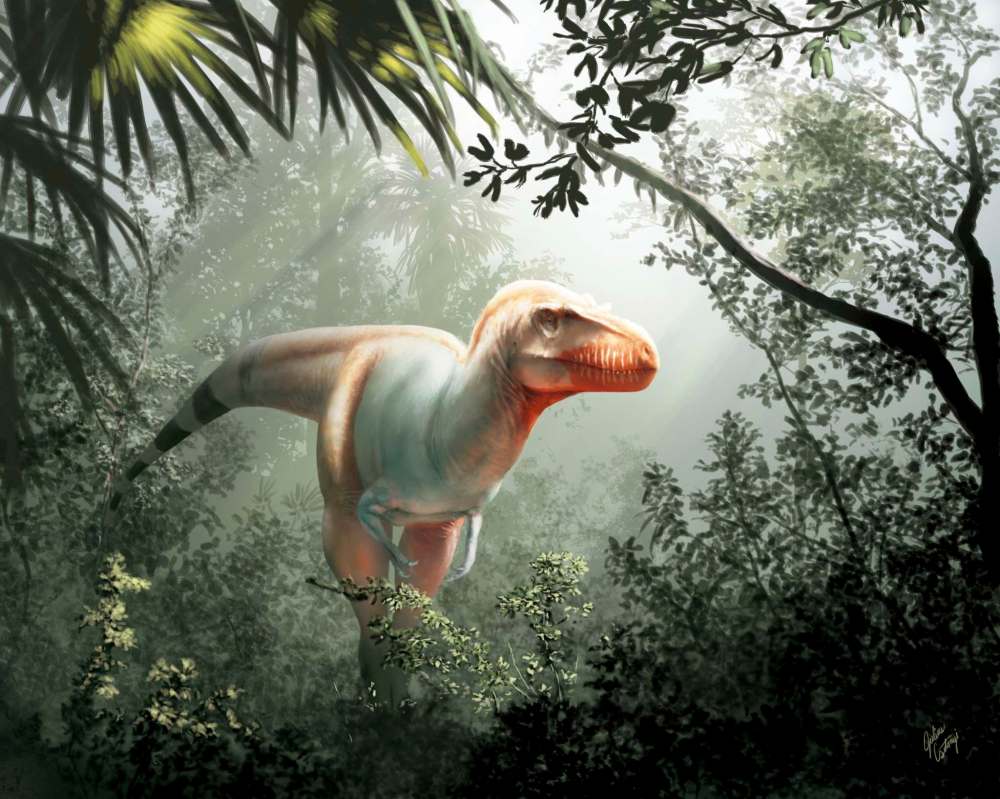
Earlier this week, it was revealed that a brand new species of tyrannosaur — the oldest ever found in Canada — had been discovered in Alberta and blessed with an imposing name that means “reaper of death.”
This prehistoric Canuck, Thanatotheristes degrootorum, was as long as two cars lined up bumper to bumper and would have towered over an adult human.
“This animal would have absolutely been an imposing creature in the ecosystem that it lived in and it would very likely have been the apex predator,” said Jared Voris, a University of Calgary PhD candidate who led the research identifying it as a new species.
The second part of the animal’s name honours two ranchers, John and Sandra De Groot of Hays, Alta., who discovered the fossil as they were walking along the shoreline of the Bow River in 2010. Researchers believe the creature — which could reach up to 10 metres in length and weigh more than two tons as an adult — lived about 2.5 million years before its close relative, T. Rex.
It’s further proof Western Canada was home to a wealth of terrifying dinosaurs and their cousins, as we see from today’s partially fossilized list of Five Recently Unearthed Prehistoric Residents of the West:
5) The prehistoric Canuck:
Albertosaurus
The Dino-mite discovery: This may not come as a huge surprise, but in prehistoric times Alberta was a major dinosaur destination, with all manner of scary critters stalking the landscape. It’s most famous former resident was Albertosaurus, a meat-eating dinosaur and an earlier, close relative of the legendary Tyrannosaurus rex.
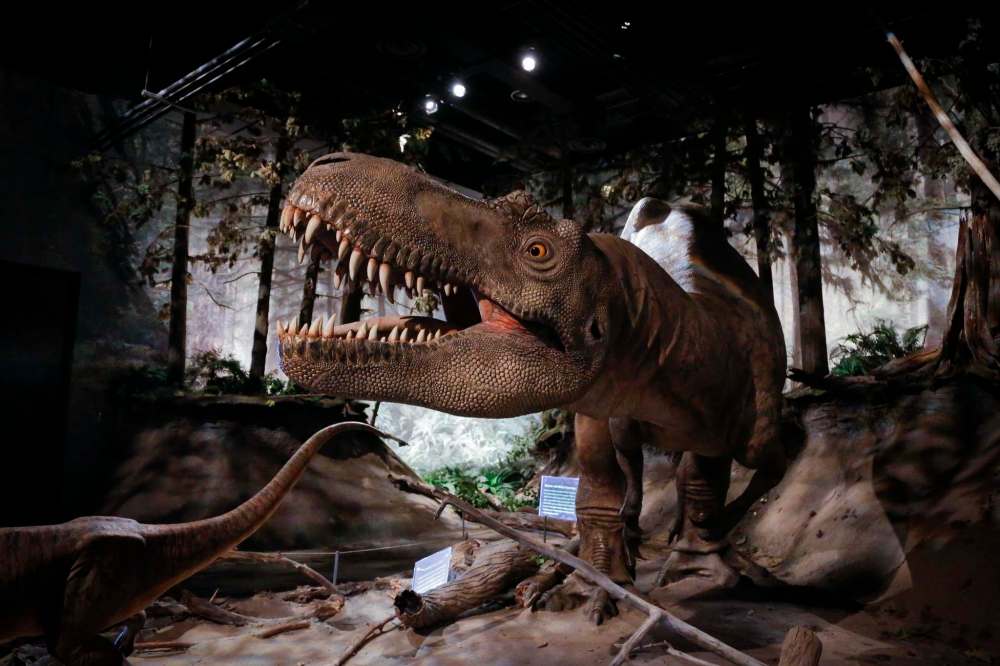
In 1884, geologist Joseph B. Tyrrell — after whom the Royal Tyrrell Museum in Drumheller, Alta., is named — discovered the first major dinosaur in Canada, digging up the skull of a ferocious beast that lived about 70 million years ago and would eventually become the namesake of the province in which its bones were discovered.
Though smaller, Albertosaurus was almost identical to its much more famous younger cousin, both of which shared oddly stunted arms. Like T. rex, it stood on two legs, had a massive skull and jaws, but human-sized arms, each with two claw-like fingers.
“Albertosaurus resembled a smaller version of Tyrannosaurus rex,” University of Alberta paleontologist Scott Persons explained in 2016. “Keep in mind, smaller than T. rex can still mean pretty dang big. A full-grown Albertosaurus exceeded 30 feet in length.”
Persons told CBC the dinosaur’s puny arms would have been little help in hunting. “To be useful to a tyrannosaurid like Albertosaurus, its biceps and triceps would need to do more than reliably open a jar of pickles or win the Mr. Universe contest,” Persons said. “Its arms would have to grapple with struggling prey… animals the size of bulldozers and with just as much horsepower. That’s a tall order, and I don’t think the arms of Albertosaurus were up to the challenge.”
It relied on its hulking jaws and bone-shattering serrated teeth. It is so beloved in Alberta that, in 2018, the province announced that all driver’s licences and ID cards would be redesigned to include an image of Albertosaurus in the bottom-right of the card.
4) The prehistoric Canuck:
“Frozen dragon of the north wind”
The Dino-mite discovery: It is believed to be one of the largest creatures ever to fly on this planet, boasting a wingspan roughly the length of a school bus as it soared through the skies above Western Canada about 77 million years ago.
Fossils for this winged pterosaur, which has been dubbed “Cryodrakon boreas” — Greek for “Frozen dragon of the north wind” — were discovered 30 years ago in Alberta’s Dinosaur Provincial Park, known for being one of the richest sources of dinosaur fossils in the world. Until recently however, the remains were wrongly thought to belong to an already known species of pterosaur, called the Quetzalcoatlus, that was first found in Texas.
For the record, pterosaurs lived among dinosaurs and became extinct around the same time, but they are considered flying reptiles, not dinosaurs. Research published last year in the Journal of Vetebrate Paleontology revealed the fossils found in Alberta were those of an entirely new flying reptile. According to the journal, it could grow to about four metres tall, with a wingspan of up to 10 metres, making it one of the largest flying animals ever.
It had no chewing apparatus, so it would likely eat whatever was small enough to go down the gullet, including lizards, mammals and baby dinosaurs. Researchers said it likely looked less like a dragon from Game of Thrones than it did a giraffe-sized, reptilian stork. François Therrien, curator of dinosaur palaeoecology at Alberta’s Royal Tyrrell Museum of Paleontology, told the National Post that while modern-day Alberta is known for its harsh winters, the landscape that the Cryodrakon would have soared over in the late dinosaur age would actually have been a tropical paradise near to a large inland sea.
The discovery sparked headlines around the world, partly thanks to an artist’s rendering showing the Cryodrakon’s plumage as a red-and-white pattern shockingly reminiscent of a Canadian flag, which was a nod to where the fossils were found.
3) The prehistoric Canuck:
“The Mona Lisa of dinosaurs”
The Dino-mite discovery: Delighted scientists have hailed it as arguably the “best-preserved dinosaur on Earth.” It was about 5.5-metres long and built like a tank, but you can’t see the bones because they remain covered by intact skin and armour, even though it died about 110 million years ago.
The Royal Tyrrell Museum of Palaeontology in Alberta unveiled the Canuck nodosaur specimen in 2017, and many visitors have taken to calling it not a fossil, but an honest-to-goodness “dinosaur mummy.” “We don’t just have a skeleton,” Caleb Brown, a researcher at the Royal Tyrrell Museum, told National Geographic magazine in 2017. “We have a dinosaur as it would have been.”
Nodosaurs were herbivores who walked on four legs and were covered in tank-like armour and dotted with spikes for protection. What makes this one so unique isn’t its size, but rather its spectacular state of preservation. This nodosaur is a new species and a new genus.
“Museum experts say it is the oldest known dinosaur from Alberta and the most well-preserved of the armoured dinosaurs ever unearthed,” CNN reported at the time. It was found in 2011 when an unsuspecting excavator operator uncovered the “mummy” while digging in an oil sands mine.
Six years and 7,000 painstaking reconstruction hours later, the nodosaur was unveiled at the museum in Drumheller. National Geographic says the mummified nodosaur weighs 2,500 pounds, not far off its 3,000-pound fighting weight estimated by experts. Scientists think this plant-eater may have been swept away by a flooded river and carried out to sea, where it eventually sank.
Researchers even determined its skin colour — a dark reddish brown on top, and lighter on the underside. “It will go down in science history as one of the most beautiful and best preserved dinosaur specimens — the Mona Lisa of dinosaurs,” Brown said.
2) The prehistoric Canuck:
World’s biggest T. Rex
The Dino-mite discovery: As most residents of Canada and Texas already know, bigger is usually better. That’s especially true when it comes to dinosaurs. Which explains why Canadians from coast to coast were bursting with pride in March 2019 when it was announced the world’s largest Tyrannosaurus rex — and the biggest dinosaur skeleton ever found in Canada — had been unearthed at a site in Saskatchewan.
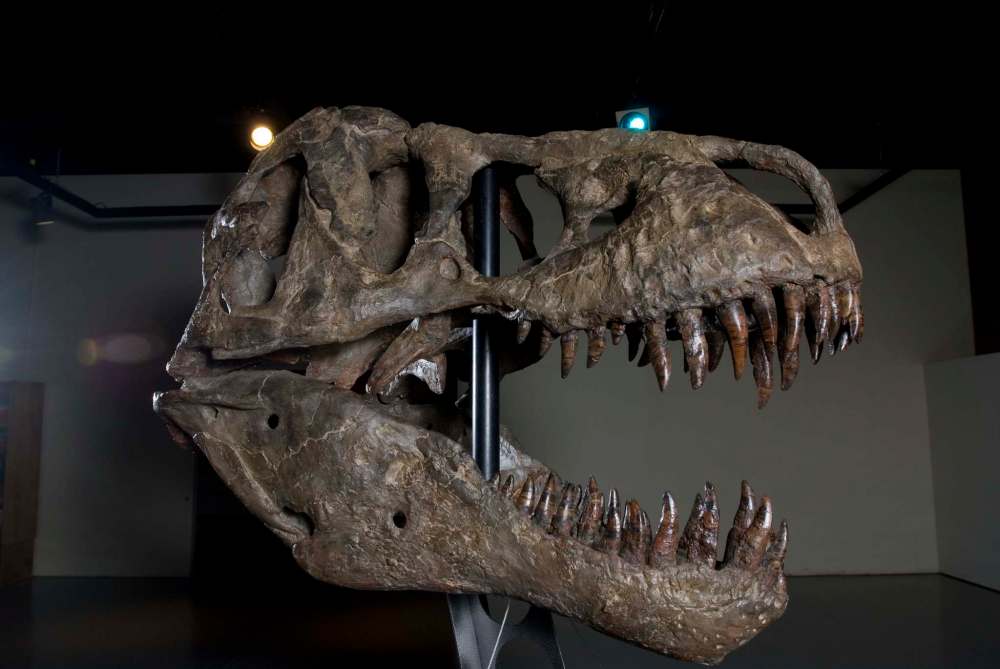
The enormous dinosaur, which was 13 metres long and weighed 9.8 tons, far heftier than an adult elephant, roamed prehistoric Saskatchewan 66 million years ago. It was nicknamed “Scotty.” According to National Geographic magazine: “Scotty has actually been known to paleontologists since 1991, when its bones were dug up at a site in Saskatchewan. To celebrate this T. rex’s discovery, the field crew wanted to raise a toast to the creature. By that point in the field season, all they had on hand to celebrate the occasion was a bottle of scotch — hence the nickname.”
Its leg bones suggest it was larger than all other carnivorous dinosaurs. “This is the rex of rexes,” Scott Persons, lead author of the study and postdoctoral researcher in the University of Alberta’s Department of Biological Sciences, said in a news release. “There is considerable size variability among Tyrannosaurus. Some individuals were lankier than others and some were more robust. Scotty exemplifies the robust.”
The hard sandstone that encased the bones took more than a decade to remove, and scientists have only recently been able to study Scotty fully assembled and realize how special it is. He might have been in his 30s. “Scotty is the oldest T. rex known,” Persons said. “You can get an idea of how old a dinosaur is by cutting into its bones and studying its growth patterns. Scotty is all old growth.” The record-breaking rex was put on display at the Royal Saskatchewan Museum.
1) The prehistoric Canuck:
“Bruce” the Manitoba mosasaur
The Dino-mite discovery: Call us a homer if you must, but we feel compelled to award today’s top spot to arguably the greatest — and certainly the biggest — Manitoban of all time. As many of you have already deduced, we are referring to “Bruce,” the world’s largest Tylosaurus pembinensis skeleton, which is on display at the Canadian Fossil Discovery Centre in Morden.
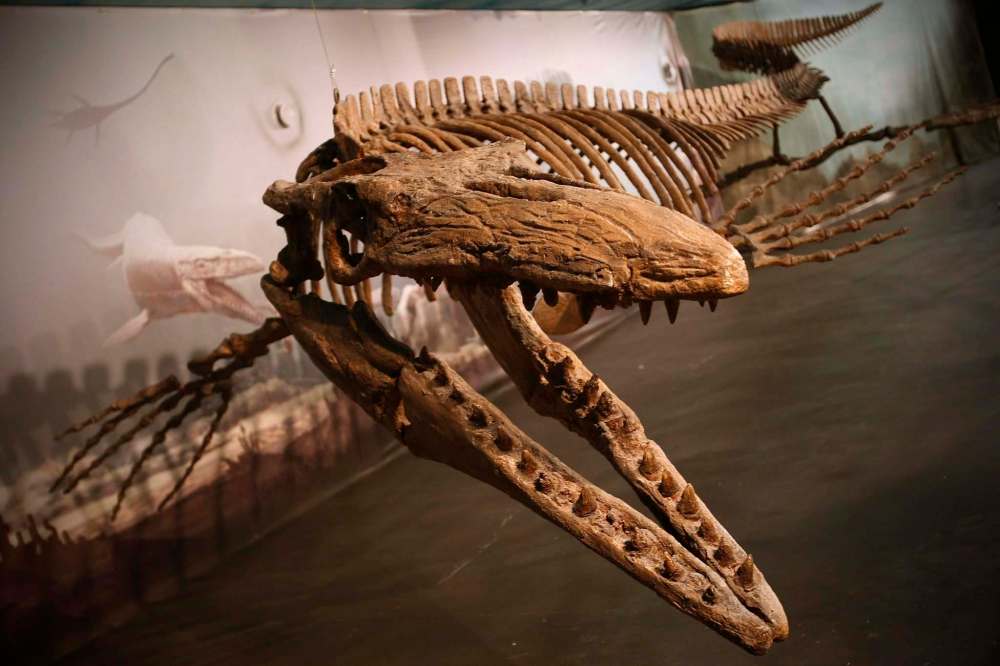
A giant sea-dwelling monster that could open its jaws as wide as a snake to swallow large prey, Bruce is technically not a dinosaur, but a mosasaur, a more than 13-metre-long marine lizard that paddled around the inland sea that covered Manitoba about 80 million years ago.
Mosasaurs were “eating machines,” apex predators that would have chomped on anything that came their way, from ancient sharks and sea turtles to squid and smaller mosasaurs. With four sets of terrifying and enormous teeth, the mosasaur is sometimes referred to as the Sea-Rex.
In 2014, The Canadian Fossil Discovery Centre, home to Bruce since the fossil’s discovery in 1974, was awarded a Guinness World Record for having the largest mosasaur on display in the world. The 13-metre-long Bruce, discovered in Thornhill, west of Morden, was determined by museum researchers to be larger than his nearest competitor, Bunker, a 12-metre mosasaur on display at the Oceans of Kansas in the United States.
In 2015, Canada Post issued a series of five stamps featuring dinosaurs that used to call Western Canada home, including Bruce, the official fossil for Manitoba. “It’s great to be able to highlight local Canadian finds of that magnitude,” illustrator Julius Csotonyi, the paleoartist and former Winnipegger who created the sharp-toothed creatures captured on the stamps, told this columnist. “Bruce is amazing. He’s spectacular in how large he is and how complete he is. It’s amazing to try and imagine what these animals looked like when they were alive.”
doug.speirs@freepress.mb.ca